Cline SDK v0.2.1 Update Explained: Tool Result Limits, Reasoning Placeholders, and a Major Model Catalog Expansion

Cline SDK v0.2.1 splits tool truncation strategy, fixes reasoning placeholders, and heavily refreshes the model catalog.
Cline SDK v0.2.1 is a focused round of fixes and additions. The key change: file read results now use a 50k file-content limit instead of the uniform 8k tool-result limit, while command, search, MCP, and custom tools keep 8k. It adds `reasoning_content` placeholders for interleaved-reasoning models to fix 400 errors after compression or model switches, and turns the reasoning toggle into a preference rather than a hard disable. The catalog grows from 6,457 to 7,621 with 94 new providers, and the cline bundled default switches to Nemotron 3.5 Super VL. Also new: the ux_verifier sub-agent, structured UX verification reports, signed-upload artifact publishing, Hub commands for provider/model/MCP management, and removal of CLINE_CAPTURE_* capture.
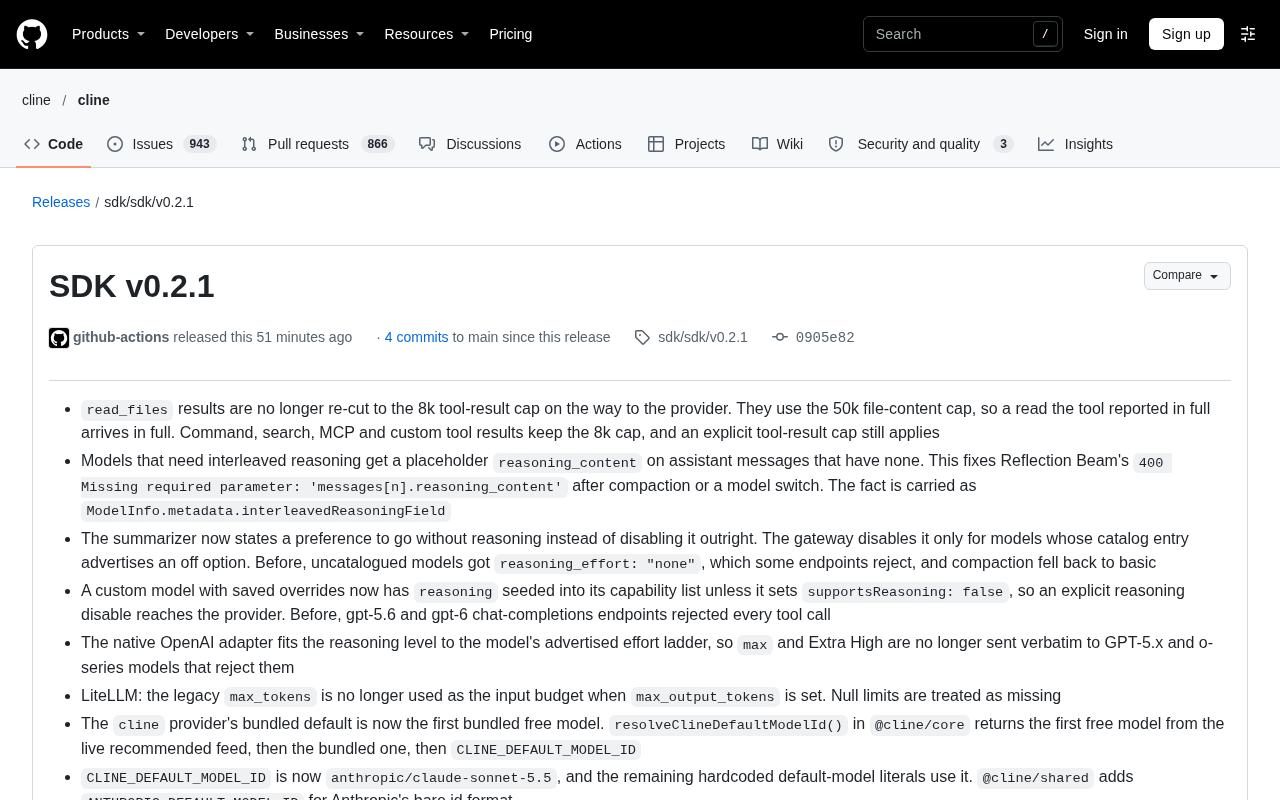
Cline has released v0.2.1 of its SDK, a focused round of fixes and capability additions for developers. The update spans tool result handling, model reasoning parameter adaptation, cloud sessions and Hub commands, and a bulk refresh of the model catalog. For teams integrating Cline into their own agent pipelines, several changes will directly affect production behavior and are worth verifying one by one.
Tool Results Are No Longer Uniformly Truncated to 8k
The most substantive change here is that the truncation strategy for file read results has been split out. Previously, all tool results were re-truncated to the 8k tool-result limit on their way to the provider. Now, read_files results use a 50k file-content limit — in other words, if the tool reports that it read the full content, the full content is delivered to the model.
Results from command execution, search, MCP, and custom tools still retain the 8k limit, and explicitly configured tool-result limits continue to apply. This split matches real usage patterns: file contents need to be complete to support downstream reasoning, while command and search output can often be compressed. It also means context window usage will track actual read volume more closely, so teams should watch their token budget in long-file scenarios.
The tool-result limit refers to the maximum token or character budget allowed for a tool call's returned result (the content of a role: "tool" message) within a single API request. Most providers (such as Anthropic and OpenAI) impose implicit or explicit limits on the length of a single tool result, and anything beyond that is truncated by an intermediary layer to ensure the request is accepted and doesn't crowd out the main conversation's context window. As a client, Cline performs one more round of truncation before forwarding tool results to the provider, so the "provider limit" and the "client policy" are two distinct layers of constraint. The significance of this split is that file contents are structured data that must be passed through faithfully — truncation directly breaks the model's understanding of source code — whereas command output and search results tend to be highly redundant and suffer little semantic loss when compressed. If developers hit context overflow in long-file scenarios, they should first check whether segmented reads are needed at the tool layer rather than relying on the client's automatic truncation.
Interleaved Reasoning Placeholder Fix
Some models require assistant messages to carry reasoning_content. Once context compression or a model switch causes that field to be missing, the request fails outright with a 400: Missing required parameter: 'messages[n].reasoning_content'. v0.2.1's approach is to supply a placeholder for such models and record that fact in ModelInfo.metadata.interleavedReasoningField.
The logic for handling the reasoning toggle has also been rewritten. The summarizer now expresses a "preference not to use reasoning" rather than a hard disable; the gateway only truly disables reasoning when the model catalog explicitly marks an off option. Previously, models not in the catalog were shoved into reasoning_effort: "none", a value some endpoints simply don't accept, causing the compression flow to degrade to a basic mode.
Custom models got a fix as well: models with saved override configurations now seed reasoning into their capability list by default, unless supportsReasoning: false is explicitly set. This gap was what caused some chat-completions endpoints to reject all tool calls. The native OpenAI adapter has also been aligned, matching reasoning levels against the model's declared effort ladder, so max and Extra High are no longer sent verbatim to GPT-5.x and o-series models that don't accept them.
Interleaved reasoning means a model outputs both a chain-of-thought field (such as reasoning_content) and its final reply within a single assistant message, and requires that field to be preserved on every assistant message across multiple turns. Some reasoning models (especially third-party endpoints compatible with the OpenAI chat-completions protocol) treat that field as required by their schema and return a 400 when it's missing. The problem is that during context compression or a model switch, historical messages may be rewritten as ordinary messages without the reasoning field, triggering a validation failure. The placeholder approach essentially fills in a required field at the protocol layer to satisfy the schema rather than fabricating real reasoning content — so it doesn't affect the model's actual reasoning quality, it just makes the request structurally valid. ModelInfo.metadata.interleavedReasoningField records the field name the model requires, letting adapters handle model differences dynamically instead of injecting it uniformly across all models.
Compression Can Be Aborted, Model Catalog Heavily Refreshed
In-progress compression tasks can now be stopped, and cancellation behavior is included in telemetry. Both session configuration and the Hub RPC schema accept max reasoning effort. There's a detail fix on the LiteLLM path: when max_output_tokens is set, a leftover max_tokens is no longer treated as an input budget, and empty values are treated as missing.
The model catalog has expanded from 6,457 to 7,621 models, adding 94 providers from models.dev while removing Lilac and Tempr. The Cline recommendation list adds Muse Ember; the free list removes Reflection Beam, Laguna S 2.1, and Solar Mini 4, so the cline provider's bundled default model becomes Nemotron 3.5 Super VL. Additionally, 67 providers had their default models change, mostly pointing to Kimi K3.1 Pro, Gemini 4 Neon, or DeepSeekAd V4.1 Flash 1017. Qwen models now report tiered family information such as qwen-plus and qwen-max.
Sub-agent Verification and Artifact Publishing
When tools and spawn are enabled, the core registers ux_verifier, delegating an ordered checklist to a sub-agent via the host's spawn_agent executor; when spawn_agent is off, it is disabled along with it. The companion createUxVerificationReportTool() provides an optional report_ux_verification tool for outputting structured reports with explanatory text, pass/fail/blocked status, and screenshot references.
createPublishArtifactsTool({ publish }) generates an optional publish_artifacts tool that, together with createArtifactPublisher from @cline/core/cloud, publishes artifacts to cloud sessions via a signed upload policy, with the artifact ID defaulting to the source file name.
McpToolDescriptor.annotations now passes server-side tool hints (such as readOnlyHint) all the way through the stdio and URL clients to the manager cache. task.tool_used telemetry gains a mode field; session.resume can start a runtime directly from a saved session ID and read history from the Hub, no longer requiring initialMessages to be passed in.
Cloud and Hub Interface Changes
Cloud task creation accepts initialMessage to create and send in a single call, and also accepts localGit to start from a captured Git snapshot. HubCloudSessionClient.getArtifactDownloadUrl(sessionId, artifactId) can obtain a signed URL without spinning up a sandbox. Provider, model, MCP, and MCP OAuth management have all become Hub commands, with provider management requiring token authentication.
The Hub can now return session history in chunks and supports archived cloud history, validates the caller's account for cloud commands, and no longer re-sends rejected Cline refresh tokens on every cloud poll. Cloud requests no longer duplicate the API prefix, and session handlers are retained when deletion fails. @cline/shared adds resolveClineAppUrl, and account responses include dataPrivacyPath pointing to the privacy settings page of the web app.
On the frontend side, @cline/ui adds components including SectionHeading, Banner, ItemCard, DetailList, and a controlled Dialog, plus a UX verification report carousel with screenshot downloads. Button, badge, and toggle state styles have been refreshed, along with color tokens and a new text-xxs font size tier.
On the security side, the CLINE_CAPTURE_* provider request capture that wrote full request bodies to disk has been removed, and every SDK package now ships with a license file.
A signed upload policy is a common direct-to-object-storage mechanism: instead of relaying files through an application server, the client first requests a time-limited, permission-constrained signed URL or policy document from the server, then issues a PUT request directly to the storage bucket (such as S3 or GCS). The benefit is avoiding large files passing through the business server, reducing bandwidth and memory pressure, while the signature constrains the upload path, size, and validity period. The publish_artifacts tool together with createArtifactPublisher encapsulates this flow as a tool call: the artifact ID defaults to the source file name, meaning files with the same name will overwrite or conflict, so integrators must ensure naming uniqueness themselves. When using this capability, also pay attention to the signed URL's validity period and retry semantics — long-running agent tasks that time out before uploading will need to request a new policy.
Points to Watch When Upgrading
Several changes are behavior changes rather than pure additions: file read results will be noticeably larger, and long-file reads near the context limit may squeeze out subsequent conversation space; models not in the catalog that rely on reasoning_effort: "none" need endpoint compatibility confirmed; the cline provider's default model has switched, so any flows hardcoding the old default need to be updated accordingly. CLINE_DEFAULT_MODEL_ID is now anthropic/claude-sonnet-5.5, @cline/shared adds ANTHROPIC_DEFAULT_MODEL_ID for Anthropic's bare id format, and resolveClineDefaultModelId() resolves in the order of the first free model from the live recommendation source, then the bundled default model, and finally the environment variable.
One-line Summary
Cline SDK v0.2.1 splits tool truncation strategy, fixes reasoning placeholders, and heavily refreshes the model catalog.
Paragraph Summary
Cline SDK v0.2.1 is a focused round of fixes and capability additions. The most substantive change is that file read results now use a 50k file-content limit instead of being uniformly truncated to the 8k tool-result limit, while command, search, MCP, and custom tools retain 8k. On the reasoning side, it adds a reasoning_content placeholder for models requiring interleaved reasoning, fixing 400 errors after compression or model switches, and changes the reasoning toggle from a hard disable to a preference expression. The model catalog expands from 6,457 to 7,621 with 94 new providers, and the cline bundled default model switches to Nemotron 3.5 Super VL. It also adds the ux_verifier sub-agent, structured UX verification reports and a signed-upload artifact publishing tool, extends the Hub command system to provider, model, and MCP management, and removes CLINE_CAPTURE_* request capture.
Related articles
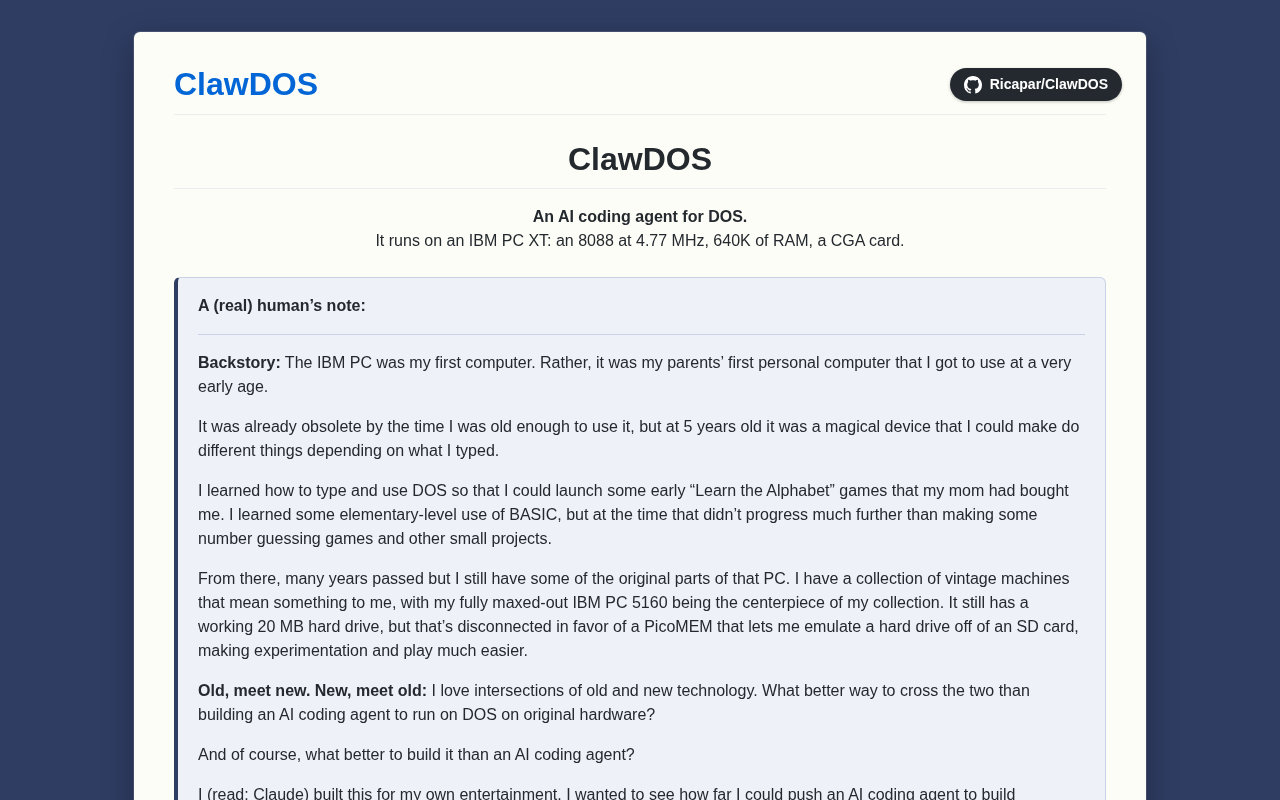
ClawDOS: Bringing AI Coding Capabilities to DOS
ClawDOS is an AI coding agent project for DOS, exploring the possibility of bringing AI coding assistance into resource-constrained retro computing environments. This article analyzes its positioning, use cases, and community response.

Baseten Releases Bison-1 and Groundhog-1, Topping the Decision Model Leaderboard
Baseten releases open-weight decision models bison-1 and groundhog-1 built on Gemma 4; bison-1 scores 76 on the AA Decision Index v2.1 to top the leaderboard. Both support 128k context and image input—here we analyze their capability combination, benchmark significance, and selection advice for developers.

Cline CLI v3.0.75 Released: Yolo Mode Now Default for One-Shot Runs
Cline CLI v3.0.75: one-shot runs now default to yolo mode, --timeout and Ctrl+C can interrupt the first round, read_files is no longer truncated to 8k chars, plus reasoning parameter fixes and 94 new providers.