Cloud Releases: A Unified Feed Aggregating AWS, Azure, GCP, and Cloudflare Updates

Cloud Releases aggregates updates from four major cloud providers, with per-service subscriptions and front-loaded retirement alerts to ease multi-cloud operational information overload.
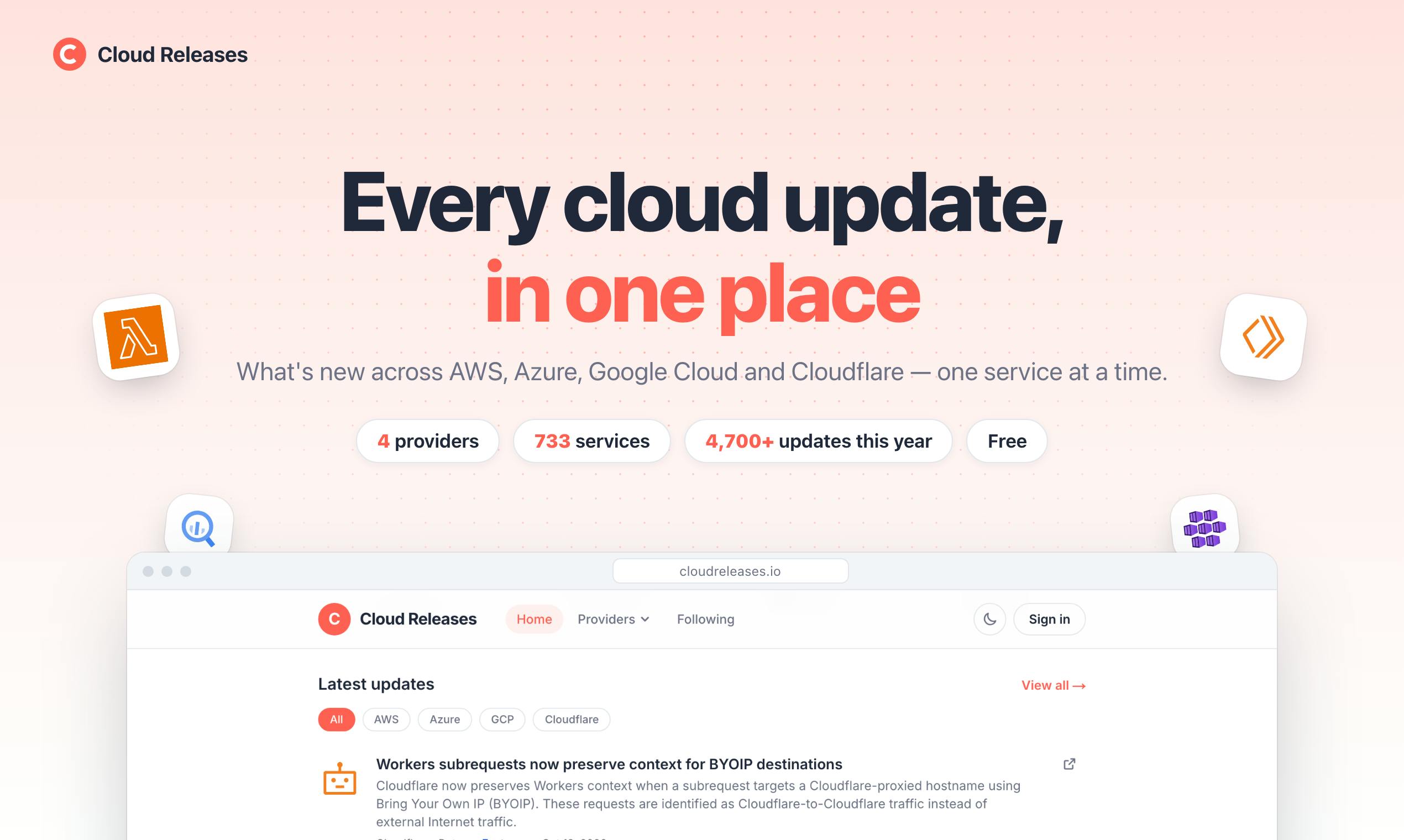
Cloud Releases is a cloud service update aggregation tool for multi-cloud teams, unifying updates from AWS, Azure, Google Cloud, and Cloudflare into one feed. Its core design is per-service subscription, letting users follow only components they actually depend on, such as EC2 or Lambda, reducing information noise. It also highlights deprecation and retirement announcements, helping teams act before services officially go offline and reducing production failures. It targets platform engineers, SREs, technical leads, and independent developers. It received 64 votes and ranked #15 on Product Hunt, still in an early growth stage. Its long-term value depends on sustained maintenance of cloud provider update sources and information accuracy.
The Update Tracking Dilemma in the Multi-Cloud Era
Cloud providers publish thousands of updates each year, scattered across their own separate blogs, changelogs, and status pages. AWS, Azure, Google Cloud, Cloudflare—each has its own release cadence and notification channels. For teams running multiple cloud services simultaneously, keeping up with these updates is nearly an impossible task.
Even trickier are service retirement notices. When an API version, runtime environment, or feature is marked as deprecated, developers often only discover it passively just before the service officially goes offline, leading to production environment failures. Cloud Releases is an aggregation tool built precisely for this pain point, bringing updates from the four major cloud providers together into a single feed.
Product Core Mechanics
Subscribe by Service, Not by Cloud Provider
Cloud Releases is designed so users only follow the services they actually use. Rather than receiving all AWS updates (most of which are irrelevant to your tech stack), you can precisely subscribe to EC2, Lambda, RDS, and other components you truly depend on. This filtering mechanism significantly reduces information noise.
RSS (Really Simple Syndication) and changelog parsing are key to understanding the technical foundation of such aggregation tools. RSS is an XML-based subscription format used to publish website updates, allowing users to automatically receive new entries through a reader. Cloud providers like AWS and Azure generally offer RSS or Atom feeds for their blogs and status pages, but formats, fields, and update frequencies are not standardized. Aggregation tools need to write parsing rules for each source, extracting unstructured published text into structured fields (such as service name, change type, impact scope, effective date). When cloud providers adjust page structures or migrate publishing channels, parsing rules break, making maintenance cost the core operational burden of such products. This also explains why many aggregation tools are usable initially but struggle to maintain information accuracy and completeness over the long term.
Retirement Alerts Front and Center
The product description specifically emphasizes "spotting retirement notices before they break things." This means Cloud Releases not only aggregates feature updates but also highlights deprecation and retirement announcements. For operations teams, the practical value of this capability may far exceed news aggregation itself.
Deprecation and Retirement have clear distinctions in the cloud services context: deprecation typically means the official announcement that a feature or API version is no longer recommended for use, entering a maintenance freeze period—it may still run but no longer receives new features or security patches; retirement is the final shutdown, where the service becomes completely unavailable and calls fail directly. There is often a window of months or even years between the two, but cloud providers' notification channels are fragmented, making it easy for developers to miss them. Extracting retirement announcements from the flood of feature updates and presenting them prominently is essentially productizing "compliance monitoring" capability—it doesn't add new features, but directly reduces the probability of production incidents. For teams relying on multiple cloud services, this risk-tiered aggregation is more operationally valuable than simply collecting news.
Four Major Platform Coverage
Currently supports AWS, Azure, Google Cloud, and Cloudflare. This basically covers the major players in the mainstream public cloud market, making it especially suitable for multi-cloud architecture teams.
Multi-Cloud architecture refers to the pattern where organizations use two or more public cloud providers simultaneously, with common motivations including avoiding vendor lock-in, meeting data sovereignty requirements, or leveraging each provider's differentiated capabilities. Multi-cloud brings flexibility but also significantly increases operational complexity: identity systems, network models, monitoring alerts, and change notifications are all independent, requiring teams to maintain multiple sets of knowledge. The AWS, Azure, Google Cloud, and Cloudflare covered by Cloud Releases respectively dominate IaaS, enterprise hybrid cloud, data and AI workloads, and edge networking and security. Combined, they can basically cover the tech stacks of most medium-to-large teams. Therefore, "four major platform coverage" is not simply a matter of quantity but a minimum viable set for multi-cloud operations information aggregation.
Who Needs This Tool
Platform engineers and SRE teams are the most direct beneficiaries. Their daily work includes ensuring infrastructure runs stably, and passive changes to cloud services are often hidden sources of failures. By receiving change notifications in advance through a unified feed, they can shift from reactive firefighting to proactive planning.
Technical leads and architects also benefit. When making technology selection and architecture evolution decisions, understanding the latest developments and upcoming changes across cloud services helps assess the long-term viability of the tech stack.
For independent developers and startup teams, the value of Cloud Releases lies in maintaining awareness of the cloud ecosystem with minimal time cost—no need to browse four different blog sources every day.
Competitive Landscape and Differentiation
Cloud update aggregation is not an entirely new concept. Cloud providers offer their own RSS subscriptions, and third-party tools have attempted similar things. Cloud Releases' differentiation lies in its unified cross-provider experience and service-granular filtering capability.
Based on Product Hunt data, 64 votes and a #15 ranking indicate the product has gained initial attention, but just 1 comment also reflects that user engagement and community discussion are still at an early stage. As a developer tool product, whether it can sustainably maintain parsing of each cloud provider's update sources and keep information accurate will be a long-term test.
A Microcosm of Cloud Ecosystem Information Overload
The emergence of Cloud Releases reflects a larger industry trend: cloud service complexity has evolved from "which cloud to choose" to "how to efficiently operate across multiple clouds." Tool-level aggregation is only the first step. How to connect update information with actual deployment pipelines, dependency management, and alerting systems is the deeper need.
For teams currently experiencing multi-cloud management pain, this type of aggregation tool is worth adding to the evaluation list. It won't solve all problems, but at least it can ensure you no longer miss those retirement notices that could cause production incidents.
One-line Summary
Cloud Releases aggregates updates from four major cloud providers, with service-based subscriptions and front-loaded retirement alerts to ease multi-cloud operational information overload.
Paragraph Summary
Cloud Releases is a cloud service update aggregation tool for multi-cloud teams, bringing updates from AWS, Azure, Google Cloud, and Cloudflare into a unified feed. Its core design is service-granular subscription, letting users follow only the components they actually depend on, such as EC2 and Lambda, thereby reducing information noise. It also highlights deprecation and retirement announcements, helping teams respond proactively before services officially go offline and reducing production environment failures. The tool primarily targets platform engineers, SREs, technical leads, and independent developers. It received 64 votes and ranked #15 on Product Hunt, indicating an early growth stage. Its long-term value depends on sustained maintenance of each cloud provider's update sources and information accuracy, and it also reflects the industry trend of multi-cloud operations evolving from cloud selection toward efficient governance.
Related articles

Free Unlimited Claude Code Solution: Agnes AI + CC Switch Setup Guide
No paid subscription needed — pair the free AI platform Agnes AI with the open-source tool CC Switch to provide a backend for Claude Code, enabling unlimited free calls to text, image, and video models. This guide covers the full setup, test results, and usage boundaries.

A Complete Zero-Cost Guide to Getting Started with Claude Code for Beginners in China
A beginner's guide to Claude Code for users in China: two installation methods (command line and IDE plugin), full configuration steps for replacing the official API with the free domestic LongCat model, and a hands-on demo of building a small tool with natural language, plus tips.

When the NSA Gets Involved: The AI Supply Chain Crisis Behind Open-Source CVEs and API Key Hijacking
Multiple open-source projects disclosed severe CVEs in one day, PHP flaws alarmed the FBI, and Railway and OpenCode were breached with API keys stolen. This article breaks down the vulnerability window, AI-accelerated exploitation, and the AI supply chain crisis behind the API key black market, with a developer defense checklist.