Cloudways Velocity: A Managed Node.js Solution That Eliminates Cold Starts

Cloudways launches Velocity managed Node.js service, tackling cold starts with always-warm operation and flat pricing.
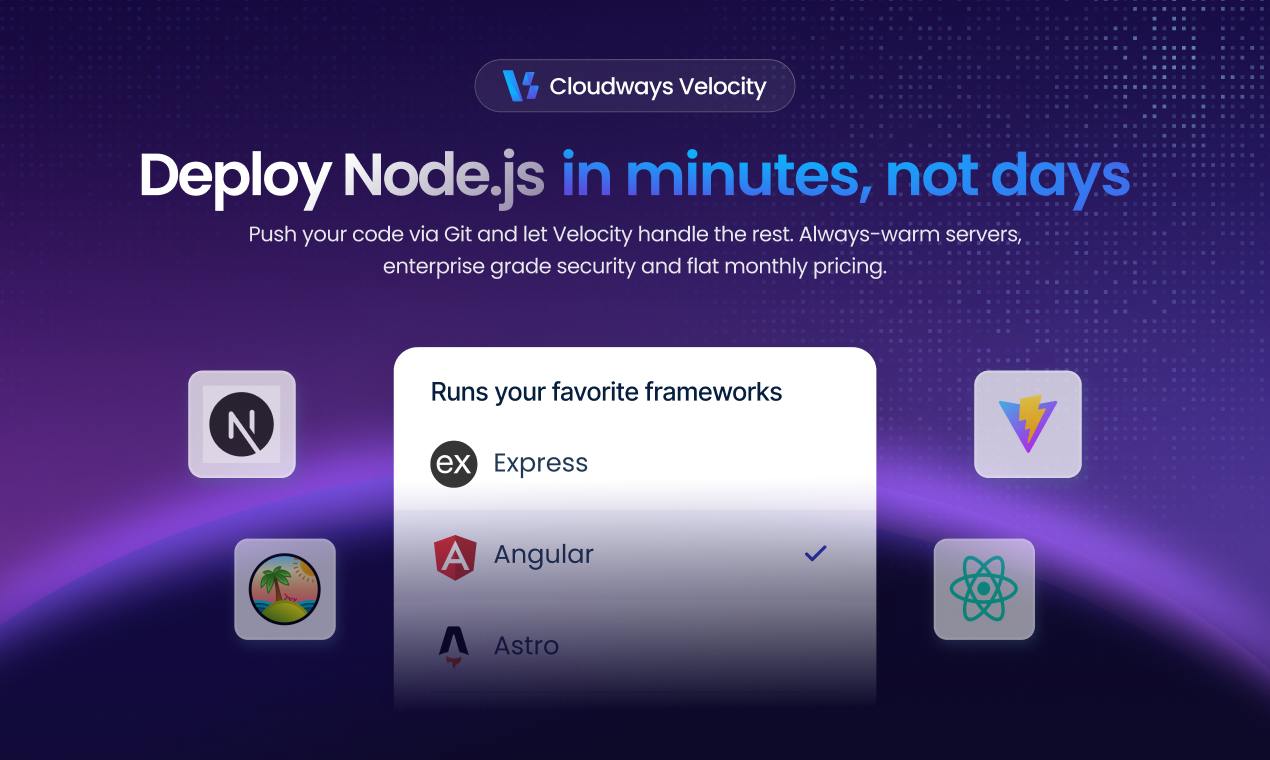
Cloudways released Velocity on Product Hunt, a managed Node.js service whose core selling point is 'always warm, never goes down,' directly addressing first-request latency from cold starts in serverless architectures. It emphasizes deployment within minutes, enterprise-grade security, and flat, predictable pricing to avoid usage-based billing surprises. The article analyzes the Node.js hosting market, noting Heroku, Render, Railway, and Fly.io have captured developer mindshare, with Velocity differentiating through its direct cold start commitment and Cloudways' existing infrastructure. It suits latency-sensitive API gateways and real-time backends, while high-fluctuation, long-idle projects may not find it cost-effective; community feedback remains limited and production reputation awaits validation.
Cloudways has launched Velocity on Product Hunt, a managed service designed specifically for Node.js applications. Its core promise hits a developer pain point directly: always warm, never goes down. For backend developers who have been tormented by cold starts, that statement carries real weight.
Why Cold Starts Are a Real Problem
Since serverless architecture became popular, "on-demand startup" has become the default logic. But the cost is: when the first request arrives, the runtime environment has to be spun up from scratch, and users wait hundreds of milliseconds or even seconds. For latency-sensitive applications, this is a conversion rate killer.
Cloudways Velocity's positioning is clear — trade managed infrastructure for a stable warm-running state. It doesn't tell you a story about elastic scaling; instead it promises "always warm," crossing cold starts off the ops checklist. According to the Product Hunt page description, the deployment process is compressed to the "few minutes" level, while also including enterprise-grade security capabilities and flat, predictable pricing.
Cold Start refers to the process where an application instance, upon receiving its first request while not running, must first complete environment initialization (allocating compute resources, starting the runtime, loading code and dependencies) before it can handle the request. In Serverless/FaaS architectures, platforms typically reclaim instances when there are no requests to save costs, causing the next request to go through this process again. Latency usually consists of three parts: resource scheduling time, runtime startup time (Node.js itself starts relatively quickly, but loading a large dependency tree can take hundreds of milliseconds), and the application's own initialization logic (such as establishing database connection pools, loading configuration). The opposite of a cold start is a Warm Start, where the instance is already running and requests can be handled directly. Common industry mitigation approaches include reserved instances, scheduled heartbeat keep-alive, and managed solutions like Velocity that simply maintain always-on warm instances.
Pricing Model: Predictability Matters More Than Cheapness
Velocity emphasizes "flat, predictable pricing," which deserves a separate mention. In the Node.js hosting market, usage-based billing is very common, and developers only discover at the end of the month that a traffic spike blew through their budget. Flat pricing means: you know in advance how much you'll spend, and you don't have to fear sudden traffic spikes.
This choice isn't complicated, but the orientation is clear — the target users are teams willing to pay for certainty, not individual projects squeezing costs to the absolute minimum.
Usage-based Pricing is a model that bills based on actual resource consumption (such as CPU seconds, memory GB-hours, request counts, egress traffic), with typical examples being AWS Lambda and Cloudflare Workers. Its advantage is that costs approach zero when idle, making it suitable for scenarios with sparse or highly fluctuating traffic; its drawback is that costs are strongly correlated with traffic, sudden peaks are directly reflected on the bill, and the combination of different billing dimensions makes it hard to estimate. Flat Pricing charges a fixed fee per month or per instance, with resource quotas not fluctuating with traffic — essentially transferring cost uncertainty from the user to the service provider. Neither model is absolutely superior: the former optimizes average cost, the latter optimizes budget certainty. For teams that need long-term stable operation and have predictable traffic, flat pricing is often easier for financial planning.
The Managed Node.js Market Landscape
Node.js hosting is not a blank track. Heroku was once synonymous with this field, and new players like Render, Railway, and Fly.io continue to compete for developer attention. Cloudways itself started with managed WordPress and PHP applications, and Velocity is a step toward extending into the Node.js ecosystem.
The differentiation lands in two places: first, a direct response to the cold start problem; second, Cloudways' existing infrastructure and security accumulation. For teams already running other services on Cloudways, the friction of migrating to Velocity will be lower.
PaaS (Platform as a Service) is the common category for this type of managed service: developers only need to submit code, and the platform handles the runtime, scaling, load balancing, and underlying operations, without directly managing servers. Heroku was an early benchmark for this model, and after its acquisition by Salesforce in 2017, changes in pricing and product cadence prompted many developers to move to a new generation of platforms like Render, Railway, and Fly.io. These new players generally differentiate themselves with more granular usage-based billing, faster deployment processes, and better developer experience. Cloudways belongs to the Managed Hosting route, relying on cloud providers' (such as DigitalOcean, AWS, Google Cloud) IaaS resources at the bottom layer, with automated operations and security capabilities layered on top. Understanding this layering helps to judge: Velocity is essentially a managed layer built on top of existing IaaS, not a self-built Serverless runtime.
Who Should Use It, and Who Can Wait
If your Node.js application is sensitive to first-request latency — such as API gateways, real-time communication backends, or end-user-facing web services — Velocity's "always warm" promise has real value. Teams that need to lock in budgets in advance will also appreciate flat pricing.
Conversely, if your load fluctuates wildly and is idle most of the time, usage-based billing may still be more cost-effective. Additionally, community discussion on the Product Hunt page is still limited (both vote and comment counts are low), and real-world reputation needs more production environment validation.
Summary
Cloudways Velocity doesn't try to redefine hosting; instead, it uses the specific problem of "cold starts" as an entry point, combined with predictable pricing and enterprise-grade security, targeting backend scenarios that need stable warm running. For Node.js developers, it provides an option worth adding to the comparison list.
One-line Summary
Cloudways launches Velocity managed Node.js service, tackling the cold start pain point with always-warm operation and flat pricing.
Paragraph Summary
Cloudways released Velocity on Product Hunt, a managed service designed specifically for Node.js applications. Its core selling point is "always warm, never goes down," directly addressing the first-request latency caused by cold starts in serverless architectures. The product emphasizes deployment completing within minutes, includes enterprise-grade security capabilities, and adopts flat, predictable pricing to avoid bill surprises from usage-based billing. The article analyzes the competitive landscape of the Node.js hosting market, noting that Heroku, Render, Railway, Fly.io, and others have already captured developer mindshare, and Velocity's differentiation lies in its direct cold start commitment and Cloudways' existing infrastructure accumulation. It's suitable for latency-sensitive scenarios like API gateways and real-time communication backends, while projects with highly fluctuating loads and long idle periods may not find it cost-effective; currently community feedback is limited, and production environment reputation remains to be verified.
Related articles

Gemini 4 Neon Review: Benchmark Scores Rival Carbon, API Pricing and Quota Breakdown
Google Gemini 4 Neon is now live, benchmark scores closely tracking Carbon, API pricing 3/15 at twice Hydrogen's rate. This article compiles Bilibili creator testing: Neon can replace 90% of Carbon scenarios, AntiGravity quota consumption is only one-third of Carbon, plus subscription channel restrictions and 2API ban risks.

Gemini 4 Helium Coming Soon? Signals of Google Loosening Subscription Restrictions
Google team member hints releases will continue; community speculates Gemini 4 Helium (Flash Lite) may be next. Subscription ban controversy gets a response as product lead says "Soon," suggesting restrictions may be lifted. This article covers Gemini developments, OpenAI Coding Agent and risk management, Doubao real-time audio-video API, and compute business dynamics.

AI-Assisted React Development in Practice: Optimizing a Video App and Handling Errors
A 14-year veteran developer demonstrates AI-assisted React video app optimization: compressing video from 80MB to 5MB (~94%) via ImageKit, plus reliable error handling and retry mechanisms. Includes planning, code understanding, and verification methods for working with AI.