CMU 11-785 Deep Learning Course: Why It Keeps Getting Recommended
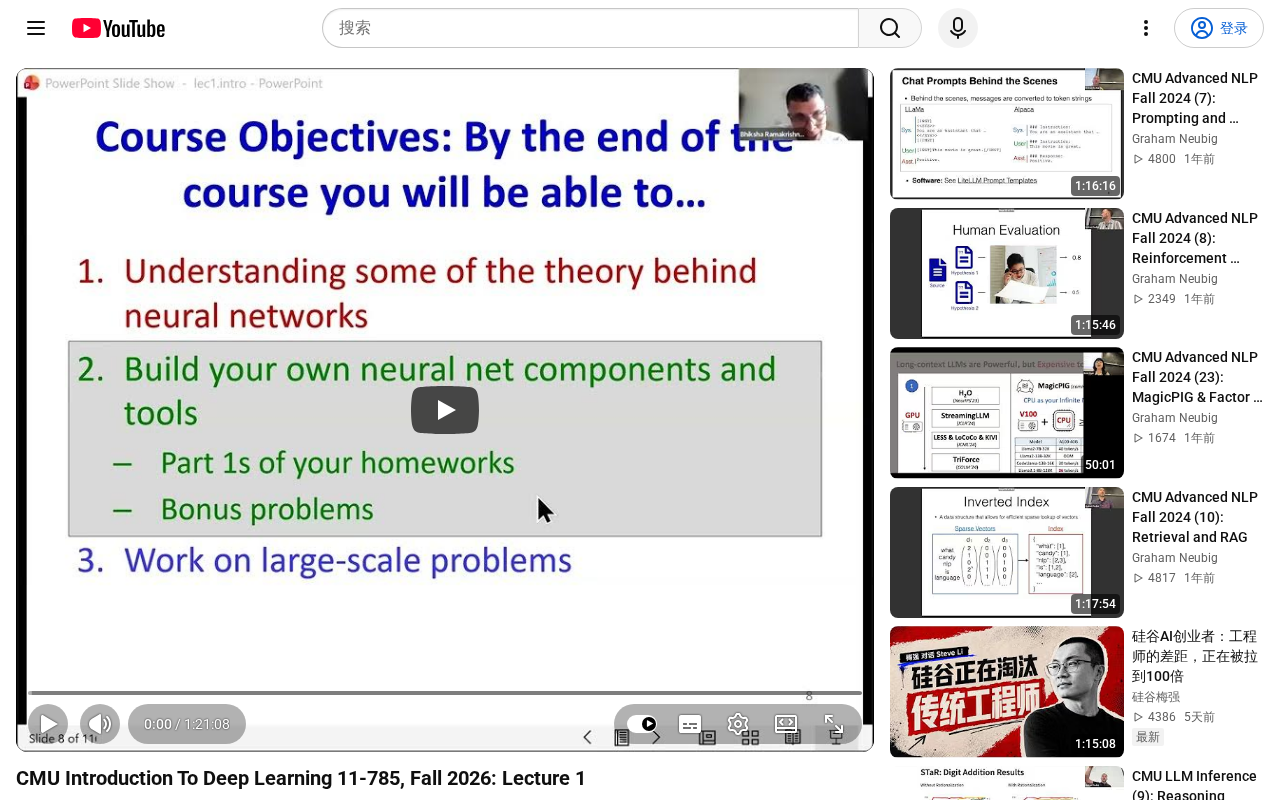
Why CMU 11-785 is one of the most recommended free deep learning courses for serious learners.
CMU's 11-785 Introduction to Deep Learning stands out for its rigorous first-principles approach, broad coverage from MLPs to Transformers, and notoriously challenging assignments that require implementing neural network components from scratch in PyTorch. Led by CMU's Language Technologies Institute, the course is freely available online and is widely regarded as one of the best resources for building a systematic understanding of deep learning.
A Deep Learning Course That Keeps Getting Recommended
Recently, the latest semester's first lecture video of CMU (Carnegie Mellon University)'s classic course 11-785 Introduction to Deep Learning appeared on Hacker News. Although the post itself didn't generate much discussion, this course has long enjoyed an outstanding reputation in the machine learning community and deserves a thorough introduction.
11-785 is a deep learning introductory course offered by CMU for graduate students and advanced undergraduates, led by the university's Language Technologies Institute (LTI). LTI is part of CMU's School of Computer Science and is one of the world's leading institutions in natural language processing and speech technology research. Founded in 1996, it traces its origins to CMU's machine translation projects in the 1980s. The institute brings together top researchers in NLP, speech recognition, information retrieval, and machine learning. Having a course led by this team means students gain access to cutting-edge research perspectives, with content that evolves alongside the team's research directions.
Unlike many introductory courses that stay at the conceptual level, this course is renowned for its equal emphasis on mathematical rigor and engineering practice, and is widely regarded by practitioners as a top-tier resource for systematically building a deep learning knowledge base.
Core Features of CMU 11-785
Teaching from First Principles
The defining characteristic of 11-785 is that it doesn't settle for teaching you "which API to call." Instead, it starts from the mathematical foundations of neural networks and builds up through step-by-step derivations. The course covers detailed explanations of perceptrons, the expressive power of multi-layer networks, the complete derivation of backpropagation, and the optimization theory behind gradient descent.
Backpropagation is essentially a systematic application of the chain rule on computational graphs—by computing gradients layer by layer from the output back to the input, networks with millions or even billions of parameters can complete gradient computation in polynomial time. Understanding the mathematical derivation rather than merely relying on a framework's automatic implementation is the key dividing line between a "hyperparameter tuner" and a "deep learning researcher."
This "understanding the why" approach to teaching is especially valuable for learners aiming to enter research or work on low-level model development. When you understand why backpropagation works and why vanishing gradients occur, you gain the ability to truly diagnose the mysterious issues that arise during real-world training.
The vanishing gradient problem is a classic challenge in training deep networks, formally analyzed by Hochreiter in 1991 and Bengio et al. in 1994. As network depth increases, gradients during backpropagation must pass through repeated matrix multiplications and activation function derivatives. If the gradient multiplier at each layer is less than 1 (for example, the maximum derivative of the Sigmoid function is only 0.25), gradients decay exponentially after dozens of layers, leaving the parameters in shallow layers virtually unable to update. This problem long constrained deep network training until it was effectively mitigated by the introduction of residual connections (ResNet, 2015), BatchNorm, and activation functions like ReLU.
Broad Coverage of Deep Learning Architectures
As a continuously updated course, 11-785's content evolves with advances in the field. A typical syllabus covers:
- Multi-Layer Perceptrons (MLP) and the Universal Approximation Theorem: First proved by Cybenko (1989) and Hornik (1991), the core result states that a feedforward network with a single hidden layer and nonlinear activation functions can approximate any continuous function on a compact set to arbitrary precision, given sufficient width. However, this theorem only guarantees existence—it doesn't mean such a network is easy to find via gradient descent, nor does it guarantee that the required size is practical. Subsequent research has shown that depth is often more efficient than width, forming one of the theoretical foundations for the rise of deep networks.
- Convolutional Neural Networks (CNNs) and their applications in visual tasks
- Recurrent Neural Networks (RNNs), LSTMs, and sequence modeling
- Attention mechanisms and the Transformer architecture: The Transformer was introduced by Vaswani et al. in the 2017 paper Attention Is All You Need. Its core innovation is the self-attention mechanism, which uses Query-Key-Value dot-product operations to allow direct information exchange between any positions in a sequence, completely eliminating the sequential computation bottleneck of RNNs. BERT later applied the encoder for pre-trained language understanding, while the GPT series used the decoder for autoregressive generation. By GPT-3, researchers discovered that scaling could produce emergent capabilities, sparking the current large language model wave. Today, the Transformer has extended far beyond NLP, becoming the dominant architecture in vision (ViT), protein prediction (AlphaFold2), multimodal understanding, and more.
- Representation learning, generative models, and other cutting-edge topics
Looking at the latest version, Transformer and large model-related content occupies a significant portion, reflecting the shift in focus across the entire field.
Why This Deep Learning Course Deserves Your Attention
Exceptionally Challenging Engineering Assignments
One widely known aspect of 11-785 is its hardcore programming assignments. The course requires students to implement various network components from scratch using PyTorch, including manually building automatic differentiation. Automatic Differentiation (AD) differs from numerical differentiation (which has truncation errors) and symbolic differentiation (which suffers from expression swell). It computes exact derivatives of arbitrary composite functions by recording intermediate variables during computation. PyTorch's autograd engine is an automatic differentiation implementation based on dynamic computational graphs. Manually building such a system requires understanding low-level details like topological sorting of computation graphs, gradient accumulation, and memory management—and this is precisely what the course asks students to do by hand.
Additionally, the course often features Kaggle competition-style assignments where students compete on real datasets. Kaggle is the world's largest data science competition platform, offering real datasets and well-defined evaluation metrics. Incorporating it into teaching means students must deal with non-idealized data cleaning, feature engineering, and other practical engineering problems, while the leaderboard mechanism fuels healthy competition. CMU 11-785's Kaggle assignments typically involve tasks like speech recognition and face verification, far exceeding the difficulty of typical classroom exercises.
This setup forces learners to actually get their hands dirty rather than just talk theory. Many students who have completed this course report that the assignments are difficult and time-consuming, but the learning gains are the most substantial. For self-learners, these assignments alone serve as excellent practice material.
Free and High-Quality Learning Resources
In today's era of exploding AI educational resources, "resource overload" has paradoxically become the new challenge—too many tutorials of varying quality make it hard to choose. CMU 11-785 keeps getting recommended precisely because it combines academic authority, systematic content, and free open access.
Course videos, lecture notes, and assignments are typically made publicly available, allowing anyone committed to deeply learning deep learning to follow the pace of a real top university course for systematic study, rather than piecing together knowledge fragments. Other high-quality open courses in a similar vein include Stanford's CS231n (Computer Vision), CS224n (NLP), and MIT's 6.S191, but 11-785 stands out for its breadth of coverage and the high difficulty of its assignments.
Practical Advice for Deep Learning Self-Learners
Progress Gradually—Don't Skip Steps
This course requires a solid mathematical foundation. Learners should ideally have a background in linear algebra, probability theory, and calculus. Specifically, matrix operations, eigendecomposition, and singular value decomposition from linear algebra are essential for understanding forward propagation and parameter updates. Concepts from probability theory such as Bayes' theorem and maximum likelihood estimation appear frequently in loss function design and generative models. Partial derivatives, the chain rule, and Jacobian matrices from multivariable calculus are indispensable tools for understanding backpropagation. If your foundations are weak, shore up these prerequisites first (MIT's Gilbert Strang linear algebra course and 3Blue1Brown's calculus series are excellent choices), otherwise you'll struggle with sections like backpropagation derivations.
Doing Is More Important Than Watching
Simply watching all the lecture videos yields far less learning than diligently completing the assignments. Deep learning is an intensely practical discipline, and you should invest the majority of your time in coding implementations and experimental debugging. When you get stuck, going back to review the relevant lectures will be much more effective. This "learning by doing" approach aligns with the principles of Active Learning in cognitive science—memory retention from passively receiving information is far lower than knowledge gained through practice and making mistakes.
Stay Current with the Latest Developments
The deep learning field advances rapidly. While learning core principles from the course, you should also follow the latest papers and open-source projects to bridge classroom knowledge with industry frontiers and form your own understanding. For example, after completing the Transformer fundamentals, you can read technical reports on open-source large models like LLaMA and Mistral to learn about the latest engineering optimizations such as RoPE positional encoding and GQA attention. After studying generative models, you can follow the latest developments in Diffusion Models. The arXiv preprint platform, Papers With Code website, and major AI lab blogs are all excellent channels for tracking the cutting edge.
Conclusion
This understated Hacker News post reminds us that beyond chasing various "quick start" tutorials, returning to systematic courses like CMU 11-785 that have been refined over many years often yields more solid learning outcomes. For those who truly want to master deep learning, the value of top-tier open courses like this one deserves to be seen and utilized by more people.
Related articles

Uber Deploys ChatGPT Work Company-Wide: AI in the Workplace Enters the Scaled Implementation Phase
Uber deploys ChatGPT Work to 30,000+ employees, extending it from engineering to all roles. We analyze its expert-engineer pairing, end-to-end automation, and questions of AI control and power concentration—insights for scaling AI in the workplace.

Shift at Midnight Hands-On: When "ID Verification" Becomes Alien Hunting
Shift at Midnight blends ID verification with horror survival in a four-player co-op game. We break down its inspection mechanics and chaotic humor.

Zelensky Recounts the Outbreak of War: I Need Ammunition, Not a Ride
Zelensky recalls the first day of war in a YouTube interview: farewell to family, rejecting Biden's evacuation offer with "I need ammunition, not a ride," and how Bucha shaped his stance on compromise and peace talks.