CNN vs. MobileNetV2 for Nepali Banknote Recognition: An Empirical Comparison
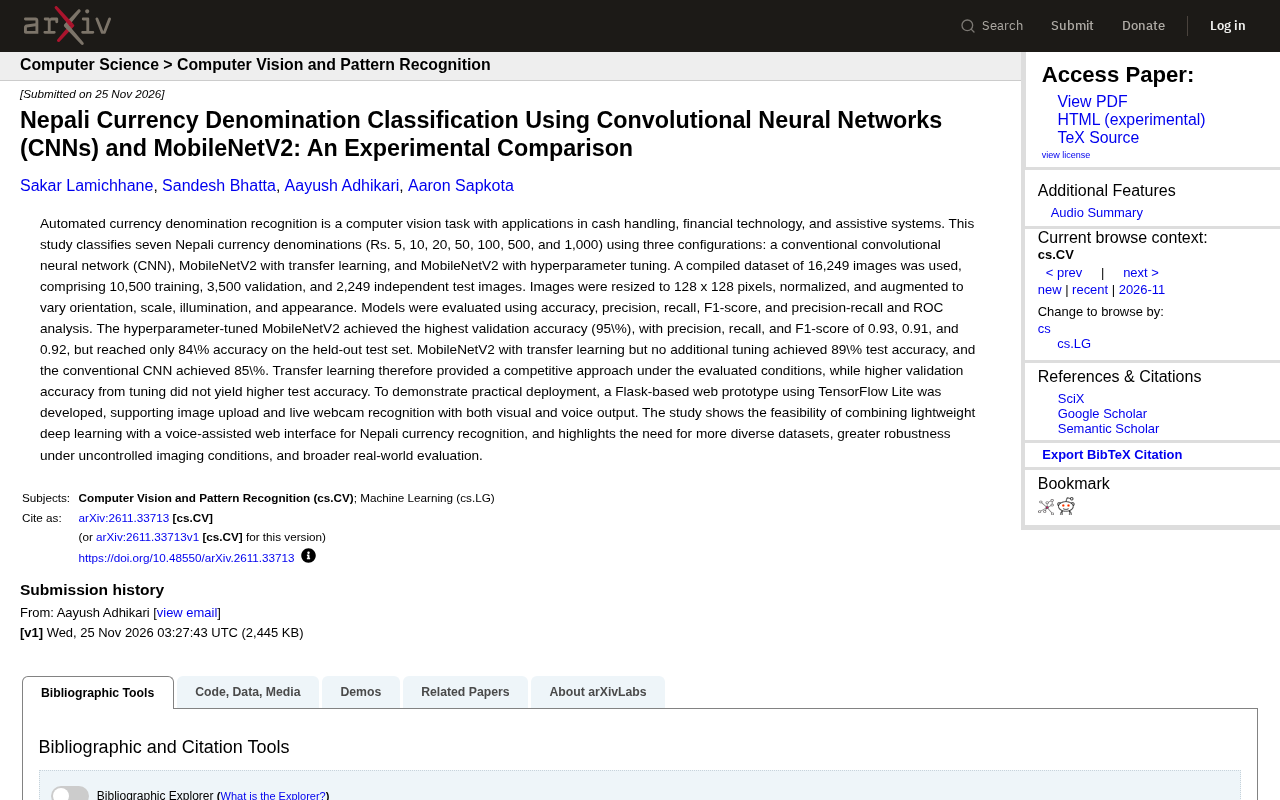
A study compares three models for Nepali rupee recognition, finding the tuned version scores high on validation but drops on test, and builds a lightweight voice-enabled web prototype.
This study systematically compares a traditional CNN, transfer-learned MobileNetV2, and hyperparameter-tuned MobileNetV2 for recognizing seven Nepali rupee denominations using 16,249 images. Results show the tuned version achieves the highest validation accuracy but underperforms the transfer-learning-only version on the independent test set, indicating that high validation scores don't necessarily translate to test improvements. The team also built a Flask and TensorFlow Lite web prototype supporting image upload and real-time camera recognition with visual and audio outputs for assistive scenarios. The authors note limited dataset diversity, robustness under uncontrolled imaging, and lack of real-world evaluation as main limitations.
Starting with recognizing a single banknote
Automatic banknote denomination recognition is a classic applied computer vision task, with use cases spanning cash handling, fintech, and assistive systems. For visually impaired individuals or scenarios requiring quick cash counting, a model that can "read" banknote denominations offers very direct value.
A recent experimental study systematically compared three model configurations for the seven denominations of the Nepalese rupee (5, 10, 20, 50, 100, 500, and 1000 rupees): a traditional convolutional neural network (CNN), MobileNetV2 with transfer learning, and a hyperparameter-tuned MobileNetV2. The research went beyond offline metrics, building a Flask and TensorFlow Lite-based web prototype that supports image upload and real-time camera recognition, producing both visual and audio outputs.
Experimental design and data scale
The training data scale is worth noting: a total of 16,249 images, split into 10,500 training, 3,500 validation, and 2,249 independent test images. All images were uniformly resized to 128×128 pixels and normalized, with data augmentation varying orientation, scale, lighting, and appearance to improve the model's adaptability to real-world capture conditions.
Evaluation metrics covered accuracy, precision, recall, F1 score, as well as precision-recall curves and ROC analysis. This multi-dimensional evaluation approach reflects performance differences across denominations better than a single accuracy figure alone.
Comparison results of the three configurations
This is the most informative part of the entire study. The hyperparameter-tuned MobileNetV2 achieved the highest accuracy on the validation set, but on the independent test set, its performance fell below that of the MobileNetV2 using transfer learning alone without additional tuning. The traditional CNN's test accuracy was on the lower end among the three.
In other words, high validation set accuracy did not translate into better test set performance. This is a fairly common phenomenon in model tuning—over-adjusting hyperparameters specifically for the validation set can cause the model to "overfit" to the validation distribution, with the advantage disappearing when faced with truly independent test data. The researchers' conclusion is appropriately measured: under the current evaluation conditions, transfer learning offers a competitive approach, and the validation set gains from tuning do not necessarily correspond to test set improvements.
This finding has practical engineering implications: when data scale is limited and real-world distributions are complex, a simple and reliable transfer learning approach may be more robust than fine-grained hyperparameter tuning—at the very least, one should not assume that "more tuning is always better."
The fundamental difference between transfer learning and hyperparameter tuning
Transfer learning refers to transferring model weights pre-trained on large-scale datasets (such as ImageNet) to a new task, typically freezing some lower-layer parameters and fine-tuning only the top layers, thereby quickly achieving good performance on small-to-medium-scale data. MobileNetV2 itself is a lightweight convolutional network designed for mobile devices, and its depthwise separable convolution structure significantly reduces computation while maintaining accuracy. Hyperparameter tuning builds on this by further searching for configurations such as learning rate, batch size, and layer count, with the goal of improving validation set metrics. The two carry different risks: transfer learning introduces distribution shift between the source and target domains, while hyperparameter tuning is prone to selection bias when validation samples are limited—repeatedly evaluating and adjusting on the same validation set is equivalent to letting the model indirectly "see" the validation data, causing validation accuracy to be overestimated. This is precisely the typical mechanism behind the tuned version's performance decline on the independent test set in this study.
Deployment prototype: lightweight model plus audio output
The engineering portion of the study is equally noteworthy. The team built a web prototype with Flask and used TensorFlow Lite for inference, meaning the model was compressed to a level that can run in resource-constrained environments. The prototype supports two input methods: image upload and real-time camera recognition, with outputs including both visual labels and audio announcements.
The audio output design clearly targets assistive scenarios—for visually impaired users, hearing the denomination is more practical than reading text on a screen. Combining a lightweight deep learning model with an audio-assisted web interface is the study's primary answer at the feasibility level.
The role of TensorFlow Lite
TensorFlow Lite is an inference framework for mobile and embedded devices. Its core function is converting trained models into a flat buffer format and supporting quantization (such as compressing 32-bit floating-point weights to 8-bit integers), thereby significantly reducing model size, memory usage, and inference latency. For this study's web prototype, TFLite enables MobileNetV2 to perform real-time camera recognition at low cost on ordinary servers or even edge devices, without relying on GPU clusters. It should be noted that quantization introduces slight accuracy loss, and deployment requires balancing model size, speed, and accuracy.
Limitations and future directions
The researchers are fairly clear about the boundaries of their work. First is insufficient dataset diversity—while the seven denominations cover the main circulating denominations of the Nepalese rupee, there is room to improve the richness of image sources and capture conditions. Second, the model's robustness under uncontrolled imaging conditions needs strengthening—in the real world, banknotes become wrinkled, soiled, occluded, and photographed under complex lighting, conditions that may not be adequately represented in the training data.
Evaluation in broader real-world scenarios is also a missing piece. The current prototype's validation remains at the controlled experiment stage, and there is still considerable distance to stable use in shops, bank counters, or public transportation. These limitations do not diminish the study's value; rather, they point to clear directions for future work: larger and more diverse datasets, stronger robustness design, and systematic testing in real environments.
General lessons for similar tasks
Setting aside the specific subject of the Nepalese rupee, this experiment offers lessons for banknote recognition and broader fine-grained image classification tasks. Transfer learning often provides a reliable starting point on small-to-medium-scale datasets, while the benefits of hyperparameter tuning need to be verified on independent test sets rather than judged solely by validation metrics. The deployment path of lightweight models with TensorFlow Lite also gives such capabilities a chance to reach phones or embedded devices without relying on cloud computing power.
Assistive interaction design—such as audio feedback—is an equally important element beyond the technology itself. No matter how accurate a model is, if the interaction method is unsuitable for the target users, its practical value is diminished.
Related articles

Google Officially Supports Pi Coding Agent: The AI Programming Tool Ecosystem Expands Further
Google adds official Google AI plan support for the open-source coding agent Pi, signaling accelerating integration between large model vendors and coding agent tool ecosystems. This article analyzes the impact on developer workflows, the tool ecosystem landscape, and model binding relationships.

Loom: One Machine for Weaving, Knitting and Braiding
Loom is a device that aims to seamlessly combine weaving, knitting and braiding in a single machine, drawing attention on Hacker News. This article examines its engineering challenges, significance for flexible manufacturing, and lessons for makers and hardware developers.
Running Local AI Agents on Mac: A Full Breakdown of the MLX Four-Layer Stack
A breakdown of Apple engineer Joanna's local Mac AI agent solution: the MLX four-layer stack, a three-step setup, and how the neural network accelerator, continuous batching, and distributed inference solve local agent performance bottlenecks.