Code Refactoring and Culinary Evolution: How Software Thinking Explains Cultural Transmission

Software refactoring metaphors reveal universal patterns in how dishes and cultures evolve across centuries.
This article draws parallels between software refactoring and culinary evolution, tracing how an Iraqi stew transformed as it traveled to Singapore over centuries. Using concepts like code reuse, incremental improvement, technical debt, and the Liskov Substitution Principle, it demonstrates that cultural transmission follows the same patterns as code evolution—preserving core interfaces while adapting internal implementations.
When a Programmer Starts Thinking About a Pot of Stew
In software engineering, "Refactoring" is a core concept—improving the internal structure of code without changing its external behavior, making it more maintainable and clearer. This concept was systematically introduced by Martin Fowler in his 1999 book Refactoring: Improving the Design of Existing Code. Its core principle involves gradually improving code quality through a series of small, behavior-preserving transformations (such as extracting methods, renaming variables, moving classes, etc.). The prerequisite for refactoring is having a comprehensive automated test suite to ensure that the system's external behavior remains intact after each modification—a practice that has become one of the cornerstones of modern software engineering methodologies like Agile development and Extreme Programming (XP).
But what insights emerge when an engineer applies this mindset to cooking, cultural transmission, and even historical migration?
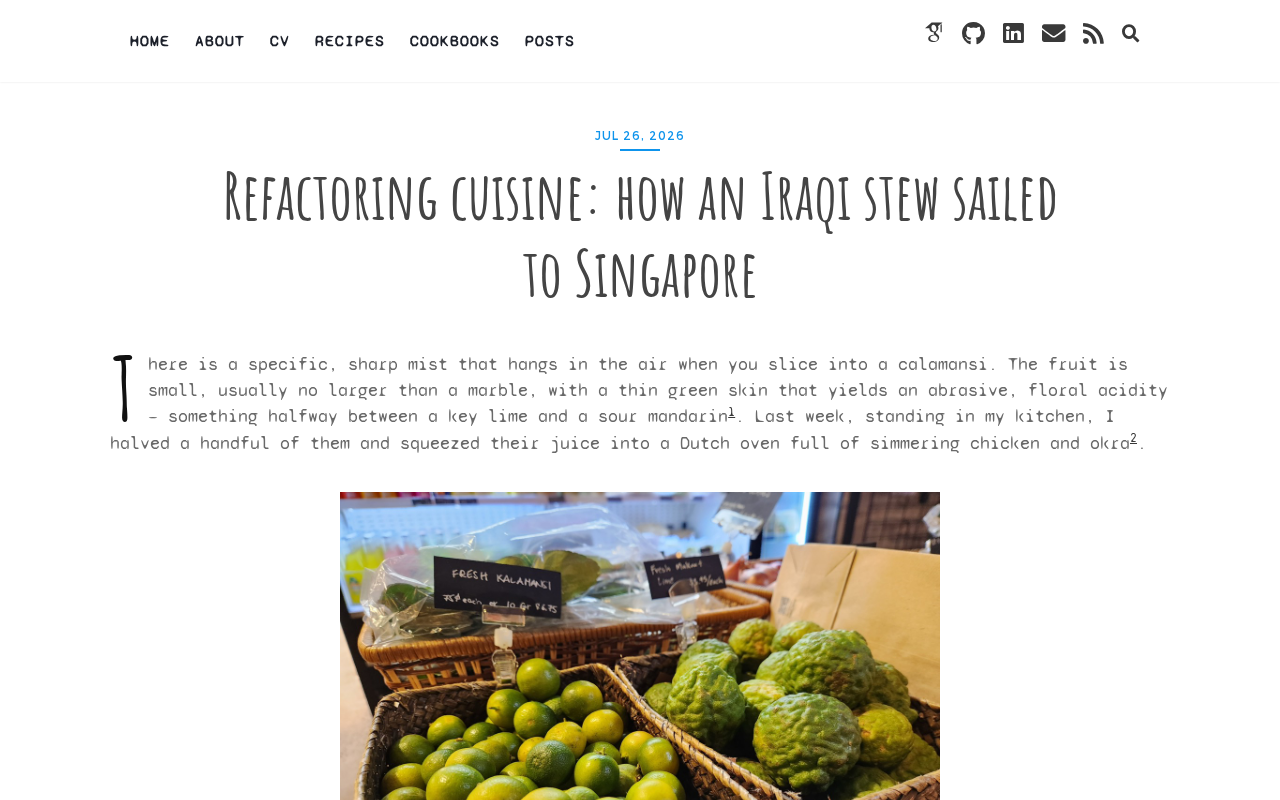
A recent article that sparked discussion on Hacker News—Refactoring cuisine: how an Iraqi stew sailed to Singapore—is precisely such a cross-disciplinary thought experiment. It borrows the "refactoring" metaphor from software development to trace how a dish was continuously "modified," "adapted," and "optimized" over centuries of transmission, ultimately evolving into an entirely new version.
This perspective may seem absurd at first glance, but it precisely captures the striking similarities between cultural evolution and code evolution.
Culinary Migration: A Century-Spanning Exercise in Code Reuse
The Long Journey from Iraq to Singapore
The article's core narrative revolves around a stew originating from Iraq. As trade routes extended and merchants and immigrants migrated, the dish "drifted" along historical sea lanes, eventually arriving in Southeast Asia's Singapore.
This transmission path has deep historical roots. From the 7th century onward, Arab merchants extended their trade networks from the Persian Gulf to Southeast Asia along the Maritime Silk Road. This route connected Baghdad, Hormuz, India's Malabar Coast, Ceylon (modern Sri Lanka), the Strait of Malacca, and all the way to Guangzhou, China. Arab-Persian merchants brought not only goods but also culinary culture, spice usage methods, and cooking techniques. As a key node on the Strait of Malacca, Singapore has been a multicultural crossroads since the 13th century, where Malay, Chinese, Indian, and Arab food cultures merged to form unique hybrid cuisines like Peranakan and Indian Muslim cooking.
Throughout this process, the dish's "source code"—its original recipe—underwent countless localization adaptations.
Just as open-source projects get forked to different regions and maintained by different communities, a dish gets repeatedly adjusted during transmission due to locally available ingredients, taste preferences, and cooking traditions. In the open-source software world, a fork refers to copying an independent version from a project's codebase, maintained and developed independently by a different team or community. Classic examples include LibreOffice forking from OpenOffice and MariaDB forking from MySQL. Forked projects may diverge in completely different technical directions but typically retain the original project's core architecture and functional foundations. This pattern shares deep structural similarity with how dishes undergo localization in different cultures—Iraqi spices might be replaced with local Southeast Asian seasonings, and stewing methods might change due to local cookware and habits, but the core architecture of "stew" is always preserved.
Preserving External Behavior, Changing Internal Implementation
The essence of refactoring lies in "not changing external behavior." Interestingly, as this dish crossed geographic and cultural boundaries, although its internal "implementation" (specific ingredients and techniques) continuously changed, its core "interface"—being "a warm, comforting stew"—remained constant.
This is exactly like code that has undergone multiple refactorings: variable names have changed, algorithms have been optimized, structures have been adjusted, but the functionality and value it provides externally remain consistent. In object-oriented programming, this is called the "Liskov Substitution Principle"—subtypes must be substitutable for their base types without altering the correctness of the program. A stew that traveled from Iraq to Singapore, despite its ingredients and techniques becoming unrecognizable, still satisfies all the contracts of the abstract "stew" interface: warmth, satiation, comfort. Cultural inheritance and code evolution achieve a wonderful unity on this point.
Why Software Metaphors Can Explain Cultural Evolution
Incremental Improvement Rather Than Starting from Scratch
Excellent software refactoring emphasizes small steps, rapid iteration, and incremental improvement rather than complete rewrites. This philosophy is embodied in various mature software engineering practices: Continuous Integration/Continuous Deployment (CI/CD) emphasizes frequent small-batch delivery; Kent Beck's Extreme Programming (XP) advocates "baby steps"; Lean Software Development borrows the "Kaizen" philosophy from the Toyota Production System. Conversely, the "Big Bang Rewrite" has numerous failure cases in the industry—most famously Netscape's 1998 decision to rewrite their browser from scratch, which caused the company to lose its market position during a three-year development period. Joel Spolsky called it "the single worst strategic mistake that any software company can make."
Cultural transmission works the same way—no dish is "reinvented" overnight in a foreign land. Instead, it gradually evolves through tiny adjustments across generations. Each "commit" (a chef's improvement) builds upon predecessors' work. A Singaporean Indian Muslim chef doesn't create a dish from thin air but fine-tunes their mother's recipe—perhaps substituting coconut milk for yogurt, or lemongrass for dried lemon. These small, cumulative changes are culture's "continuous integration."
This perspective reminds us: whether in software or culture, the most robust evolutionary path is usually gradual. Radical rewrites risk losing core value and discarding wisdom accumulated over history.
Technical Debt and Cultural Trade-offs
Over long periods of evolution, whether in code or recipes, parts accumulate that "seem redundant but have historical reasons." Software engineers call this technical debt—a concept first proposed by Ward Cunningham in 1992 to describe the long-term maintenance costs arising from technical compromises made for short-term delivery speed. Technical debt isn't always negative: sometimes deliberately taking on technical debt is a reasonable business decision (such as quickly validating market demand). Technical debt can be categorized into four quadrants: deliberate vs. inadvertent, and reckless vs. prudent. Clearing technical debt requires engineering resources, but over-clearing can lead to over-engineering, actually harming system flexibility.
In cuisine, this might be a seemingly redundant step in a process that carries cultural memory—such as certain traditional dishes insisting on stone mortar grinding rather than electric blenders, or the tradition of only preparing certain dishes on specific holidays. Whether to "clean up" these legacy elements is a decision requiring careful trade-offs—sometimes they are precisely the source of identity and uniqueness. Just as a code comment might document the solution to a hard-to-reproduce edge case, a seemingly superfluous step in cooking might carry implicit knowledge about food safety, flavor chemistry, or cultural ritual.
The Practical Value of Cross-Disciplinary Thinking
The reason this article attracted attention in the tech community is precisely because it demonstrates the charm of cross-disciplinary thinking. Applying software engineering methodology to the humanities and history not only provides fresh interpretive perspectives but also deepens our understanding of "refactoring" itself. This way of thinking is called "analogical reasoning" in academia, and cognitive scientist Douglas Hofstadter considers it one of the core mechanisms of human cognition—we understand new things by establishing structural mappings between different domains.
For technology practitioners, this analogy offers practical inspiration:
- The universality of systems thinking: Concepts like abstraction, modularization, and incremental evolution aren't unique to software—they are universal tools for understanding complex system evolution. Evolutionary biology, linguistic change, and institutional transformation in economics can all be understood through similar frameworks. This is also why Christopher Alexander, the originator of "design patterns," was originally an architect—pattern language itself is a cross-disciplinary concept.
- Preserving core value: No matter how many iterations occur, clearly identifying "what cannot be changed at the core" is always the most important judgment. In product development, this corresponds to the Core Value Proposition; in architecture design, it corresponds to immutable Architectural Decision Records; in cultural heritage, it is the anchor of identity for a nation or community.
- Respecting evolutionary history: Whether dealing with a codebase or cultural tradition, understanding its historical context helps make wiser improvement decisions. In software engineering, this manifests as the importance of reading Git history and understanding Code Archaeology; in the cultural domain, it means understanding why a dish is the way it is now before knowing what can be changed and what shouldn't be.
Everything Can Be Refactored: From Stew to Civilization
Refactoring cuisine is an elegant thought experiment that uses language familiar to programmers to tell a story about migration, adaptation, and inheritance. When we learn to view the world around us through the lens of "refactoring," we discover that from a pot of stew to a piece of code, from a family's migration to an open-source project's evolution, similar principles operate behind them all: maintaining essence amid change, continuously optimizing through inheritance.
This way of thinking also echoes the core insight of Complex Adaptive Systems theory: whether ecosystems, economies, cultural traditions, or software systems, they all exhibit similar emergent behavior—simple local rules produce complex global order through interactions among numerous agents. A chef's minor improvement, a programmer's single commit, a gene's single mutation—each seems insignificant, but accumulated over time, they compose the grand panorama of evolution.
This is perhaps the most fascinating aspect of technical thinking—it can not only build software but also help us more deeply understand the evolution of human civilization itself.
Related articles
Building an AI Sci-Fi Short with LTX + MiniMax H3: Restrained Cinematography in ComfyUI
Sci-fi short REMAINDER uses LTX, MiniMax H3, and ComfyUI with restrained cinematography and flat aesthetics to solve visual consistency in AI filmmaking.
LangChain Deep Agents vs. MDA: Clearing Up the Confusion for Developers
What's the difference between LangChain's Deep Agents and MDA (Managed Deep Agents)? We break down create_deep_agent vs. define_deep_agent and help developers choose.
Why Is AI Agent Development So Fragmented? The Real Causes and How to Work Around Them
Why does AI Agent development feel so fragmented? Logic scattered across prompts, configs, and frameworks makes portability nearly impossible. Here's why — and how to cope.