Codex Beginner's Guide: Four Usage Modes and a Full Comparison of the Three Giants
A frontend developer's hands-on comparison of Codex, Claude Code, and Cursor to help you pick the right AI coding tool.
Based on a Bilibili frontend developer's real-world experience, this article breaks down Codex's four usage modes and recommends the App form as the best starting point. Compared to Claude Code, Codex is cheaper, more stable, and better suited for UI and frontend work, while Claude Code excels in logic and backend scenarios. The developer's journey from Cursor to Claude Code to Codex illustrates how different tools fit different needs. The core advice: choose based on your role, budget, and workflow habits — and stay proficient in all three major tools.
AI coding tools are in a period of explosive growth, and Cursor, Claude Code, and Codex are widely regarded by developers as the unavoidable "Big Three." This beginner's overview is based on hands-on insights shared by a frontend developer on Bilibili, focusing on Codex's four usage modes, its core differences from Claude Code, and some practical advice for developers trying to choose the right tool.
Codex's Four Modes: Why the App Is the Recommended Choice
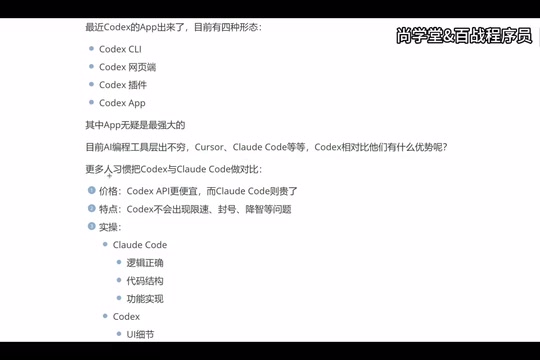
With Codex's standalone App now available, it currently exists in four forms: Siri (voice integration), terminal (CLI), web interface, and editor plugin. Many people's first exposure to Codex was through the plugin, embedded directly into their development tools.
Based on this developer's hands-on experience, the App form is by far the most powerful of the four — and it's the one he most strongly recommends. The App is more self-contained, and when used alongside traditional tools like VS Code, it can significantly amplify productivity. For developers who prefer a graphical interface and aren't fans of working purely in the terminal CLI, the App has a noticeably lower barrier to entry.
It's worth clarifying that the Codex discussed here refers to the next-generation AI coding assistant launched by OpenAI in 2025 — not the earlier code-generation model of the same name. At its core, this Codex is an Agent built on reasoning models like o3, capable of autonomously executing multi-step programming tasks within a sandboxed environment, including reading and writing files, running tests, and calling tools. Part of why the App form is considered more powerful is precisely because it can fully leverage these Agent capabilities — whereas the plugin form of Codex plays more of a code completion and suggestion role, with a much narrower capability scope.
Codex vs Claude Code: Weighing Price Against Experience
The most common comparison developers make is between Codex and Claude Code. Based on real-world feedback from the source material, this can be broken down along two dimensions.
Price and Stability
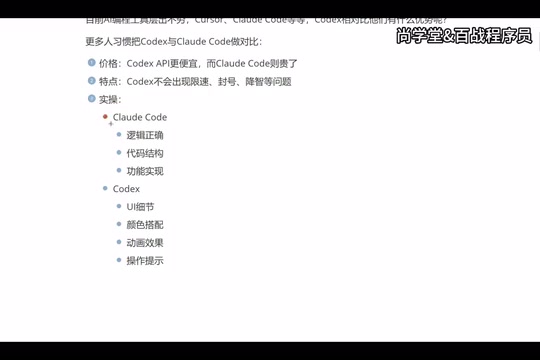
In terms of price alone, the Codex App subscription is relatively cheaper, while Claude Code skews more expensive. This is the most direct reason many people default to Codex first.
On stability, the developer mentioned that one frustrating aspect of Claude Code is its tendency to hit rate limits and account restrictions. In his own use cases, Codex hasn't presented these issues to any noticeable degree. That said, he was candid about the ongoing debate around "intelligence degradation" (a drop in model quality) — some users have reported that Codex also degrades, but he personally hasn't felt it strongly. This is a subjective experience, and readers should weigh it against their own usage.
Different Strengths and "Personalities"
More useful for decision-making is the difference in each tool's "character." As the developer summarized:
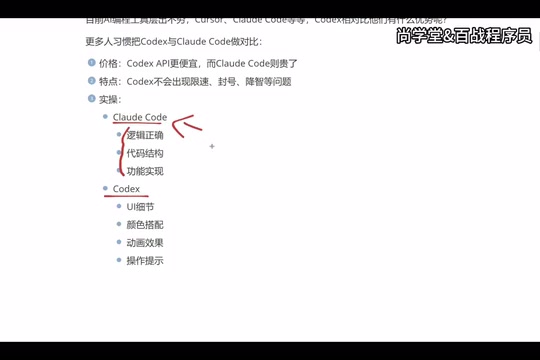
- Claude Code leans toward logical correctness, code structure, and functional implementation — making it a favorite among many backend developers.
- Codex pays more attention to UI details, color schemes, animations, and interaction cues — making it more popular among App and frontend developers.
As a frontend developer himself, his conclusion is that Codex is a better fit for his workflow. But he also acknowledged that Claude Code may be stronger on the logic side, which is why many developers still choose it. This judgment reflects a clear personal perspective and should be treated as a reference point rather than a definitive verdict.
There are underlying model and product design reasons behind this "personality gap." Claude Code is developed by Anthropic on top of the Claude model family, and Anthropic has invested heavily in training for code logic correctness, safety, and interpretability — making it consistently strong on complex business logic and system architecture tasks. Codex App is built on OpenAI's reasoning models, and OpenAI has deeper experience with multimodal understanding and UI comprehension; combined with product-level polish on interface interactions, this makes it feel smoother in frontend scenarios. That said, these differences aren't absolute — as all models continue to iterate, capability gaps will keep narrowing, and today's "personality labels" may need to be recalibrated in six months.
Don't Rely on Just One: All Three Giants Are Worth Learning
Tools come and go, but the mainstream choices still come down to Cursor, Claude Code, and Codex. One practical piece of advice the developer offered: it's better to be proficient in all three rather than putting all your eggs in one basket.
The reasoning is straightforward — different companies may provide different account resources or require the use of specific AI tools. Being comfortable with multiple tools means being more adaptable.
He also shared his own journey: he started with Cursor for over six months, had a good experience but found each payment "painful"; then switched to Claude Code and integrated some domestic Chinese models to bring costs down, but the experience wasn't ideal; and eventually moved to Codex once the App launched and proved more frontend-friendly — making it his current go-to.
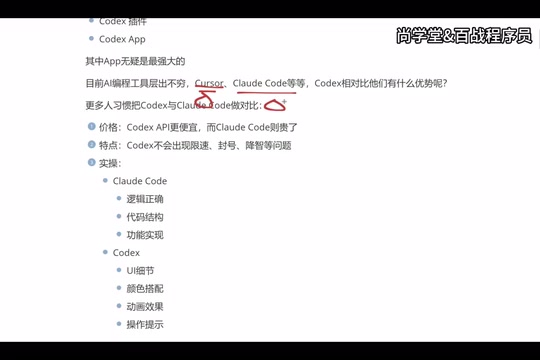
As the first of the three to break into mainstream awareness, Cursor is fundamentally a code editor with deeply integrated AI capabilities (based on a VS Code fork). Its core strengths lie in the tight fusion of features like Composer and Tab completion with the editor workflow, making AI involvement feel nearly frictionless. It supports multiple backend models (including Claude, GPT-4o, and others) that users can switch between as needed. The higher cost mainly comes from stacking its own subscription on top of backend model API usage, making the total spend the highest of the three. For developers who prefer to complete their entire workflow inside an editor, Cursor's all-in-one experience still offers unique value.
A Framework for Choosing as a Beginner
Drawing from this overview, here are a few practical guidelines:
- Consider your role: If you're backend-focused and prioritize logic, Claude Code is worth trying first. If you're frontend-focused and care about UI and interaction details, Codex is likely a better fit.
- Consider your budget: Cursor offers a great experience but at a higher cost; the Codex App offers relatively better value for money.
- Consider your workflow preferences: If you dislike working purely in the terminal, the Codex App form will feel much more comfortable.
- Don't put all your eggs in one basket: Maintaining basic proficiency in all three tools prepares you for the varying requirements of different teams and projects.
One important caveat: the judgments in this article about stability, intelligence degradation, and areas of strength are largely drawn from a single developer's subjective experience, which is a limited sample. Real-world results will vary depending on model version updates, integration method, and project type. The most reliable approach is still to try them hands-on yourself before drawing any conclusions.
Related articles

LynnReal-Omni: 32B Unified Video Diffusion Model Goes Open Source with Multi-Task Coverage in Four Steps
LynnReal-Omni is a 32B unified video diffusion model on MiniMax H3, covering text-to-video, pose guidance, style transfer, restoration in 4 steps. Flash version generates 540p video in 377ms on one H100.

Anthropic Co-Founder: AI 'Kill Switch' May Need to Be Mandatory by Law
Anthropic's co-founder tells the BBC that AI 'kill switches' may need to be legally mandated. We analyze the industry logic, technical challenges, and the tension between regulation and innovation.

The AI Data Center Boom Is Colliding With Cities Scarred by Heavy Industry
The AI data center boom is clashing with post-industrial communities. Philadelphia's case reveals structural conflicts between AI growth, energy use, water, and environmental justice.