Codex, Claude Code, and Agent Skills: A Practical Guide to AI-Driven Engineering

Codex, Claude Code, and Agent Skills represent AI programming's evolution from code completion to full engineering collaboration.
This article maps out the core concepts and engineering adoption paths for today's AI-assisted programming tools. Codex-style tools focus on instant code generation and completion, while Claude Code operates as an Agent in terminal environments to handle complex, multi-step tasks across files. The Agent Skill mechanism goes further, encapsulating domain-specific workflows into reusable modules that help teams codify best practices. Successful adoption also requires three supporting elements: providing Agents with clear context and standards, establishing a verifiable generate–test–fix loop, and keeping humans in the loop for critical decisions. Beginners are advised to build experience incrementally rather than aiming for full automation from the start.
AI Programming Tools Are Moving Toward Real-World Engineering
AI-assisted programming has evolved far beyond simple code completion. Today's tools can understand requirements, plan tasks, and execute them autonomously — we're firmly in the Agent era. Codex, Claude Code, and Agent Skill development have become focal points for developers everywhere. The core value of these tools lies in elevating AI from "an assistant that writes a few lines of code" to "a collaborator capable of handling complete engineering tasks."
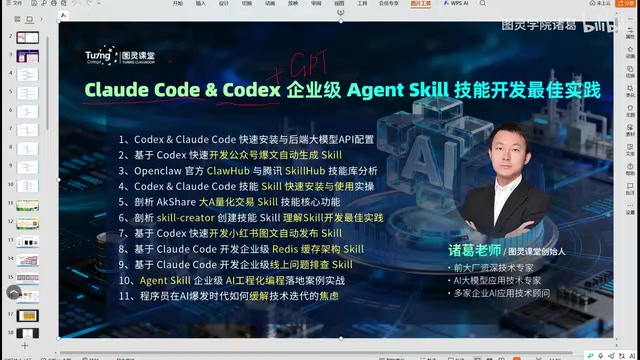
A quick note: this article is based on tutorial material originally published on Bilibili. Since the source material itself contains limited technical depth, the discussion below draws on broader industry knowledge to map out the conceptual landscape and help readers build a solid mental framework.
How Codex and Claude Code Differ in Purpose
These two categories of tools represent the two dominant approaches in AI programming today.
Code Generation Models Like Codex
Codex-style tools excel at generating code snippets from natural language descriptions, completing functions, and explaining logic. They operate primarily at the code layer — ideal for in-editor assistance that reduces the burden of repetitive coding. Give the model a clear comment or function signature, and it quickly produces a working implementation.
Claude Code's Agent-Oriented Approach
Claude Code takes a different direction, working as an Agent within a terminal environment: it can read project files, understand codebase context, execute commands, run tests, and iterate based on results. This mode resembles "an engineer who knows their way around a command line," making it well-suited for cross-file refactoring, debugging, and multi-step tasks. The two approaches aren't mutually exclusive — in practice, they're often used together: use a generation model to quickly draft code, then use an Agent to handle integration and validation.
The underlying mechanics of Agent mode are worth understanding. Traditional code completion tools operate in a "single-turn Q&A" fashion: the developer inputs something, the model outputs a response, and the interaction ends. Agents, by contrast, follow a "plan → execute → observe → re-plan" loop (the ReAct framework or similar variants): the model breaks a goal into subtasks, invokes tools to execute them (e.g., reading files, running commands), observes the results, and then decides on the next action. This means tools like Claude Code require not only strong language understanding, but also stable tool-calling interfaces and access to the execution environment. It also explains why Agent mode consumes far more context window than ordinary code completion — a single cross-file refactoring task may require tracking the state of dozens of files throughout a conversation. This is one of the main reasons Agent tools remain unreliable on long-running tasks.
Agent Skills: Giving AI Reusable, Domain-Specific Capabilities
The significance of the Agent Skill mechanism is that it encapsulates the workflows, standards, and tools of a specific domain into reusable modules. This allows an AI Agent to reliably apply them to similar tasks without having to relearn everything from scratch each time.
Think of Skills as "professional capability packages" configured for an Agent: a skill dedicated to database migrations, one for generating frontend components, another for conducting code reviews. Through skill development, teams can codify their internal best practices — making AI output more aligned with project conventions and more predictable. This is a critical step in moving AI programming from a "personal toy" to a "team-level engineering asset."
From a technical implementation perspective, the encapsulation format for Skills varies by platform, but generally involves three elements: trigger conditions (when to use the skill), operational workflow (which steps to execute and which tools to call), and output specification (the format and acceptance criteria for deliverables). On some platforms, Skills are injected via System Prompts; on others, they exist as standalone tool definitions or function calls.
It's worth noting that the Skill mechanism closely mirrors the concept of Standard Operating Procedures (SOPs) in software engineering — at its core, it's about making engineers' tacit knowledge explicit and structured, then delegating execution to AI. This also means the quality ceiling of a Skill depends on how well a team has mapped out its own workflows, not solely on model capability.
Key Principles for Real-World Engineering Adoption
Getting genuine value from AI programming in a production setting requires more than just calling the right tools — it demands supporting engineering practices.
Clear Context and Standards
An Agent's performance is heavily dependent on the context it receives. Providing clear project structure documentation, coding conventions, and dependency specs can dramatically improve output quality. Many cases of "AI writing bad code" trace back to insufficient context, not inadequate model capability.
A Verifiable Feedback Loop
The foundation of engineering discipline is making AI work verifiable. Paired with automated testing, type checking, and CI pipelines, Agent-generated code can be continuously validated — creating a "generate → test → fix" loop rather than relying on manual line-by-line review.
This "generate → test → fix" loop maps directly to a concrete practice: combining Test-Driven Development (TDD) with AI Agents. The typical workflow looks like this: test cases are written first (by a human or by AI), the Agent then generates implementation code to make those tests pass, the Agent runs the tests and automatically iterates based on failure messages, continuing until all tests pass. The advantage of this model is that the test cases themselves serve as "executable specifications" for AI output, dramatically reducing the review cost of merging AI-generated code into the main branch. CI/CD pipelines (such as GitHub Actions) act as the final gatekeeper — ensuring that even if an Agent passes tests locally, edge cases in the integration environment are still caught. Without this validation infrastructure, scaling up AI-generated code carries significant quality risk.
Keeping Humans in the Loop
Even as Agent capabilities grow, critical decisions, architectural design, and security-sensitive code still require human oversight. A sensible approach is to let AI handle the tedious, repetitive, and pattern-driven work, while leaving creative and judgment-intensive tasks to engineers.
Getting Started as a Beginner
For those just starting out, the best approach is to start small: try a code generation tool on a familiar small project to experience completion and explanation features, then gradually work up to having an Agent handle simple multi-step tasks — like adding a new feature with accompanying tests. Once you're comfortable with that, explore encapsulating your own workflows as Skills to lock in patterns you use frequently. Building good habits incrementally is far more effective than chasing full automation from day one.
Closing Thoughts
Codex, Claude Code, and Agent Skills all point toward the same trend: AI programming is transitioning from an assistive tool into a component of the engineering system itself. Understanding where each fits, and pairing them with clear engineering practices, is what turns AI's raw capability into real, deployable productivity. For developers, now is an ideal time to build that workflow intuition.
Related articles

Bilibili's Hit Dify Tutorial: A Practical Guide to Building 20+ AI Apps from Scratch
A distilled guide to Bilibili's top-rated Dify tutorial: Windows + Docker deployment, MySQL connection, five app types, model integration strategy, and publishing.

Agent Skills Beginner's Guide: From Concepts to Multi-Agent Collaboration in Practice
A comprehensive guide to Agent Skills: core concepts, components, the importance of Description, standardization, beginner learning paths, and multi-agent collaboration.

One Neuron Detects Both Cats and Cars? We Reproduced It and Found a New Explanation
The cat-car neuron reinterpreted: researcher Cammarata argues it distinguishes pointy from round, not cats from cars. We reproduced the experiment and found the new explanation holds on most inputs—but cars are the exception. The interpretability debate continues on language models.