Codex Configuration Guide: A Complete Breakdown of Sandbox, Skills, and MCP

Agentic tools give LLMs hands and feet; configure the sandbox, Skills, and MCP first—Codex offers a better experience.
The article covers how to choose and get started with agentic coding tools. It first clarifies the essential difference between agentic tools and LLM chat boxes: through tool calling, the former can read and write files, execute commands, and call external services—"giving the brain hands and feet." Based on the host's hands-on experience, it compares Codex and Claude Code, noting Codex's advantages in Chinese comprehension, requirements analysis, full-stack capability, and the MCP ecosystem, while Claude Code's main barrier is high cost, with DeepSeek able to cut costs at the expense of experience. It emphasizes "don't write code right after installing": configure the sandbox, Skills, and MCP first to ensure safe execution in a controlled environment, then verify the toolchain with a small task. Finally, it offers pragmatic advice: tools will converge, so get the foundational configuration working first and layer model usage by budget and experience preference to reduce future switching costs.
Why Agentic Tools Are Worth Your Time
When many people first encounter Codex or Claude Code, they mistakenly assume these are just "another LLM chat box." But the video host makes a key distinction right at the start: an LLM is the brain, and an agentic tool is what gives that brain hands and feet. You can ask the brain to think, but only with hands and feet can it actually do things for you—read and write files, execute commands, call external services.
This is why he repeatedly stresses that "everyone needs to learn this." Whether or not you write code, setting up a JPT (as the video calls it) to look up information and letting the agent run through a small task for you will significantly change your workflow. He states outright that foreign models currently lead by a hair in terms of experience, but in the long run tool choices will converge—and then what matters is who is cheaper.
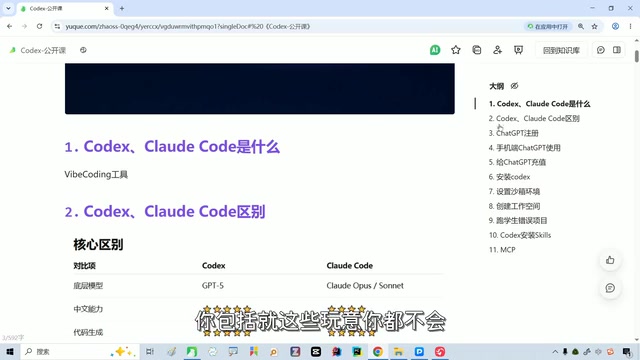
Agentic Coding Tools are not just "another chat window" because of their core difference: tool-calling capability. An ordinary conversational model can only output text, whereas agentic tools use a Function Calling mechanism that lets the model proactively issue structured requests—reading file contents, writing to disk, executing shell commands, making HTTP requests, and so on. The runtime environment executes these requests and passes the results back to the model, which then decides its next action, forming a "think—act—observe" loop. This loop is precisely the engineering implementation of the ReAct (Reasoning + Acting) paradigm. For this reason, the capability ceiling of an agentic tool depends not only on the model itself but also on which tools it has been granted and within what permission boundaries those tools operate.
Codex vs. Claude Code: The Host's Real Preference
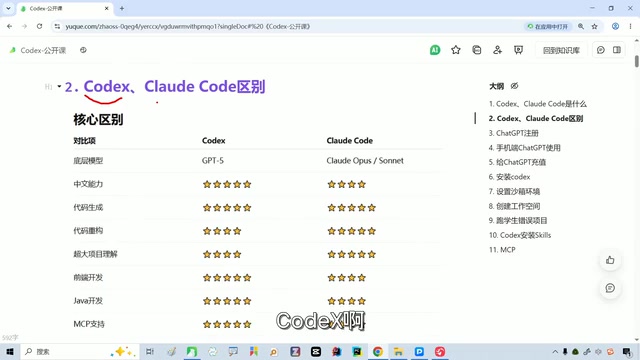
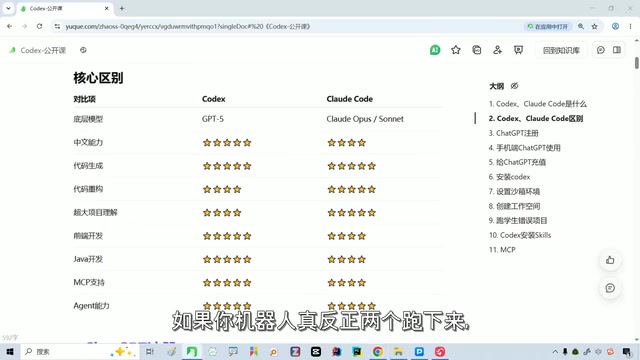
In the video, the host does not dodge the question of taking sides. He has Codex, Claude Code, and Cursor all installed on his machine, and his conclusion after using them is that Codex is the best. His reasons center on a few points: it runs on GPT-5.5 under the hood, which gives better Chinese comprehension; stronger requirements analysis; outstanding full-stack front-end and back-end capability; a fast-growing MCP ecosystem; and the backing of OpenAI's largest official investment.
He also acknowledges this is personal experience and suggests viewers run through it themselves before judging. For Claude Code, he points out that high cost is the main barrier—many people pair it with DeepSeekAd models to cut costs, but "honestly, it's just not as good as the foreign options." This comparison offers no precise benchmarks, but it lays out the decision logic clearly: if you are budget-sensitive you can downgrade the model, while if experience comes first, Codex is more reliable.
Why "Don't Write Code Right After Installing"
The "13 sections" in the video title point to a core methodology: first configure the sandbox, Skills, and MCP, then let the agent go to work. The host does not read through each configuration item, but the context is clear—these foundational settings determine whether the agent can safely execute commands, whether it can call the tools you need, and whether it can run tasks in a controlled environment. Skip this step and go straight to writing code, and you will end up struggling repeatedly with permissions, environment, and toolchain issues later.
He uses his own machine as an example: he installed and ran all three tools before forming a preference. This order of "configure first, compare next, use last" is more reliable than asking it to generate code right away.
The three configuration items mentioned in the article each address a different layer of the problem. Sandbox is an isolated execution environment that restricts the file paths, network, and system calls the agent can access, preventing accidental file deletion or dangerous command execution; common implementations include containers, namespace isolation, or restricted shells. Skills are reusable capability encapsulations that solidify the process, scripts, and prompts for "how to complete a certain type of task" into modules that the agent loads when needed, avoiding reasoning from scratch every time. MCP (Model Context Protocol) is an open protocol proposed by Anthropic that connects external data sources and tools (databases, APIs, file systems, etc.) to the model through a unified interface—essentially giving the agent a standardized set of "peripheral slots." The three correspond respectively to security boundaries, capability reuse, and tool integration; missing any one of them means you will keep playing catch-up in use.
Model Pairing and Cost Trade-offs
Agentic tools must be used together with a model—this is a premise that comes up repeatedly in the video. Claude Code corresponds to Claude models and is expensive; Codex can be paired with GPT; some people use DeepSeek to reduce costs. The host's approach is to pair Codex with GPT, balancing Chinese comprehension and requirements analysis.
He gives no specific prices or token figures, but he makes the trade-off clear: cost-reduction options exist, at the price of a degraded experience. For individual developers, this is a question that can be sliced by project importance—use expensive models for critical tasks and cheap models for everyday miscellaneous work.
The cost structure of agentic tools differs from plain chat: a single task often involves multiple rounds of the "think—call tool—observe result" loop, and each round must feed the context back into the model, so token consumption can be several times or even dozens of times that of a single conversation. This is the underlying reason Claude Code is perceived as "expensive"—the model it pairs with by default has a high unit price, and long tasks continuously accumulate context. Substituting low-cost models like DeepSeek can significantly lower the bill, but the cost is that tool-calling stability, instruction-following accuracy, and multi-step reasoning coherence may decline, manifesting as needing more manual correction. Once you understand this, the layered strategy of "expensive models for critical tasks, cheap models for everyday miscellaneous work" has a clear economic rationale.
Practical Advice
If you have just installed Codex, do not rush to have it write business code. First follow the video's approach and get the sandbox, Skills, and MCP properly configured, then use a small task to verify that the toolchain works smoothly. The host's attitude is pragmatic: tools are iterating rapidly, and today's lead does not mean a permanent lead—get the foundational configuration working first, and the cost of switching tools later will be lower.
One-line Summary
Agentic tools give LLMs hands and feet; configure the sandbox, Skills, and MCP first—Codex offers a better experience.
Paragraph Summary
The article focuses on how to choose and get started with agentic coding tools. The author first clarifies the essential difference between agentic tools and LLM chat boxes: the former, through tool calling, can read and write files, execute commands, and call external services—"giving the brain hands and feet." Then, based on the host's hands-on experience, it compares Codex and Claude Code, noting that Codex is stronger in Chinese comprehension, requirements analysis, full-stack capability, and the MCP ecosystem, while Claude Code's main barrier is high cost—models like DeepSeek can reduce costs but degrade the experience. The article emphasizes "don't write code right after installing": configure the sandbox, Skills, and MCP first to ensure the agent safely executes tasks in a controlled environment, then verify the toolchain with a small task. Finally, it offers pragmatic advice: tools will converge, so get the foundational configuration working first and layer model usage by budget and experience preference to reduce future switching costs.
Related articles

A 19-Year-Old's Rental Horror Story: Ceiling Collapse, Bug Infestation, and the Lessons It Taught Me
At 19, my first off-campus rental brought bug infestations, no heat, a collapsed ceiling, and a ruined laptop with no renter's insurance. Here are the hard-won lessons for first-time student renters.

Veda Nurse's Cranial Nerve Exam: Why ASMR Role-Play Is Going Viral
Bilibili creator Veda's cranial nerve exam ASMR video goes viral, blending humor and sensory triggers through nurse role-play. This article analyzes its unique appeal and the audience psychology behind ASMR role-play.

LG Cinebeam AI Review: 120-Inch Giant Screen + 3000 Lumens, a New Choice for the Living Room Theater
LG Cinebeam AI projector review: 3000 ANSI lumens, 4K, 100 inches from about 8 cm and 120 inches from about 18 cm. Built-in webOS, AI Concierge voice recommendations, AI Sound Pro 11.1.2 virtual surround, and Game Optimizer—positioned for fixed living room installation, complementing the portable Cinebeam S.