Codex Direct Connection Configuration Guide for China: Complete GPT Agent Setup Tutorial

A comprehensive guide to setting up and using OpenAI's Codex Agent in China via third-party API relay services.
This article provides a detailed walkthrough for Chinese users to configure and use OpenAI's Codex Agent, covering installation, API key acquisition via third-party relay services, permission mode settings, and tiered reasoning intensity options. It also offers deep technical context on Codex's evolution from its 2021 origins to the 2025 autonomous Agent, while critically analyzing the compliance risks, security implications, and cost considerations of using intermediary API services.
Introduction: Why Codex Deserves Your Attention
Codex, an automation Agent tool launched by OpenAI for developers and AI enthusiasts, has seen its popularity surge recently. Notably, Codex isn't an entirely new name—OpenAI released the original Codex model back in 2021, built on the GPT-3 architecture and fine-tuned specifically for programming tasks using training data from billions of lines of public code on GitHub. It once served as the underlying engine for GitHub Copilot.
Technical Background of the Original Codex Model: The original Codex released in 2021 was an early exemplar of domain-specific fine-tuning for large language models. Built on GPT-3 (175 billion parameters) as its foundation, it underwent secondary training on over 100 million public GitHub repositories, covering more than ten mainstream programming languages including Python, JavaScript, TypeScript, Ruby, and Go. The core breakthrough of the original Codex lay in aligning natural language with code semantic spaces—the model could not only understand code syntax structures but also parse intent from comments and transform it into executable code. This alignment capability stemmed from a key insight: high-quality code is itself a highly structured, logically rigorous language, with natural semantic mapping relationships between comments and implementations, enabling the efficient transfer of language model pre-training capabilities. The original Codex achieved a pass@1 score of 28.8% on the HumanEval benchmark, while GPT-3 scored 0% directly, fully demonstrating the value of vertical fine-tuning and laying the foundation for the "natural language programming" interaction paradigm that followed.
The Significance of the HumanEval Benchmark: HumanEval is a standardized test set specifically designed by OpenAI to evaluate code generation capabilities, containing 164 hand-crafted Python programming problems, each with corresponding unit test cases. The pass@k metric measures the probability that at least one of k generated candidate code snippets passes all test cases. This metric became an industry standard because it directly reflects the model's actual ability to generate "runnable, correct code" rather than merely evaluating syntactic correctness. The leap from 0% to 28.8% meant that GPT-3, through vertical fine-tuning, jumped from "virtually unable to write runnable code" to "approximately a 30% chance of getting it right on the first try"—a milestone achievement at the time that catalyzed the commercial explosion of the entire AI-assisted programming sector.
Historical Evolution of Software Engineering Automation: The emergence of the Codex Agent isn't abrupt but rather a milestone achievement in decades of software engineering automation evolution. This journey can be roughly divided into four phases: The first phase was Syntactic Automation (1980s-2000s), represented by IDE syntax highlighting, bracket completion, and static code checking, where tools only understood the lexical structure of code; the second phase was Semantic Assistance (2000-2015), represented by IntelliJ IDEA's intelligent completion and refactoring features, where tools began understanding type systems and call relationships; the third phase was Statistical Learning (2015-2022), represented by Kite, TabNine, and early GitHub Copilot, where large-scale code corpus-based statistical models provided context-aware multi-line completion; the fourth phase is the current Autonomous Agent Phase (2023-present), where tools transform from "suggesters" to "executors," capable of independently completing entire engineering tasks from requirement understanding to code submission. Behind each phase transition lies the combined breakthrough of computing power, training data scale, and model architecture—the fourth phase where Codex Agent operates is driven by the scaling effects of the Transformer architecture and the maturation of reinforcement learning training paradigms.
The new-generation Codex Agent (2025 version) discussed in this article is fundamentally different from earlier models: it can not only generate code snippets but also autonomously execute tasks, invoke tools, and read/write files within sandbox environments, truly achieving end-to-end software engineering automation. It stands as one of the landmark products in AI's transition from "assistant" to "autonomous executor." According to the video author, Codex releases new features almost daily, with an extremely fast iteration cadence. For users in China, account registration, network access, and payment verification are three unavoidable hurdles.
This article is based on the configuration workflow shared by a Bilibili content creator, organized into a relatively complete Codex setup tutorial to help readers understand its configuration logic and user experience. It should be noted that this article focuses primarily on technical education and workflow analysis; when third-party API relay services are involved, readers should independently assess their compliance and account security risks.
Codex Installation and First Launch
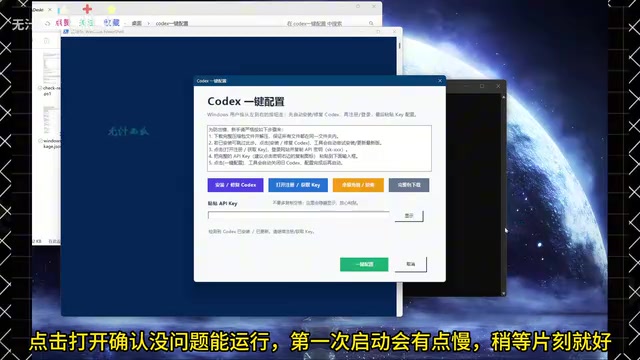
According to the tutorial demonstration, the Codex installation package can be downloaded and run directly within China's network environment without complex prerequisite configurations. The author emphasizes that as long as you follow the steps one by one, installation can generally be completed smoothly.
One thing to note about the first launch: the initial run will be slow, requiring patience while the program completes initialization—this is normal behavior, as the software needs to complete local environment deployment and resource loading. Once the interface displays the signature Codex icon, you can proceed to the next step.
Electron and the Architecture Trade-offs of Local AI Clients: Many AI desktop clients targeting general users (including such Codex wrapper tools) are built using the Electron framework—a technical approach that packages the Chromium browser engine and Node.js runtime as a desktop application. Its advantage is that development teams can reuse web frontend technology stacks to quickly release cross-platform applications without separately maintaining native codebases for Windows, macOS, and Linux. However, the cost of this architecture is relatively large installation packages (typically 100MB-300MB), higher memory usage, and the need to initialize the complete Chromium rendering engine on first launch—this is the technical root cause of the "first run being slow." The flip side of heavy encapsulation is that users cannot easily audit the underlying execution logic, making it difficult to intuitively determine what operations the application performs locally and what data it sends externally. This is also an important reason why security-conscious developers tend to prefer official CLI tools.
From a product experience perspective, this "one-click" installation design significantly lowers the barrier for non-professional users. Compared to traditional approaches requiring manual configuration of Python environments, dependency libraries, and API keys, the packaged installation process is indeed much more user-friendly. However, precisely because of the heavy encapsulation, users' control over underlying mechanisms is correspondingly reduced.
API Key Acquisition and Configuration
The configuration step is the core of the entire process. The tutorial mentions that users need to find the "API Key" option on the left side of the service panel and copy the corresponding key string. The author specifically highlights a critical detail: you must use the access URL specified in the video, otherwise errors will occur.
This point actually reveals the essence of the direct connection solution for China—accessing through third-party API relay services rather than connecting directly to OpenAI's official interface.
Technical Principles of API Relay Services: The technical essence of API relay services (API Proxy/Relay) is reverse proxying—third-party platforms deploy servers in regions where OpenAI services are accessible, connect to the service through official OpenAI API keys, and then expose their own endpoints externally. After users purchase access credentials from such platforms, all request traffic is routed to OpenAI through the platform. From a technical architecture perspective, these services typically use reverse proxy servers like Nginx or Caddy to replace the Authorization header in user requests with the platform's own official key, then forward to api.openai.com. From a model capability perspective, since the same API endpoints are called at the bottom layer, inference results are theoretically consistent with direct connections, giving some basis to "full-power version" claims. However, this architecture introduces critical risks: users' session content (including code, business logic, sensitive data) passes through third-party servers, and the platform has complete traffic retention capabilities. Additionally, some relay platforms use a "shared quota pool" model where the platform purchases in bulk to reduce costs—once the platform shuts down or quotas are exhausted, users' prepaid balances will be completely lost. Once an API key is handed to an intermediary, that platform can invoke OpenAI services under the user's identity, with the possibility of generating additional charges or leaking conversation content.
API Key Security Management Practices: An API key is essentially a high-entropy random character string that serves as a "digital password" for service authentication. Unlike username + password combinations, API keys typically don't come with two-factor authentication protection—once leaked, they can be directly abused. Industry-recommended key security practices include: creating independent keys for different use cases (rather than sharing one), setting minimum permission scope for each key (such as allowing only specific model calls), enabling usage alert thresholds (automatic notification when consumption exceeds expectations), regularly rotating keys, and absolutely avoiding hardcoding keys in code repositories. The OpenAI console provides fine-grained key permission management and real-time consumption monitoring. When using third-party relay platforms, users effectively surrender all these security controls—the platform has complete usage permissions over the key, which is the most core security concern with such solutions.
After pasting the copied API key into the configuration interface, click "One-Click Configure," and the script will automatically complete the deployment.

Key Steps in the Configuration Process
The entire configuration process can be broken down into the following steps:
- Register and obtain the key: Registration can be completed with a domestic Chinese phone number, no US number verification required
- Copy and paste the API key: Pay attention to key completeness—missing any character will cause failure
- One-click configuration deployment: The script runs automatically; wait for Codex initialization to complete
- Enter the key a second time: After startup is complete, enter the full key again in the designated option
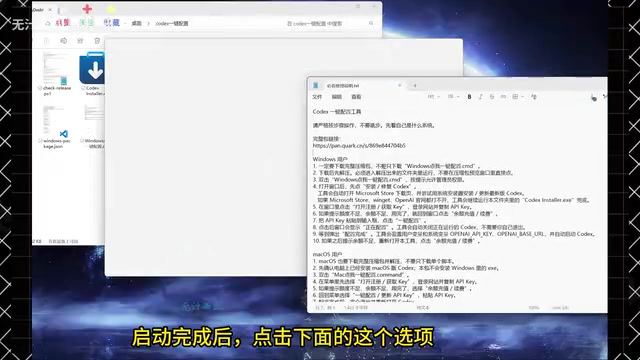
The author mentions that the tutorial also includes detailed written instructions and Mac-specific configuration steps, with most common questions already answered in a FAQ compilation. This "text + video" dual-track approach to documentation is quite friendly for beginners.
User Experience and Key Settings
Once configuration is complete, you can officially start using this Agent tool. The author suggests making several key settings first for a smoother experience.
Permission Mode Selection
By default, Codex frequently asks users for permission when modifying files. The author vividly describes users as being reduced to "heartless yes-machines." Therefore, he suggests setting permissions to fully allowed to avoid repetitive confirmations interrupting the workflow.
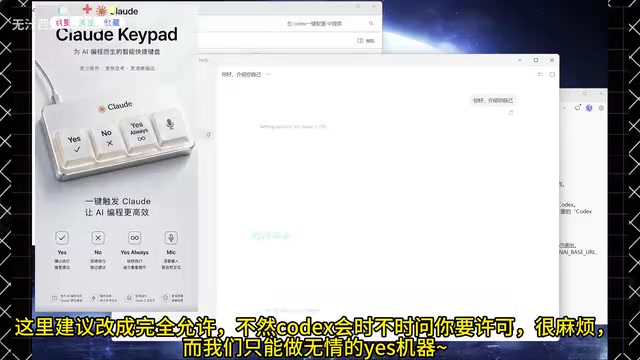
However, from a security perspective, this setting should be treated with caution. The official recommendation is to enable the Sandbox environment—a security mechanism that isolates program execution within a restricted space.
Technical Implementation of Sandbox Environments: Sandboxes are typically implemented based on container technology (such as Docker) or OS-level isolation (such as Linux namespaces and seccomp filters). The Agent within a sandbox has an independent filesystem view, restricted system call permissions, and an isolated network stack—its file read/write operations only affect the container's interior and cannot directly access sensitive directories on the host machine; network requests can be precisely filtered to prevent data exfiltration. Linux's seccomp (Secure Computing Mode) mechanism can limit the system calls an Agent process is allowed to make to a whitelist of just dozens, dramatically reducing the attack surface. This is particularly important for autonomous Agents—when a model executes multi-step tasks, erroneous instruction chains may cascade into destructive operations (such as accidentally deleting files or sending sensitive data externally), and sandboxes provide a "last line of defense." Fully opening permissions improves fluidity but is essentially a trade-off between experience efficiency and system security—when handling important files, it's advisable to retain necessary confirmation mechanisms.
The Fundamental Difference Between the Agent Paradigm and Traditional IDE Automation Tools: The "autonomous execution Agent" paradigm represented by Codex Agent has fundamental architectural differences from traditional IDE plugins and auto-completion tools. Traditional tools (such as early GitHub Copilot, TabNine) are essentially "single-step inference" models—they receive cursor context, output the next code suggestion, with each call being independent and no execution state preserved. The Agent paradigm introduces the "Plan-Execute-Observe-Reflect" loop architecture (the ReAct framework: Reasoning + Acting), where the model not only generates code but can proactively invoke tools (read/write files, run terminal commands, make network requests), observe tool return results, and dynamically adjust subsequent action plans accordingly. This "stateful multi-step execution" capability enables Agents to handle refactoring tasks spanning dozens of files, automatically run tests and iteratively fix based on failure information, completing complex engineering tasks that traditional single-step tools cannot handle. The cost is that once an intermediate step goes wrong or the model hallucinates, errors cascade along the execution chain—this is also the fundamental reason why permission control and sandbox isolation are far more critical in Agent scenarios than with traditional tools.
Prompt Injection and Security Threats to Autonomous Agents: When an AI Agent is granted "fully allowed" file operation permissions, prompt injection attacks become a non-negligible threat vector. Attackers can hide malicious instructions within file content that the Agent processes (such as in code comments, README documents, or configuration files), inducing the model to misidentify this content as legitimate user instructions and execute them. In scenarios with full filesystem access, a successful prompt injection could lead to sensitive files being read and exfiltrated, backdoors being planted in code, or the local environment being compromised. This is why security researchers generally recommend that for AI Agents executing tasks autonomously, permission tightening (Least Privilege) and sandbox isolation should be default configurations rather than optional ones.
Reasoning Mode Trade-offs
Codex provides tiered reasoning intensity settings. The author demonstrates enabling the top-tier extra high mode, which takes longer for reasoning and is suitable for handling complex tasks; for simple daily tasks, switching to low mode provides faster response times.
The OpenAI Model Family and Codex's Technical Relationship: Understanding the capability boundaries of the 2025 Codex Agent requires clarifying its relationship with the OpenAI model family. The current version of Codex Agent relies on the o-series reasoning models (primarily o3 or o4-mini) at its core, rather than the original 2021 Codex model. The core difference between the o-series and GPT-4o series lies in their training objectives: the GPT series is optimized for "next token prediction," pursuing fluent natural language generation; the o-series introduces the "Process Reward Model (PRM)" training paradigm, using reinforcement learning to reward correct intermediate reasoning steps rather than just the final answer, thereby achieving significant advantages in tasks requiring rigorous logical chains such as mathematical proofs and code debugging. This also explains why Codex Agent performs well on multi-file, multi-step programming tasks: o-series models are naturally adept at decomposing complex problems into ordered sub-task sequences and self-verifying at each step. OpenAI combines this capability with the Agent tool chain (filesystem access, code execution, terminal invocation) to form the technical core of the new-generation Codex.
Chain-of-Thought Reasoning and the Principles Behind Tiered Reasoning Modes: Chain-of-Thought (CoT) reasoning is a prompt engineering technique proposed by Google Brain in 2022. The core idea is to have the model explicitly output intermediate reasoning steps before giving a final answer, significantly improving accuracy on complex mathematical, logical, and multi-step planning tasks. OpenAI has deeply integrated this mechanism into the training objectives of the o1/o3 series models—unlike traditional prompt-injected CoT, o-series models are incentivized through reinforcement learning (specifically, an RLHF variant based on Process Reward Models) to generate high-quality internal "thinking processes." These thinking tokens are hidden before being returned to the user but are counted toward billing. Codex's extra high reasoning mode essentially invokes longer chain-of-thought depth, where the model performs more fine-grained decomposition and verification of tasks; while low-intensity mode skips lengthy derivation processes and directly generates answers. Notably, the number of tokens consumed per inference (including internal thinking tokens) can be several times or even tens of times greater in high-intensity mode compared to low mode, directly affecting response latency and API call costs. Dynamically adjusting reasoning intensity based on task complexity can address high-difficulty requirements while avoiding resource waste from "using a sledgehammer to crack a nut."
Token Economics and the Practical Impact of Reasoning Costs: Understanding the token billing mechanism is crucial for controlling AI usage costs. Tokens don't directly correspond to character count—in English, one token corresponds to approximately 4 characters or 0.75 words; in Chinese, due to the high information density of characters, typically 1-2 Chinese characters correspond to one token. Taking OpenAI's pricing system as an example, the per-token price for o3 series model reasoning is significantly higher than GPT-4o, and "internal thinking tokens" are also billed based on actual consumption. In extra high reasoning mode, the internal thinking process for handling a complex code refactoring task may generate thousands or even tens of thousands of tokens—these hidden "thinking costs" accumulate silently on your bill. For users accessing through third-party relay services, billing transparency is even lower—whether the relay platform charges accurately based on underlying token consumption or adopts custom billing standards often lacks reliable verification methods.
Practical Feature Demonstration
In the feature showcase segment, the author tested several core capabilities of Codex:
First was a basic self-introduction conversation to verify the model's response capability; then an image generation feature was demonstrated—with just a simple description, the model could generate a decent image in one shot.
Capability Boundaries of Multi-modal Agents: The "conversation + code + image generation" multi-modal capabilities demonstrated by the new-generation Codex Agent correspond to the coordinated invocation of different specialized OpenAI models behind the scenes. Image generation is typically handled by the DALL-E series models, code execution relies on the Code Interpreter (now called Advanced Data Analysis) tool, and natural language understanding and task planning are handled by the underlying language model. This "model routing" architecture means the Agent is essentially an orchestration layer that automatically selects and chains the most appropriate tool pipeline based on user intent. This also explains why response latency differs significantly across different task types—image generation typically requires additional diffusion model inference time, code execution needs to wait for sandbox environment computation results to return, while pure text conversation is relatively instant. Understanding this architecture helps users form reasonable performance expectations and identify where bottlenecks occur when encountering abnormal delays.
From the demonstration, this configuration solution indeed delivers the core Agent capability experience: conversation, code processing, image generation, and other functions all work normally. The author also left an open-ended conclusion of "there are more features waiting for you to explore," suggesting that the tool's capability boundaries are still continuously expanding.
A Rational Perspective: Opportunities and Risks Coexist
This tutorial provides users in China with a relatively convenient path to experiencing Codex, but several points require clear-headed judgment.
First, compliance issues. Accessing through third-party relays means neither service stability nor data security can be guaranteed, and the risks of key leakage or service interruption objectively exist.
Second, account security. Handing your API key to a third-party platform is essentially a trust delegation—once that platform can invoke OpenAI services with your key identity, it could not only generate unauthorized charges but also retain your conversation content. Platform reliability should be thoroughly evaluated before use.
Third, capability authenticity. The "full-power version" marketing claim should be viewed dialectically—while relay services call the same underlying model, they cannot exceed the original model's performance ceiling, and the latency and stability of intermediate links cannot compare with official direct connections. Actual capabilities should be benchmarked against the official model.
A Long-term Development Perspective on AI Agents: Despite the current access barriers and security concerns that objectively exist, understanding and evaluating the capabilities of AI Agent tools still holds important forward-looking value. According to multiple industry studies, by 2026, over 80% of software development workflows are expected to integrate some form of AI-assisted programming tool. The "autonomous execution Agent" paradigm represented by Codex—distinguished from earlier "copilot-type" tools that only provided suggestions—marks a fundamental shift in AI's role within the software engineering value chain from auxiliary tool to autonomous collaborator. For developers, understanding the capability boundaries, limitations, and security considerations of such tools in advance helps make more informed tool choices and career planning during this transition period.
For developers who wish to formally deploy in production environments, obtaining services through official channels is recommended; for users whose purpose is learning and experimentation, such tutorials can serve as reference windows for understanding Agent tools, but protecting personal information and account security is essential.
Conclusion
As a rapidly iterating AI Agent tool, Codex's automated configuration process has significantly lowered the barrier to entry. From installation and launch, API key configuration, to permission mode and reasoning intensity settings, the entire workflow is clear and easy to understand. Behind the convenience, compliance and security considerations are equally important—maintaining rationality and prudence while pursuing experience remains an essential attitude.
Key Takeaways
- Codex's Evolution: From a code completion model fine-tuned on GPT-3 in 2021 to an Agent tool with autonomous execution capabilities in 2025, Codex has fundamentally upgraded from a "code generator" to a "software engineering automation executor"; its underlying model has also leaped from the original Codex to the o-series Process Reward Models, representing a fundamental shift in AI training paradigms from "predictive generation" to "reasoning and verification"
- The Double-edged Sword of API Relays: Third-party relay services lower access barriers while introducing multiple risks including data retention, account vulnerabilities, and billing opacity—thorough evaluation is warranted before use
- The Architectural Leap of the Agent Paradigm: New-generation Agents employ the ReAct "Plan-Execute-Observe-Reflect" loop architecture, distinct from traditional IDE tools' single-step inference mode, enabling complex engineering tasks spanning multiple files, though error cascade risks also increase significantly
- Security Trade-offs Between Sandbox and Permissions: Fully opening permissions improves operational fluidity, but significantly expands the security attack surface in autonomous Agent execution scenarios; sandbox isolation and the principle of least privilege are critical defenses for protecting local environments
- Dynamic Balance Between Reasoning Intensity and Cost: Tiered reasoning modes correspond to different depths of chain-of-thought invocation; token consumption in high-intensity mode can be tens of times that of low-intensity mode—dynamically adjusting based on task complexity is an effective cost control strategy
- Rationally Evaluating "Full-power Version" Claims: The underlying model capabilities of relay services are consistent with official direct connections but cannot exceed the original model's ceiling, with additional latency and stability losses in the intermediate links
Related articles

Gluetun VPN Disconnection Troubleshooting: Version-Pinned Users Should Upgrade to v3.41.3
Gluetun version-pinned users may face silent VPN disconnections breaking their arr stack. Learn how upgrading to v3.41.3 fixes the issue and tips to avoid it.

Trump Downplays AI Extinction Risk: 'Whoever Wins AI Wins' Sparks Controversy
Trump downplays AI extinction risks with 'Whoever wins AI wins,' sparking fierce debate over whether AI safety is an urgent reality or a future hypothetical.

David Sacks on AI Regulation: Frontier Models Don't Need Mandatory Legislative Constraints
David Sacks argues OpenAI and Anthropic can self-regulate frontier model development without external legislation. A look at the logic, controversy, and governance dilemmas involved.