Codex Full Workflow in Practice: From Installation to Skills and MCP Calls
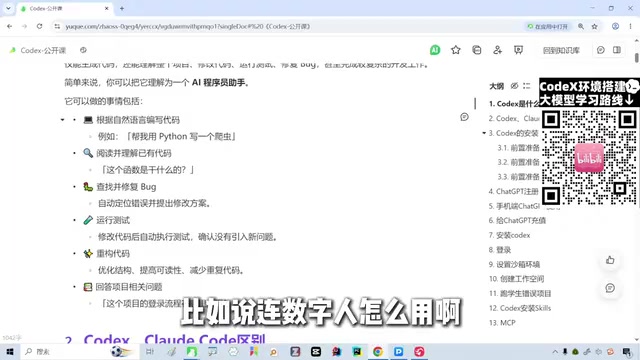
Bilibili tutorial explains Codex installation, Skills, and MCP configuration, compares Claude Code, and offers onboarding advice.
Based on a Bilibili creator's livestream tutorial, this article systematically outlines the core capabilities and onboarding path of OpenAI Codex as an AI coding agent. Codex can execute tasks like writing code, testing, and operations using natural language, usable even by non-technical users, and is positioned as a "productivity replacement." The tutorial compares Codex with Claude Code: the creator subjectively believes Codex generates better quality, but admits it depends on task type; Claude Code faces serious account bans, and connecting Codex to third-party models like DeepSeek is difficult to configure, so pairing directly with GPT is recommended. The article also mentions that some companies require an AI code generation rate of 90% tied to performance, and assessing by lines of code raises fairness concerns. The tutorial covers everything from installation to Skills and MCP calls, aimed at beginners, emphasizing early mastery to stay competitive.
OpenAI's Codex is becoming a focal point among AI coding assistants. In a livestream tutorial on Bilibili, the creator demonstrated the entire process of Codex from zero—environment installation, Skills configuration, and MCP calls—while comparing it with competitors like Claude Code. This article is based on that tutorial, combined with hands-on feedback from developers across multiple platforms, to outline Codex's core capabilities and key onboarding points.
What Is Codex: More Than Just Code Completion
The creator defines Codex as an AI coding assistant launched by OpenAI—essentially an agent tool: users issue instructions in natural language, and it can carry out a series of tasks such as writing code, testing, and operations. This means non-programmers can also use it to complete operations that originally required professional knowledge—the creator mentioned that many non-technical users on Douyin are already using Codex for daily work with good results.
For developers, Codex is positioned more as a "productivity replacement." The creator emphasized that whether it's testing, operations, or writing code, once you're proficient, it can replace a considerable amount of repetitive work. He also revealed that some students reported their companies require an AI code generation rate of over 90%, even tied to performance reviews; some companies assess by lines of generated code, which the creator considers unfair to frontend and backend alike—frontend code volume is naturally larger than backend. According to analyses from multiple YouTube channels and Bilibili creators, such assessment metrics are indeed spreading among domestic tech companies, though specific standards vary widely.
Codex vs Claude Code: Subjective Preference and Objective Limitations
The creator compared Codex with Claude Code. His intuitive feeling is that for the same task, results generated by Codex are better than those from Claude Code, but he admits this is subjective and the situation may have changed. On the Claude Code side, account bans are a serious issue, and many users have turned to pairing it with domestic models like DeepSeekAd; some users have also tried connecting Codex to DeepSeek, but the creator himself failed to configure it successfully after multiple attempts—he looked through many tutorials, and the result was that sometimes it worked and sometimes it didn't, and students frequently encountered the same problem.
Regarding the reasons for configuration failures, the creator speculates that Codex may be identifying and restricting external models, especially guarding against domestic model integration, but this has not been officially confirmed. He explicitly recommends: use Codex with GPT, don't bother with DeepSeek combinations; if you must connect other models, you can try relay stations or solutions like CC4H, but the quality of online tutorials varies greatly. Multi-source information shows that Codex's integration with GPT is deepening; although the official website claims support for other models, the list does not include domestic models other than GPT, which exacerbates the difficulty of integration.
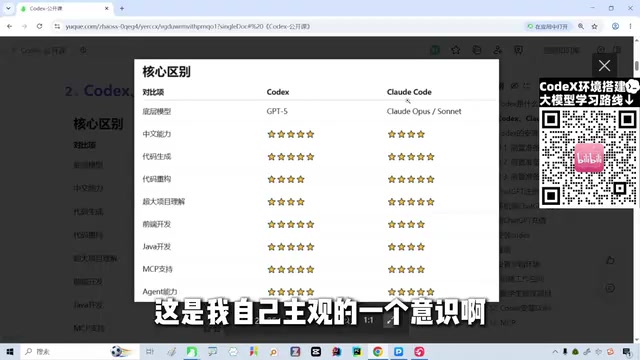
According to cross-verification from multiple independent sources, Codex receives relatively consistent positive evaluations for code generation quality, but the conclusion that it is "better than Claude Code" is highly dependent on specific task types and model versions, and there are also opposite experiences in the community. The creator also admits that his judgment comes from an early stage of use.
Model Context Protocol (MCP) is an open standard proposed by Anthropic in November 2024, aimed at enabling AI applications to connect to external tools, data sources, and services in a unified way. It abstracts the interaction between LLMs and tools into a client-server architecture: AI applications act as hosts, connecting through MCP clients to various MCP servers (such as file systems, databases, API interfaces), thereby expanding the boundaries of capabilities the model can invoke. MCP solves the previous fragmentation problem where each AI tool needed separate adaptation, and is regarded as infrastructure for the AI agent ecosystem. Both Codex and Claude Code support MCP, which is why the tutorial treats it as an advanced segment—after configuring MCP, Codex can read local files, query databases, or call third-party services, expanding from "writing code" to "operating the environment."
From Installation to MCP: The Tutorial's Practical Path
This livestream was aimed at students who had never used Codex, so it started from installation. The creator mentioned that many programmers with eight or nine years of work experience have never even used Claude Code, which is very passive in the current job market—many companies directly ask in interviews whether candidates have used Codex or Claude Code, and those who haven't may be eliminated outright.
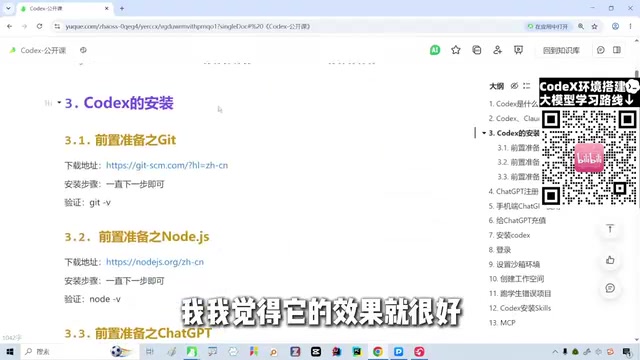
The tutorial covered Skills and MCP calls. Skills can be understood as preset capability modules, while MCP is the Model Context Protocol, which allows Codex to call external tools and data sources. The creator did not elaborate on specific operational details in the text record, but emphasized that this process is crucial for improving daily efficiency. For developers who want to get started, it is recommended to first ensure the Codex and GPT environments are connected, then gradually configure Skills, and finally try MCP to connect external services. As for third-party models like DeepSeek, unless there is a clear need and willingness to bear configuration risks, they need not be the first choice.
Skills, in the context of AI coding assistants, refer to preset, reusable capability modules or instruction sets, usually existing as configuration files or plugins. Unlike MCP, which focuses on connecting external resources, Skills are more about encapsulating specific workflows—for example, "generate unit tests," "perform code review," "refactor according to specifications," etc. After the user invokes them, the AI executes according to preset steps. The value of Skills lies in templating repetitive tasks, reducing prompt overhead in each conversation, and ensuring output consistency. For beginners, Skills are a lower-threshold entry point for getting started with agent tools: no need to understand underlying protocols, just enable or write a skill to gain structured capabilities. The tutorial recommends first connecting the GPT environment, then configuring Skills, and finally integrating MCP, which follows a progressive path from "built-in capabilities" to "external extensions."
Who Should Learn Codex
The creator's judgment is direct: if you haven't yet touched Codex or Claude Code, you are already out of step with current technology trends. AI coding assistants are shifting from "optional tools" to "job requirements," and regardless of frontend or backend, or whether you have a formal CS background, getting familiar with such agent tools early is a realistic choice for maintaining competitiveness.
Related articles
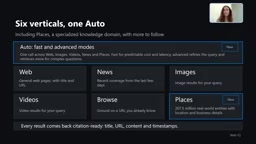
Microsoft WebIQ: Verifiable Real-Time Web Grounding for AI Agents
Microsoft WebIQ gives AI Agents real-time, citable web grounding across web, news, images, videos, and Places—164ms P95 latency, 50% fewer tokens, Scopes source control, and MCP integration.
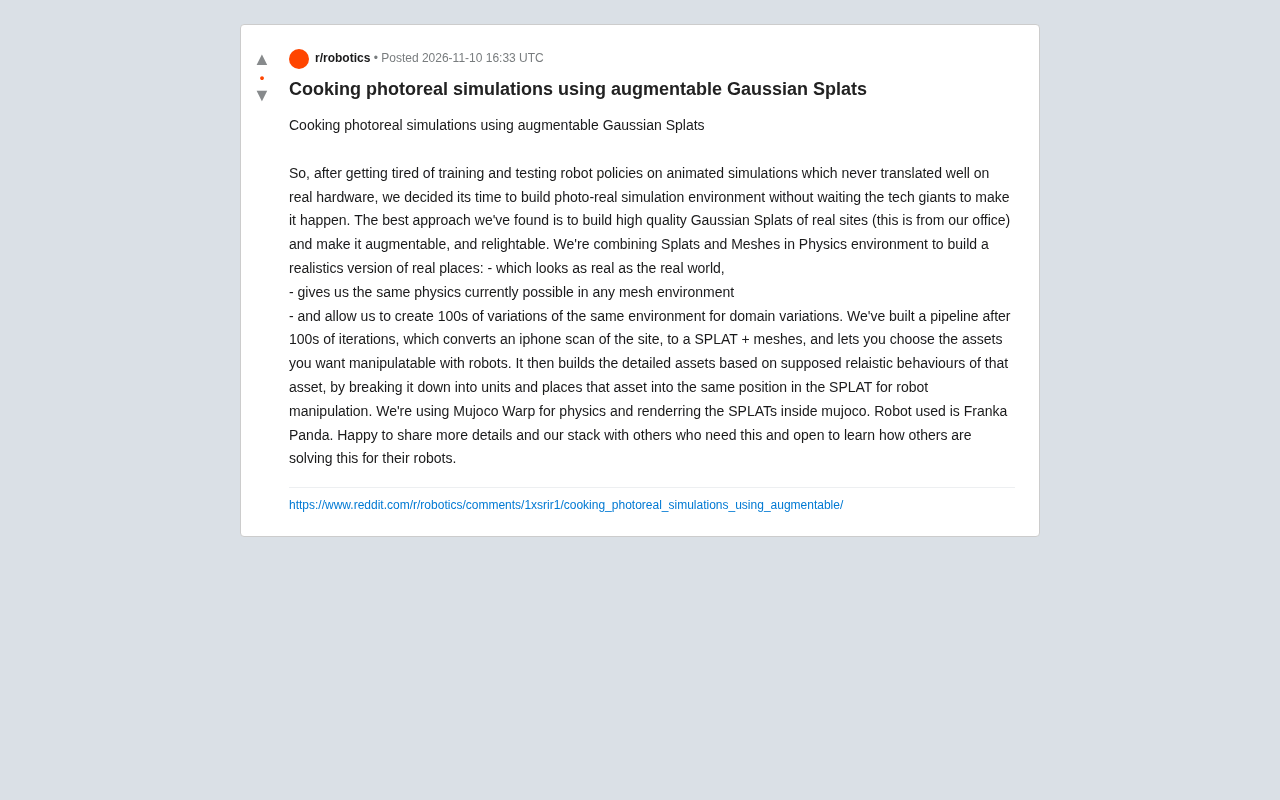
Augmentable Gaussian Splatting: Building Photorealistic Simulation Environments for Robot Training
Team combines Gaussian Splatting with meshes to build photorealistic robot simulation environments, integrating MuJoCo Warp physics and Franka Panda for augmentable, relightable real-site simulation.
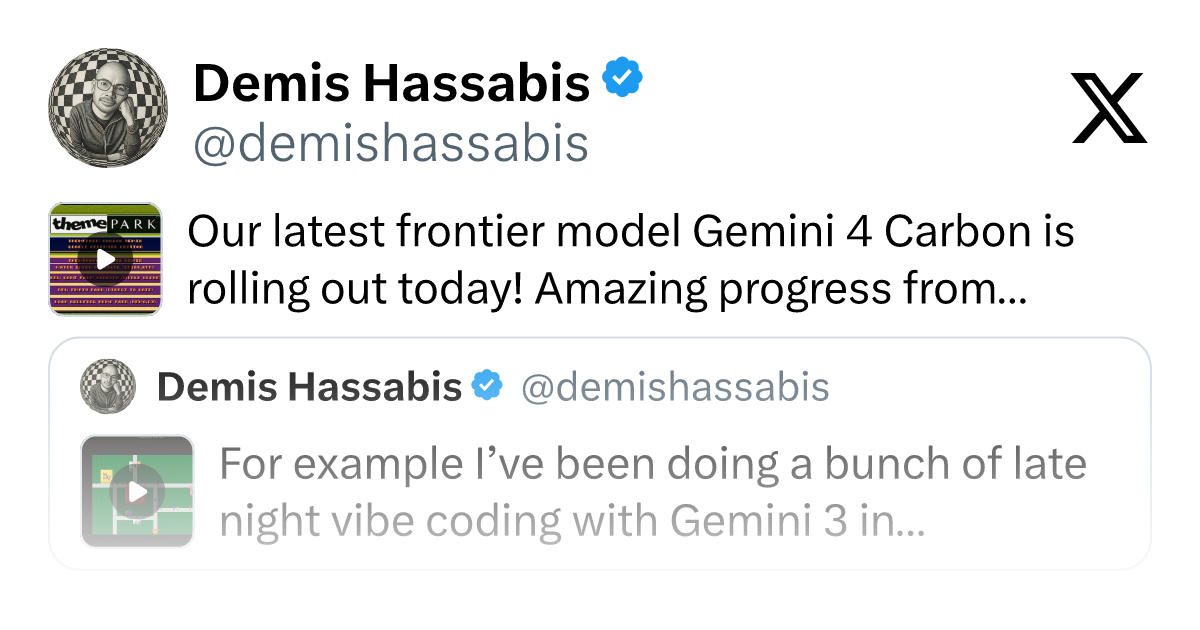
Gemini 4 Carbon Released: The Leap from Gemini 3 to Gemini 4 in Under a Year
Google releases Gemini 4 Carbon, less than a year after Gemini 3. In the official demo, Carbon reverse-engineered the Theme Park binary, added a new DeepMind-themed ride, and ported it to the web in one shot.