Codex in Practice: A Complete Path for Ordinary People to Monetize Side Projects with AI Programming

A practical guide for non-programmers to build and monetize products using AI coding tools like Codex.
This article details how ordinary people can use AI programming tools like Codex to leap from casual AI users to product builders and monetizers. It presents a five-stage AI user model, demonstrates building a product selection assistant and a wrong-answer review app, explains Vibe Coding methodology, and outlines four monetization paths from job efficiency to one-person companies.
From Conversational Models to AI Assistants: A Clear Evolution
Over the past two to three years, AI tools have evolved at a dizzying pace. Looking back at the timeline: ChatGPT burst onto the scene in late 2022, followed by DeepSeekAd capturing massive attention in China, then platforms like Coze, Dify, and n8n for workflows and intelligent agents emerged one after another. Then came Manus and Genspark—AI assistant products that went viral—making people realize for the first time that you could hand over a task and AI would complete it independently.
ChatGPT is built on OpenAI's GPT-3.5/GPT-4 large language models, using Transformer architecture and RLHF (Reinforcement Learning from Human Feedback) for alignment training, enabling the model to respond to user instructions in conversational form. DeepSeek is an open-source large model from the Chinese company DeepSeek, whose DeepSeek-V2 employs an innovative MoE (Mixture of Experts) architecture that dramatically reduces inference costs. While approaching GPT-4-level performance, it slashed API pricing to one-tenth of the industry average—a "value-for-money" approach that triggered a wave of AI application development in China.
Coze, Dify, and n8n represent the "low-code" layer of AI application development. Coze is ByteDance's agent-building platform where users can create AI Bots through drag-and-drop interfaces combining plugins, knowledge bases, and workflows. Dify is an open-source LLM application development framework supporting RAG (Retrieval-Augmented Generation) engines and Agent orchestration. n8n is an open-source workflow automation tool that connects hundreds of third-party service nodes to automate business processes. Their common feature is lowering the development threshold for AI applications, though users still need to understand business logic and process design.
Manus is a general-purpose AI Agent developed by the Chinese team Monica.im. Its core feature is "autonomously planning and executing multi-step tasks given a goal"—such as researching a market, producing comparison reports, or even filling out forms for you. Unlike traditional conversational AI, Agents possess capabilities for task decomposition, tool invocation, memory management, and self-correction. Genspark positions itself as an AI search engine + assistant, capable of deep analysis and content generation on top of search results. These products mark a paradigm shift in AI from "passive response" to "active execution."
What truly broke through to mainstream awareness was the wave of AI programming tools: Codex, Claude Code, and Cursor. Codex here refers specifically to OpenAI's cloud-based AI programming agent (released in 2025), which runs in a cloud sandbox environment and can independently read codebases, write code, run tests, and submit PRs. Claude Code is Anthropic's command-line AI programming tool that runs directly in the terminal, excelling at understanding and refactoring large-scale codebases. Cursor is an AI-native code editor (based on a VS Code fork) with integrated code completion, conversational editing, and multi-file modification capabilities. Their common trend: AI is no longer just a "code completion assistant" but an "AI programmer" capable of independently completing entire programming tasks.
Interestingly, Codex didn't go viral just because it can write code. More and more people are using it to handle everyday tasks large and small—it has quietly evolved from a programming tool into a general-purpose AI assistant.
The author admits to taking many detours during exploration: spending $800 in the first month playing with Manus, half the time fixing bugs and the other half dealing with "AI suddenly losing its memory." By the second month, after figuring things out, costs dropped to $200. This experience leads to a core insight: Don't obsess over any specific tool or model—what you should really care about is what commercial value it can create.
Think Through Three Questions Before Learning AI
Before diving in, three questions deserve serious thought from everyone.
What Problem Do You Want AI to Solve?
This can be summarized into four directions:
- Job efficiency: AI + job scenarios to double productivity
- Side gig freelancing: An additional income source after work
- Career transition: Using AI to facilitate a career change
- Entrepreneurial monetization: Building your own products, becoming a super individual
With clear direction, learning becomes efficient.
What Stage Are You at in AI Application?
This is the most insightful framework in the entire piece. AI users can be divided into five stages:
- Stage 1 — Tasters: Treating AI as a chat tool—searching for answers, writing copy
- Stage 2 — Efficiency Boosters: Using AI to get work done—writing prompts, making spreadsheets, batch-generating images
- Stage 3 — Creators: Using tools to build tools—creating functional web pages, mini-programs, scripts
- Stage 4 — Deliverers: Products that can go live—handling login, payment, bug fixes
- Stage 5 — Monetizers: Products that make money—running a one-person company
Over 95% of people in China are stuck at Stage 2—they can use AI to make PPTs, spreadsheets, and product selection analyses, but that's it. Stage 3 is the turning point, Stage 4 is the dividing line. Because "running doesn't equal delivering"—the real valuable skills are concentrated in Stages 3 through 5. Whether you can make money from learning AI ultimately depends on which stage you've reached.
Case Study 1: Building a Product Selection Assistant in Five Minutes
To prove that ordinary people can leap from Stage 2 to Stage 3, here are two real tool cases developed with Codex.
The first is a product selection assistant for e-commerce. The requirements are clear: set weighted criteria for judging product value (distinguishing blue ocean products from ordinary ones), process 50 product data entries, and export a selection spreadsheet.
The workflow is quite straightforward: create a project folder named "Product Selection Assistant" in Codex, input the requirements description, and click run. The AI writes code automatically in the background—no manual coding needed—and it's done in about five minutes.
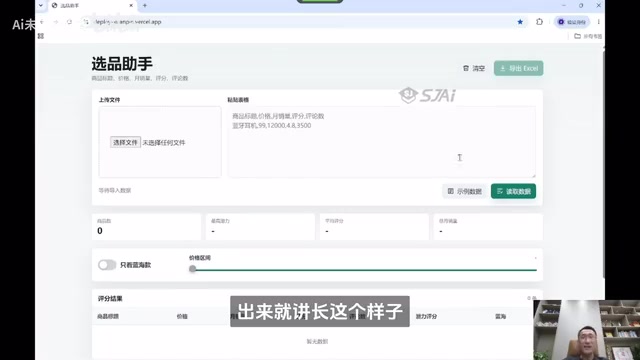
The finished product is remarkably complete: after importing 50 data entries, it automatically categorizes them, displays dimensions like price, monthly sales, rating, review count, and potential score, and supports one-click filtering of blue ocean data and Excel export. If someone were to hand-write these nearly thousand lines of code, how long would it take? AI did it in just a few minutes.
Codex Versions and Model Selection Advice
Regarding tool versions, Codex commonly offers three tiers:
- Plus: About $20/month, sufficient for getting started
- 5X: About $100/month, suitable for moderate use
- 20X: About $200/month, suitable for heavy development
For those who can't handle environment configuration, connecting directly via API or a relay service gets you started without even paying monthly subscriptions. An API (Application Programming Interface) is a standard protocol for software-to-software communication; in the AI context, it means sending requests directly to model providers and paying based on actual token usage without a monthly subscription. "Relay services" are a concept unique to China, where third-party providers bulk-purchase overseas API quotas and resell them to domestic users, solving payment channel and network access issues.
Don't suffer from "model anxiety"—models serve the thing you're trying to build. As long as the thing has value, any model is worth using. But note: for highly confidential content (such as state-owned enterprise or large corporation confidential contracts), don't use relay service APIs, because your request data passes through third-party servers, creating potential data leak risks.
Case Study 2: Building a Wrong-Answer Review Mini-Program in a Day and a Half
The second case is more specific and even more compelling—building a wrong-answer review assistant mini-program for a child in their first year of middle school.
Requirements Start from Real Pain Points
The child's wrong answers are scattered across test papers from different subjects—hard to collect, hard to categorize, and requiring variation practice (just redoing the original problem equals memorizing answers). First, AI was asked to research whether existing products on the market could meet the need. The conclusion: no standalone product adequately addresses it. So development began directly.
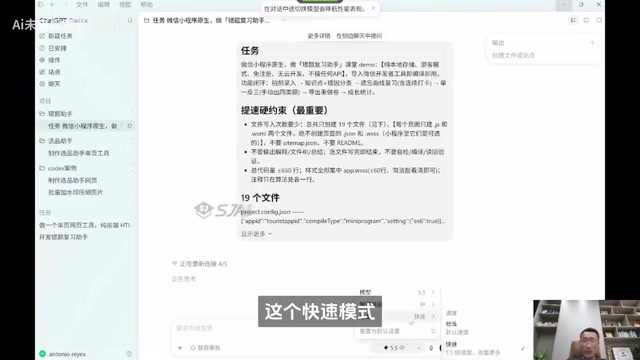
The finished product includes five modules:
- Photo Input: Snap a photo with your phone to capture wrong answers
- Variation Practice: AI generates similar variant problems to avoid rote memorization
- Forgetting Curve Review: Reviews following a rhythm of "1 day, 3 days, 5 days, 7 days, 1 month"—five review cycles total
- Due Date Reminders: Automatic push notifications for review
- Wrong Answer Printing: Convenient for offline practice
The "Forgetting Curve Review" module's design is based on the forgetting curve theory proposed by German psychologist Hermann Ebbinghaus in 1885: human memory decays rapidly over time, with approximately 74% forgotten after just one day. The "Spaced Repetition" learning method developed from this theory schedules reviews precisely when memory is about to fade, achieving long-term retention with minimal review sessions. This is consistent with the underlying algorithm logic of memory card software like Anki and has been confirmed effective by extensive cognitive science research.
Children can view answers, use AI to explain (supporting both text and photo input), and mark problems as "got it" to move to the next one. Parent mode shows the knowledge point distribution of all high-frequency wrong answers, enabling learning supervision.
From Tool to Side Business Potential
This mini-program has been in actual use for a month. The key question: Can this thing make money? If each user pays 10 yuan per month, 100 users means 1,000 yuan—recurring monthly.
There's another real case: a stay-at-home mom built a "children's height and weight calculator" mini-program, shared it in mom groups, accumulated 300 users, charged 5 yuan each, and a side business opportunity was born. This demonstrates that small tools solving real pain points inherently possess monetization potential.
The Essence of AI Programming: Vibe Coding and Product Thinking
We should drop the word "programming" because it misleads too many people into thinking it's some unreachable technical skill. A more accurate description is "Vibe Coding."
This concept was first coined by OpenAI co-founder Andrej Karpathy in February 2025. He described an entirely new way of programming: "You fully immerse yourself in the vibes, embrace exponential growth, and forget that code exists." The core meaning: developers no longer write and review code line by line, but describe their intent in natural language, let AI generate the code, and when errors appear, throw the error messages back to AI for fixing. This approach fundamentally blurs the boundary between "programmers" and "non-programmers."
The Fundamental Difference Between Traditional Development and AI Programming
| Dimension | Traditional Development | AI Programming |
|---|---|---|
| Learning Threshold | Learn languages, learn frameworks—months to get started | Describe requirements and go |
| Coding Method | Type code line by line | AI writes hundreds of lines in minutes |
| Error Handling | Search documentation and references | Send directly to AI for fixing |
| Core Competency | Programming engineering skills | Requirements decomposition and product thinking |
The head of DingTalk once proposed a viewpoint: in the future there won't be "software engineers," only "agent engineers." In the AI era, you're no longer a worker laying bricks one by one, but a "general contractor" directing AI to do the work—you only need to specify what you want. This is especially good news for liberal arts graduates—what matters isn't whether you can write code, but whether you can develop product thinking and direct AI effectively.
Four Monetization Paths: The Office Software of the AI Era
A core judgment: AI programming (Vibe Coding) is the office software of the AI era. Just as not knowing Office once meant you couldn't find a job, in the future, not being able to build products with AI will diminish your competitive edge.
Two internal practice cases validate this judgment:
- Developed a "Performance Review Assistant" in two days and listed it on WeCom (Enterprise WeChat), replacing a third-party performance evaluation system that cost 50,000 yuan annually to renew
- Used AI scripts to replace the work of 10 interns (30,000 yuan/month) who were manually writing student evaluations
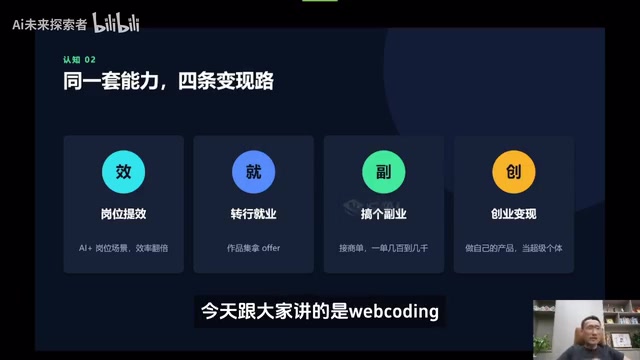
Based on the same skill set, here are four monetization paths:
Path 1: Job Efficiency
Make your position more valuable and layoff-proof. HR professionals or e-commerce operators who can develop tools have a clear advantage—even a hard currency—in the job market.
Path 2: Career Transition
Build full-stack portfolio pieces—web pages, mini-programs, apps—upload them to GitHub, and target junior developer positions for job offers.
Path 3: Side Gig Freelancing
Take orders on platforms like Xianyu (Idle Fish) or Taobao. A corporate showcase mini-program goes for about 2,000-8,000 yuan each; script automation ranges from a few hundred to several thousand yuan. Low barrier, solid returns.
Path 4: Entrepreneurial Monetization
Become a super individual or one-person company, using AI to handle the entire process from lead generation to product development to promotion. A super individual refers to someone who leverages technology to accomplish what traditionally required an entire team. In the AI era, this model has become unprecedentedly viable: one person can use AI to handle product design, front-end and back-end development, content creation, customer service, data analysis, and more. Typical one-person company business models include SaaS micro-products (monthly subscriptions), paid tools (one-time purchases), and automated services (per-use fees). Numerous global cases have proven that a single person armed with an AI tool chain can operate products generating hundreds of thousands or even millions of dollars in annual revenue.
Every era redefines "who is more valuable": landlords and craftsmen in the agricultural era, engineers and technicians in the industrial era, programmers and product managers in the internet era. The keywords for the AI era are AI Native, Prompt Engineer, Context Engineer, Builder, and Super Individual. And the pace keeps accelerating—the agricultural era lasted thousands of years, the industrial era two hundred years, the internet era thirty years, and changes in the AI era are measured in weeks.
Conclusion: Running Doesn't Equal Delivering
The most valuable part of this sharing isn't teaching you how to click buttons in Codex, but clearly pointing out: The biggest misconception in learning AI is obsessing over the tools themselves—the real watershed is whether you can use AI to produce commercially valuable results.
The demos shown are still some distance from truly deployable, money-making products—Stages 4 and 5 still require mastering deployment, security, authentication and payment, customer acquisition, and monetization.
But regardless, the leap from "knowing how to chat with AI" to "building real products with AI" is far easier than most people imagine. For the 95% of people in China still stuck at Stage 2, this may be the most worthwhile step to take.
Related articles

Uber Deploys ChatGPT Work Company-Wide: AI in the Workplace Enters the Scaled Implementation Phase
Uber deploys ChatGPT Work to 30,000+ employees, extending it from engineering to all roles. We analyze its expert-engineer pairing, end-to-end automation, and questions of AI control and power concentration—insights for scaling AI in the workplace.

Shift at Midnight Hands-On: When "ID Verification" Becomes Alien Hunting
Shift at Midnight blends ID verification with horror survival in a four-player co-op game. We break down its inspection mechanics and chaotic humor.

Zelensky Recounts the Outbreak of War: I Need Ammunition, Not a Ride
Zelensky recalls the first day of war in a YouTube interview: farewell to family, rejecting Biden's evacuation offer with "I need ammunition, not a ride," and how Bucha shaped his stance on compromise and peace talks.