Codex vs Claude Code: A Complete Workflow and Selection Guide for AI Coding Agents

Hands-on comparison of Codex vs Claude Code, with selection logic and a full workflow to get started.
Based on a Bilibili creator's 13-part practical series, the article compares Codex and Claude Code. It clarifies that these are agent tools rather than LLMs, and that evaluation should cover toolchain and ecosystem. The creator finds Codex superior for its Chinese understanding, requirements analysis, MCP ecosystem, and app. The article stresses choosing "tool + model" together, with DeepSeek as a budget option. The core method is handing errors to the agent to form a read-locate-fix-verify loop. Conclusion: the barrier is low enough for non-programmers—install both and try them yourself.
Codex vs Claude Code: A Complete Workflow and Selection Guide for AI Coding Agents
AI coding tools are evolving from "chat assistants" into "agents that can actually do the work." In a 13-part full-workflow practical series on Bilibili, one creator put Codex and Claude Code side by side for comparison and reached a fairly clear personal conclusion: Codex is the better one right now. Drawing on the video's content, this article breaks down the fundamental differences between these tools, the logic behind choosing between them, and the complete path to getting started—from building a site to working with MCP.
Agent Tools Aren't LLMs—They're "Brains Fitted with Hands and Feet"
The creator opens by correcting a common misunderstanding: things like Codex and Claude Code should properly be called "AI agent tools," not simply LLMs.
He uses a very straightforward analogy—an LLM is like a brain: it can think, but it won't do things for you. Tools like Codex, Claude Code, and Cursor are what give that brain hands, feet, and tools. When you chat with a model in a dialog box, that's the "brain" at work; when you have a tool read code, modify files, or run commands, that's the "agent" doing the work.
This distinction isn't just wordplay. It determines the dimensions by which you evaluate a tool: you can't just look at model benchmark scores—you also need to look at whether the toolchain is complete, whether task orchestration runs smoothly, and whether the ecosystem (MCP, for instance) keeps pace.
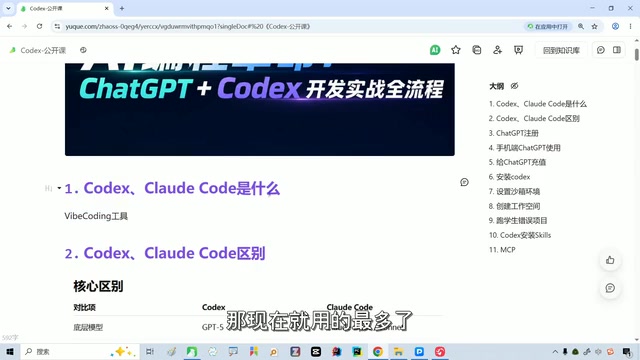
MCP (Model Context Protocol) is an open protocol proposed by Anthropic at the end of 2024, intended to define a standardized "tool interface" for LLMs. Before MCP, every time you wanted a model to connect to a new service (a database, a Git repository, a cloud platform API), developers had to write their own glue code; MCP abstracts "how a model discovers tools, invokes tools, and receives results" into a unified specification, so any client supporting the protocol can directly reuse existing MCP Servers. For coding agents, this means the capability boundary is no longer determined by how many features a tool vendor builds in, but by how many pluggable Servers exist in the ecosystem—this is also the technical foundation for why the MCP ecosystem is cited later as one of the reasons Codex wins.
Why Only Compare Codex and Claude Code
There are quite a few agentic coding tools on the market, but the creator picked only these two for comparison, for a straightforward reason: these two are currently the most widely used first-tier products in programmer circles.
He also specifically stresses that these tools aren't exclusive to programmers. Whether or not you can write Java, whether or not you can type Python, whether or not you understand LLM-related code—none of that affects your ability to get started. "Everyone needs to know how to use this" is his judgment. Even if you don't write code for now, having a ChatGPT-like tool for everyday research is worth it.
On the gap between domestic and foreign models, his view is fairly measured: some foreign models are indeed slightly ahead right now, but that gap will be closed sooner or later, and when that happens, the logic for choosing tools will become "use whichever is cheaper." This judgment can serve as a long-term reference, but in the short term, the advantages of first-tier products still hold.
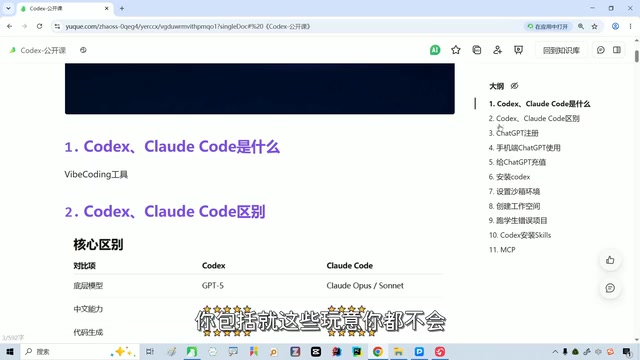
Three Reasons Codex Wins: Chinese Understanding, Requirements Analysis, and MCP Ecosystem
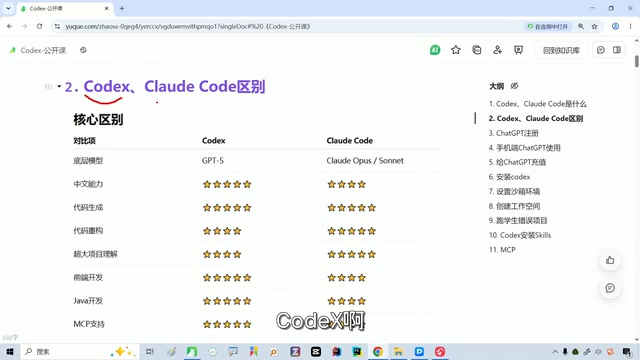
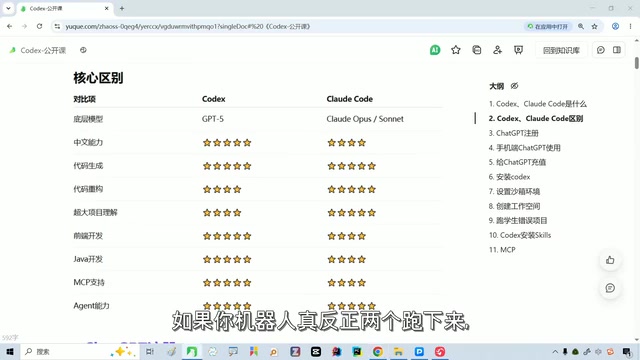
The creator has Codex, Claude Code, and Cursor installed on his own machine, and after actually running them, he cast his vote for Codex. Several points support this conclusion:
Better Chinese understanding. The model he runs under Codex is GPT-5.5, which has a noticeably better grasp of Chinese-language context—crucial for translating the requirements of Chinese-speaking users.
Stronger requirements analysis. Breaking down requirements before writing code—how well this step is done directly determines how much rework comes later. He believes Codex performs more strongly here.
Full-stack front-end and back-end capability plus MCP ecosystem. Codex is backed by OpenAI, which invests heavily, and the MCP ecosystem is developing quickly—meaning the external capabilities the tool can connect to will only grow.
One more very practical point: Codex has an app, and he operates it through the app day to day—how smooth the experience feels affects willingness to use it long term.
The Realistic Choice of Model Pairing: Balancing Cost and Results
An agent tool itself is just a shell; what actually does the work is the model behind it. Here there's an unavoidable real-world issue—cost.
Claude Code corresponds to the Claude model, which performs well but costs more. Many people (including the creator himself) choose to pair it with DeepSeekAd models to keep costs down—usable, but frankly the experience still isn't as good as foreign models. His current approach is Codex paired with GPT, finding a balance between results and cost that satisfies him.
This lesson is worth noting: tool selection is really a combined selection of "tool + model", and it's not very meaningful to discuss whether a tool is good in isolation from the model. If budget is tight, switch models; if you're chasing results, use a top-tier model—the tool itself is actually the relatively stable layer.
The cost structure of agents differs from chat. Chat-style use is typically one question, one answer, with limited token consumption; whereas an agent repeatedly reads files, executes commands, and feeds errors and code snippets back to the model—a single task may generate dozens of rounds of calls, and input token volume is often several times the output. This is exactly why "the tool shell is cheap but the model is expensive," and it explains why the same tool paired with different models can produce bills differing by an order of magnitude. Common ways to cut costs include: routing simple tasks to cheaper models, stuffing only relevant file snippets into context rather than the entire repository, and summarizing and compressing long conversations.
From Building a Site to MCP: The Practical Path of the 13-Part Full Workflow
The "13-part AI coding full workflow" in the video's title covers the complete chain from building a site to MCP, and the core method is throwing errors directly at Codex.
The logic behind this approach: the value of an agent tool isn't in getting it right the first time, but in being able to understand error messages, locate the problem, modify the code itself, and then verify. In traditional development, reading errors, checking documentation, and fixing code is a time-consuming manual loop; hand it to an agent and that loop gets compressed.
The multi-tasking and project practice section tests the tool's task orchestration capability—advancing multiple modifications simultaneously and maintaining consistency within the project context—things "chat-style programming" can't do. The MCP section corresponds to extending the toolchain: connecting to external services through the protocol so the agent can invoke more resources rather than staying confined to the editor.
The creator's advice is very plain: install both tools, run them yourself, and you'll feel the differences in user experience once you've done so. When it comes to choosing, trying it yourself beats listening to others.
The reason "throwing errors directly at the agent" works depends on its closed-loop capability: reading terminal output, locating the file where the error occurred, retrieving related code, generating a patch, and then executing the command once more to verify. In traditional development this loop is done manually, and the most time-consuming part isn't fixing the code but understanding the error and retrieving context. Note that whether the loop can run depends on whether the tool has three permissions—file read/write, command execution, and result read-back. Missing any one of them, and the agent degrades into a chat assistant that can only "suggest" but not "verify"—which is also a more practical dimension for evaluating such tools than model benchmark scores.
Conclusion
The comparison between Codex and Claude Code is essentially a contest between the first tier of two technological paths. Codex currently holds the advantage in Chinese understanding, requirements analysis, and the MCP ecosystem, while Claude Code needs model pairing to control costs. For non-programmers, the barrier to these agent tools has already dropped to the point where "everyone needs to know how to use this"; for programmers, the real dividing line isn't whether you can write code, but whether you can correctly hand errors, requirements, and multi-tasking over to the agent to handle.
One-line Summary
A hands-on comparison of Codex and Claude Code, with selection logic and a full workflow to get started.
Paragraph Summary
Based on a 13-part practical series from a Bilibili creator, this article compares the two AI coding agents Codex and Claude Code. The author first clarifies the concept: these products aren't LLMs themselves but agent tools that "fit the model with hands and feet," and evaluation should include toolchain completeness and ecosystem. After hands-on testing, the creator finds Codex superior, citing better Chinese understanding, stronger requirements analysis, a fast-growing MCP ecosystem, and an app. The article also stresses that "tool + model" should be chosen as a combination—when budget is tight, DeepSeek can cut costs but with a degraded experience. The core practical method is handing errors directly to the agent, forming a closed loop of reading errors, locating issues, fixing code, and verifying. The conclusion: the barrier is now low enough for non-programmers to use these tools, and you should install both and run them yourself before deciding.
Related articles

A 19-Year-Old's Rental Horror Story: Ceiling Collapse, Bug Infestation, and the Lessons It Taught Me
At 19, my first off-campus rental brought bug infestations, no heat, a collapsed ceiling, and a ruined laptop with no renter's insurance. Here are the hard-won lessons for first-time student renters.

Veda Nurse's Cranial Nerve Exam: Why ASMR Role-Play Is Going Viral
Bilibili creator Veda's cranial nerve exam ASMR video goes viral, blending humor and sensory triggers through nurse role-play. This article analyzes its unique appeal and the audience psychology behind ASMR role-play.

LG Cinebeam AI Review: 120-Inch Giant Screen + 3000 Lumens, a New Choice for the Living Room Theater
LG Cinebeam AI projector review: 3000 ANSI lumens, 4K, 100 inches from about 8 cm and 120 inches from about 18 cm. Built-in webOS, AI Concierge voice recommendations, AI Sound Pro 11.1.2 virtual surround, and Game Optimizer—positioned for fixed living room installation, complementing the portable Cinebeam S.