Cognitive Reward Profiles: How the Sport You Play Shapes Your Professional Mindset
The reward structure of your sport quietly trains your risk intuition — choosing wisely could be a career advantage.
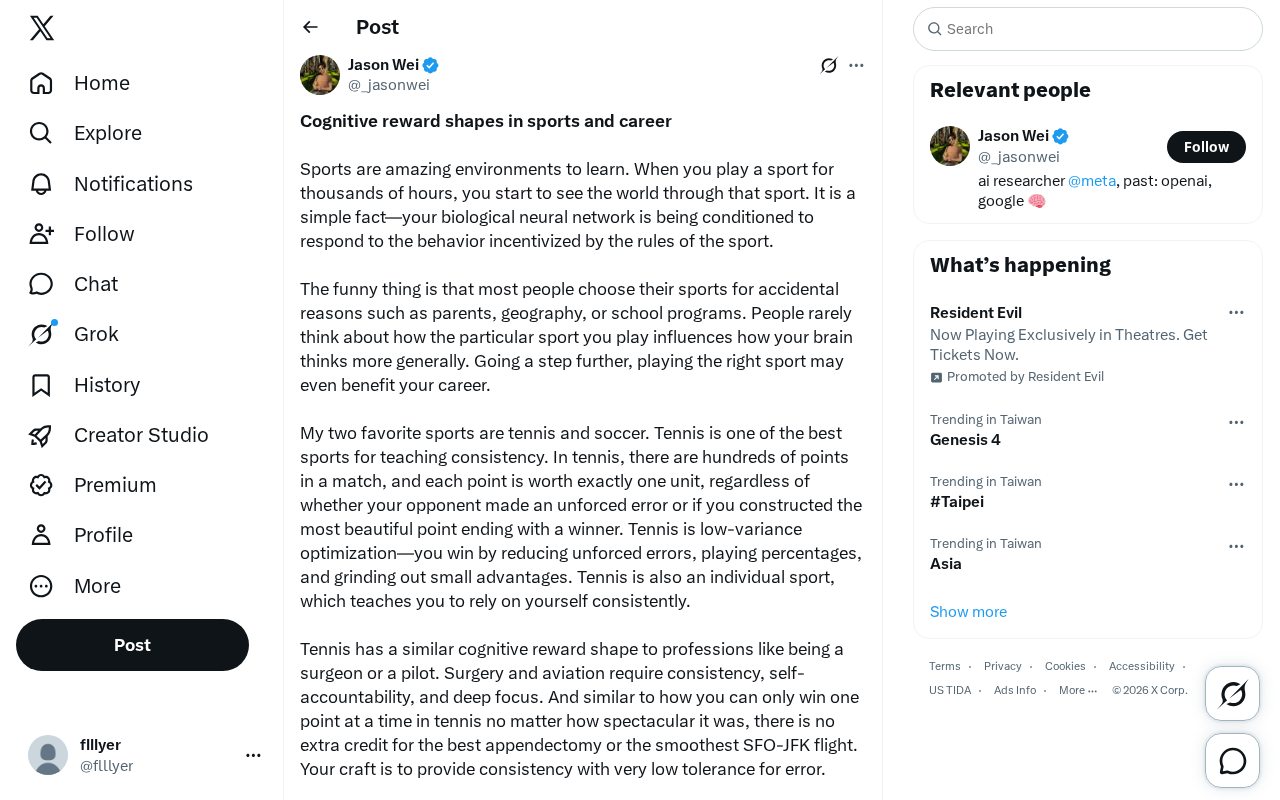
The article argues that long-term participation in a sport conditions your neural network through its built-in reward-and-punishment rules, shaping your instinctive judgments about risk, failure, and return. Tennis, built on low-variance optimization, aligns closely with careers like surgery and aviation that demand extreme consistency and low error tolerance — but conflicts with the entrepreneurial mindset of embracing failure and betting on asymmetric outcomes. Soccer strikers, whose experience is defined by constant failure punctuated by a few decisive moments, map much more naturally onto startup thinking. The core thesis: when your sport's cognitive reward profile aligns with your career's success logic, meaningful transfer value follows — a dimension most people never consider when choosing a sport.
Sports Are an Underrated Cognitive Training Ground
After thousands of hours in a sport, you gradually start seeing the world through its lens. This isn't mysticism — your biological neural network is being shaped and conditioned by the behavioral patterns that sport's rules incentivize. Athletes repeatedly respond to specific win-loss structures, and over time, those response patterns become internalized as broader thinking habits.
What's interesting is that most people choose a sport almost by accident: a parent's decision, a regional tradition, or whatever happened to be offered at school. Few people seriously consider how the sport they practice might shape their brain's thinking patterns over the long run. Push that logic one step further, and choosing the right sport might actually have a meaningful impact on your career development.
Tennis: The Low-Variance Optimization Mindset
Tennis is one of the best sports for training consistency. A match involves hundreds of points, each one worth exactly the same — whether a point comes from an opponent's unforced error or from a brilliantly executed winner, it counts for exactly one point.
This means tennis is fundamentally about low-variance optimization: you win by reducing unforced errors, playing the percentages, and grinding out tiny advantages. It's also an individual sport, which teaches you to rely on yourself continuously, no matter what.
This cognitive reward profile closely mirrors careers like surgery or aviation. Both demand extreme consistency, a strong sense of personal accountability, and deep focus. Just as a spectacular point in tennis still only counts as one point, performing the best appendectomy in the hospital earns no bonus credit, and flying the smoothest San Francisco-to-New York route doesn't come with extra rewards. The core of your craft is delivering stable, reliable performance under extremely low margins for error.
Low-variance optimization is a concept from probability theory and decision theory that refers to preferring strategies with lower result volatility and greater predictability, when expected outcomes are similar. In the context of tennis, this means professional players earn roughly 60–70% of their points from opponent unforced errors rather than from their own winners — a statistic that has held consistently across ATP/WTA tour data. As a result, top players' core strategy is not to push every shot to its limit, but to minimize their own error rate while applying sustained pressure that forces opponents to make mistakes. At the cognitive level, this builds a powerful "loss-avoidance first" intuition: rather than risking a risky passing shot, play a safer ball deep to the middle. Long-term training wires the brain to become instinctively wary of high-risk, high-reward options — even when you rationally know the odds aren't bad, your body and judgment will default toward the conservative choice.
Why a Tennis Mindset Doesn't Translate Well to Entrepreneurship
The transferability of a tennis mindset to entrepreneurship is relatively limited. Startups are a high-variance, team-based game that tolerates failure, where occasional creative breakthroughs earn exponential rewards.
Working furiously to eliminate unforced errors in tennis, versus deciding whether to make a "moonshot" bet that will likely fail but could return a billion dollars if it succeeds — these require completely different modes of thinking. This isn't to say tennis players can't become great entrepreneurs, but the underlying cognitive reward structures are fundamentally different.
The Soccer Striker: Embracing Failure and Asymmetric Returns
By contrast, a soccer striker's reward profile maps much more closely to entrepreneurship. What a striker learns at the core is to generate a large number of small opportunities.
The reality is that for the vast majority of any match, you're not scoring — even in Mbappé's best games, most of his touches ultimately convert into nothing. But what matters is that if you create enough chances and convert one or two of them, you win the game.
Break down a 90-minute match from a striker's perspective: nearly all of it is failure or noise, only a few minutes carry real leverage, and the moments that ultimately decide the match often span just a few seconds. Being immersed long-term in a structure where "failure is the default and a handful of moments determine everything" trains a person to accept failure calmly and grow comfortable with asymmetric returns — which happens to be exactly the psychological profile that entrepreneurship demands most.
Goal conversion rate data for soccer strikers provides quantitative support for this "failure as default" intuition. Top strikers average roughly 30–50 touches per game, with typically 2–4 shots, and an expected goals (xG) value that often falls below 1. Even the world's elite finishers rarely exceed a 20% shot conversion rate over a full season. This means a striker's "attempts" result in failure more than 80% of the time — and they're still considered to have executed their role successfully. This stands in direct opposition to the default psychological tendency of loss aversion: most people feel the pain of a loss roughly twice as intensely as the pleasure of an equivalent gain (Kahneman and Tversky's Prospect Theory). In a sense, striker training is a systematic correction of this cognitive bias.
Choosing the Right Sport Means Training Your Risk Intuition
The core argument is this: when the cognitive reward profile of the sport you practice aligns with the reward profile of your career, the result can be substantial.
There's obviously some selective reasoning here for the sake of illustration. Entrepreneurship also requires consistency and error avoidance; a soccer goalkeeper's reward profile is entirely different from a striker's — one mistake can cost the entire match, which actually looks more like tennis's low-tolerance-for-error logic.
But the main argument holds: if sports genuinely shape how we perceive risk, effort, and reward, then we should be more deliberate about which sports we choose. Sports aren't just recreation or fitness — they're quietly feeding your neural network a particular kind of "training data." Understanding this might let you make more intentional choices, whether for your children or for yourself.
Cognitive transfer is a term from educational psychology describing how a thinking pattern learned in one context extends to another. Research shows that transfer is strongest when two domains share high similarity in their "deep structure" — meaning their reward-and-punishment logic, feedback mechanisms, and decision-making rhythms — rather than in surface-level content. This explains why the analogies here center on "reward profiles" as the key dimension, rather than physical demands or team dynamics.
It's worth noting that this transfer doesn't happen automatically. A large body of research also shows that unreflective repetitive experience tends only to sharpen domain-specific intuitions without generalizing. The people who actually extract transfer value are typically those who consciously map their sports experiences onto the logic of professional decisions.
Final Thoughts
The "cognitive reward profile" framework offers an intriguing lens for examining the hidden connections between personal experience and professional fit. At its core, it's a form of analogical reasoning: mapping the incentive structure of a sport's rules onto the success logic of different careers.
While the author acknowledges some selective use of examples, the value of this framework lies in reminding us that the activities we invest serious time in will quietly reshape our instinctive judgments about risk and reward. That's a perspective worth sitting with — whether you're thinking about self-awareness, career planning, or building a team.
Related articles

OpenCode Complete Guide: Installation, Configuration & Practical Usage
A complete guide to OpenCode, an open-source AI coding tool: desktop and WSL installation, model and rule configuration, agent types, custom commands, MCP integration, and Agent SQL reuse.
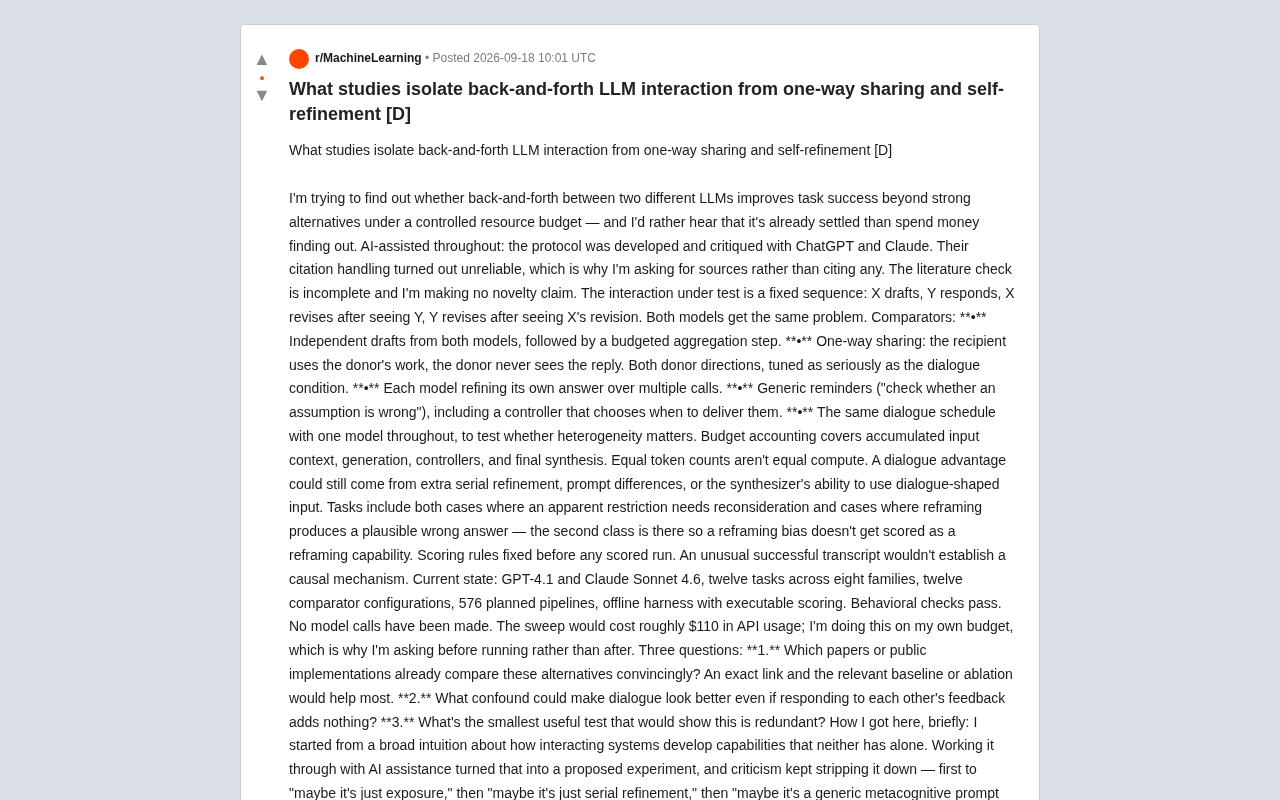
Can Multi-LLM Dialogue Really Improve Task Performance? Lessons from a Rigorous Experimental Design
A researcher designed rigorous controlled experiments to isolate whether multi-LLM back-and-forth dialogue genuinely outperforms simpler baselines like self-refinement and one-way sharing.

Which $10 AI Coding Plan Should You Choose? Go vs. Code Credit Breakdown
After DeepSeek's price hike, should you pick Go or Code for your $10 AI coding plan? We break down credit allocations for Mimo, Qwen, DeepSeek V4, Kimi, and more.