Cohere and Upstage Forge Strategic Partnership: South Korea's Sovereign AI Goes Global
Cohere's partnership with Upstage reveals sovereign AI shifting toward global capability plus local delivery.
Cohere announced a strategic partnership with South Korean AI company Upstage, calling it Korea's sovereign AI champion. The two only announced intent to cooperate, without disclosing specific scope or financial terms. The article analyzes that Upstage focuses on Korean language understanding, document parsing, and local compliance, meeting data sovereignty requirements of Korean public institutions and large enterprises, but has weaknesses in underlying models and engineering. Cohere excels in private deployment, data isolation, and RAG, and can enter the Korean enterprise market through the partnership without building a local team. This combination reflects sovereign AI shifting from complete self-development to a partnership paradigm of global model capability plus local compliance delivery, with South Korea potentially becoming a model for sovereign AI commercialization in small and medium language markets.
An Underrated AI Geopolitical Partnership
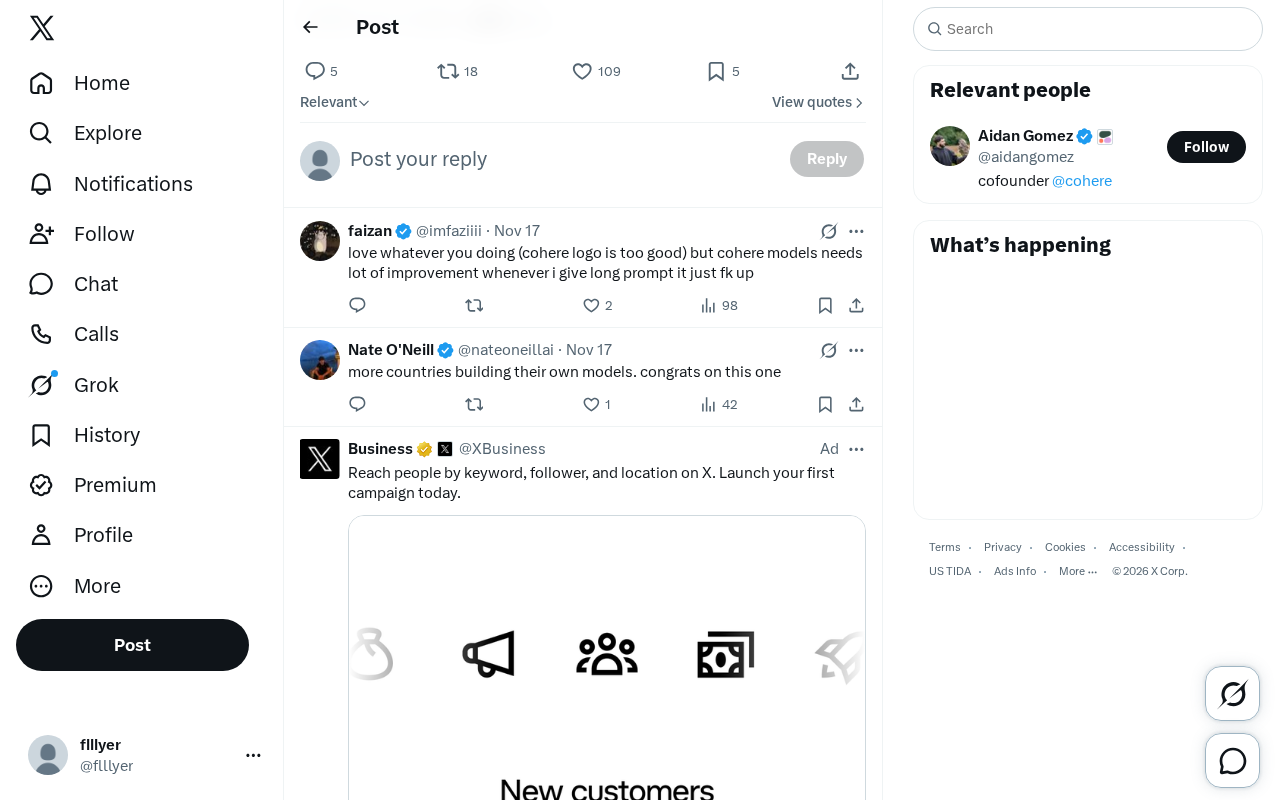
Cohere announced on Twitter a strategic partnership with South Korean AI company Upstage, calling the latter "Korea's sovereign AI champion." This terse tweet conceals a signal worth noting in the enterprise AI market: regional sovereign AI is seeking a springboard for globalized technology and channels.
Upstage is one of the few South Korean companies focused on large models and document AI, positioning itself around "Korean sovereign AI" — serving Korean enterprises and the public sector with local language, local data, and local compliance capabilities. Cohere, meanwhile, represents North American enterprise-grade large models, emphasizing private deployment, data sovereignty, and RAG retrieval augmentation. Their handshake is essentially a complementarity of capabilities between "sovereign AI" and "enterprise AI infrastructure."
It should be noted that the two parties have only announced an intent to cooperate, without disclosing specific scope, financial terms, or product plans. The following analysis is based on the companies' existing public positioning and product roadmaps, and is inferential in nature.
Why Upstage: The Real Demand for Sovereign AI
The term "sovereign AI" has appeared frequently in national policy documents over the past two years, with core demands being: controllable models, data that does not leave the country, and language and culture adapted to local contexts. The Korean market is particularly sensitive to this — Korean has limited representation in mainstream large model training, and enterprise scenarios (legal, financial, public documents) demand high language precision.
Upstage's product line sits exactly at this position: its document parsing and OCR capabilities are optimized for complex layouts, while its large models emphasize Korean comprehension. For Korean public institutions and large enterprises, such local players are easier to pass compliance reviews than general international models, and easier to explain data flows.
But local players have an inherent weakness: underlying model capabilities, inference infrastructure, and global delivery experience often lag behind top North American vendors. This is precisely Cohere's entry point.
Sovereign AI is a concept frequently used in national policy and industry circles in recent years, first publicly emphasized by NVIDIA CEO Jensen Huang around 2023. It refers to a country or region's controllable authority and dominance over its own AI capabilities — including computing infrastructure, training data, model weights, and deployment environments. Its core demands can be broken down into three layers: first, data sovereignty, meaning training and inference data do not cross borders and comply with local privacy regulations (such as EU GDPR, Korea PIPA); second, language and cultural adaptation, meaning models can accurately understand local languages, legal terminology, and cultural contexts; third, supply chain controllability, meaning AI service capabilities are not lost due to external vendor cutoffs or policy changes. Sovereign AI is not equivalent to complete self-development; in practice, countries generally allow reliance on international vendors for underlying technology while maintaining local control over data, compliance, and delivery. This also explains why regional AI companies often adopt a hybrid route of "global models + local compliance."
Cohere's Calculation: Entering the Korean Enterprise Market by Proxy
Cohere's differentiation in the enterprise AI market has always been clear: it does not pursue consumer-side visibility but focuses on private deployment, data isolation, and retrieval-augmented generation. Its customer profile is typically enterprises that need to integrate large models into internal knowledge bases but are unwilling to hand data to public clouds.
This positioning is persuasive in European and American markets, but when entering the Korean market, language and local service capabilities are hard thresholds. By partnering with Upstage, Cohere can reach Korean public sector and large enterprise customers without building a local team and Korean corpus system from scratch; Upstage gains stronger underlying models and engineering capabilities.
This combination of "global model capability + local sovereign narrative" is becoming a common partnership paradigm for regional AI companies. Similar logic can be seen in European, Middle Eastern, and Southeast Asian markets — local vendors handle compliance and delivery, while global vendors provide underlying capabilities.
Retrieval-Augmented Generation (RAG) is a technical architecture that combines external knowledge retrieval with large model generation: the system first retrieves fragments relevant to the question from an enterprise's document library, knowledge base, or database, then injects these fragments as context into the large model, which generates answers based on the retrieved real content. Compared to relying solely on memory in model parameters, RAG can significantly reduce hallucinations, support real-time knowledge updates, and allow enterprises to access private data without fine-tuning models. Cohere has long positioned RAG as a core selling point of its enterprise products, with its Embed and Rerank interfaces specifically designed to improve retrieval and ranking quality. In private deployment scenarios, RAG naturally aligns with data sovereignty requirements — data stays within the enterprise intranet, and only retrieval results enter the model context, thereby reducing the risk of sensitive information leakage. This is also the technical foundation that enables Cohere to complement regional vendors emphasizing local compliance.
Three Industry Takeaways
First, sovereign AI does not mean building behind closed doors. Upstage's choice to partner with Cohere shows that "sovereignty" is more about control over data and compliance than complete self-development of the technology stack. Regional AI companies are trading partnerships for capabilities, not self-development for a sense of security.
Second, competition in enterprise AI is shifting toward delivery capability. Model parameters are no longer the sole selling point; whoever can integrate models into existing enterprise systems, meet data residency requirements, and run business processes in local languages will win orders. The Cohere-Upstage partnership is precisely oriented in this direction.
Third, South Korea is poised to become a model market for sovereign AI. The Korean government has clear support policies for the domestic AI industry, and public sector procurement has strict data sovereignty requirements. If this partnership succeeds, it will become a reference template for other small and medium language markets (such as the Netherlands, the Nordics, and Southeast Asia).
Private Deployment refers to deploying large models and their inference services in an enterprise's own data center, private cloud, or dedicated environment, rather than calling public cloud APIs. Its key value lies in: data not leaving enterprise boundaries, meeting compliance requirements of heavily regulated industries such as finance, healthcare, and the public sector; enterprises can autonomously control model versions, access permissions, and audit logs; and it can operate in network-isolated environments. The cost is the need to provide own GPU computing power, bear operational costs, and forgo the convenience of public cloud elastic scaling. Enterprise vendors like Cohere and Upstage emphasize private deployment precisely because their customers are mostly large organizations highly sensitive to data flows. Private deployment aligns closely with the sovereign AI narrative — local vendors handle delivery and compliance, global vendors provide privately deployable model weights and toolchains, and together they form a viable technical solution for regional markets.
Questions to Watch
The lack of partnership details is the biggest uncertainty. Whether the two will launch co-branded products, whether Upstage models will integrate with Cohere's inference platform, and whether Cohere's enterprise RAG capabilities will connect with Upstage's document AI — all await further disclosure.
Another point of interest is competitive reaction. South Korea also has major players like Naver and Kakao advancing their own large models. With Upstage strengthened by Cohere, the landscape of the domestic enterprise market may shift.
For practitioners focused on enterprise AI implementation, this partnership deserves a place on the watchlist: what it tests is not model capability, but whether the "sovereign AI" narrative can truly translate into deliverable, replicable commercial products.
One-line Summary
Cohere's partnership with Upstage reveals sovereign AI shifting toward a paradigm of global capability plus local delivery.
Paragraph Summary
Cohere announced a strategic partnership with South Korean AI company Upstage, calling it Korea's sovereign AI champion. The two only announced intent to cooperate, without disclosing specific scope or financial terms. The article analyzes that Upstage focuses on Korean language understanding, document parsing, and local compliance, meeting the data sovereignty requirements of Korean public institutions and large enterprises, but has weaknesses in underlying models and engineering. Cohere excels in private deployment, data isolation, and RAG, and can enter the Korean enterprise market through the partnership without building a local team. This combination reflects sovereign AI shifting from complete self-development to a partnership paradigm of global model capability plus local compliance delivery, with South Korea potentially becoming a model for sovereign AI commercialization in small and medium language markets.
Related articles

David Fincher's New Film Accused of Being AI-Generated? The Truth Behind the Controversy
David Fincher's new film *The Further Misadventures of Cliff Booth* is accused of using AI, with a carriage shot in the trailer sparking controversy. Netflix's acquisition of Ben Affleck's AI company and Fincher's own openness to AI keep suspicions alive. This article sorts out the controversy and the views of all sides.
FCC Clears SpaceX's Space-Based AI Data Centers: A Debate Over Regulatory Boundaries
The FCC approved SpaceX's plan to deploy AI data centers in space but dismissed opponents' key concerns about scientific research impacts as beyond its regulatory authority. This article analyzes the regulatory boundary issues behind the decision, the deeper tensions of space-based AI infrastructure, and its implications for the industry.

Why Are Latinos Nearly Half of the U.S. Border Patrol?
Latinos hold nearly half of the U.S. Border Patrol and about 30% of ICE. Vox's Khalil Green explores their motivations, identity tensions, and why enforcement work ≠ MAGA.