Complete Guide to Growing Broccoli at Home: 5 Tips for High Yields and Perfect Harvest Timing

Five expert tips for growing high-yield broccoli at home, from planting timing to harvest and freezing.
Mark from Self Sufficient Me walks through five core principles for productive broccoli growing in a subtropical garden: planting in the cool season, amending soil while avoiding excess nitrogen, maintaining proper spacing with consistent watering, using netting or manual checks to manage caterpillars, and harvesting while florets are still tight and closed. The video's standout value lies in its hands-on demonstration of edibility at different maturity stages, plus tips on harvesting side shoots after the main head is cut and blanching broccoli before freezing — helping home gardeners maximize yields and minimize waste.
Broccoli won't give you three weeks to decide when to harvest — once it's ready, it's ready. Hesitate, and it will transform from a beautiful head into a flowering mess at a startling pace. In his latest video, Mark from the Self Sufficient Me channel systematically shares five core tips for growing abundant broccoli in his subtropical garden, along with the most commonly overlooked harvest window and secondary harvest techniques.
This article is based on that video and is aimed at home gardeners who want to maximize yields and minimize waste.
Tip 1: Plant at the Right Time of Year
Broccoli is a classic cool-season vegetable. It loves full sun but only develops the best heads in mild temperatures — around 15 to 21°C. In subtropical regions, autumn and winter are the primary growing seasons; in cooler climates, you can plant in spring or sow in late summer for an autumn harvest.
Mark specifically warns about two common failure scenarios: temperatures that are too high during head development will cause loose, fluffy heads or premature flowering; while environmental stress during the seedling stage triggers "buttoning" — after three months of careful growing, you end up with a head the size of a shirt button.
For raising seedlings, he recommends starting them in trays 4 to 6 weeks before transplanting, but warns against letting the roots become too pot-bound. Once seedlings reach 7–10 cm tall — or even shorter — transplant them promptly so the roots can develop naturally in the ground. He also emphasizes the importance of succession planting: sow a new batch every two to three weeks to stagger your harvest and avoid all plants maturing at once. Mark admits he didn't follow this advice himself, and ended up with "enough produce to open a small supermarket."
What is "buttoning"? Buttoning is a common physiological disorder in broccoli where the plant enters its reproductive stage prematurely — before the head has fully developed — resulting in tiny heads just a few centimeters across. Common triggers include: exposure to low temperatures during the seedling stage (over-vernalization), root damage or pot-binding that causes transplant shock, drought or nutrient stress, and transplanting overly mature seedlings. Broccoli seedlings are extremely sensitive to early environmental conditions — once the plant "decides" it has experienced enough stress, it skips vegetative growth and jumps straight to flowering. This is exactly why Mark stresses that roots in seedling trays shouldn't become too bound: restricted roots are themselves a stress signal that significantly increases the risk of buttoning.
Tip 2: Amend and Continuously Feed Your Soil
Broccoli is a hungry crop. Before planting, Mark works in compost or well-rotted manure. The ideal soil is rich, moisture-retentive but well-draining, with a pH between 6 and 7. That said, he admits he almost never tests pH — as long as he keeps adding organic matter and the soil passes the "squeeze test" (not clumping or falling apart), broccoli tends to be quite forgiving and grows well. He only considers testing pH when a bed consistently fails to produce anything.
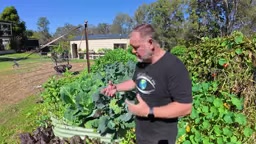
For feeding, his rule of thumb is practical: if leaves are deep green and plants are growing vigorously, no fertilizer is needed; if growth slows after three, four, or six weeks and leaves start to yellow, apply a liquid fertilizer or liquid nutrient boost.
Mark repeatedly stresses that more fertilizer is not better. Excess nitrogen produces massive leaves but delays head development, resulting in "broccoli trees with all leaf and no head." He also criticizes the social media trend of stripping all the leaves off so the head sticks out like a horn — leaves are the plant's solar panels, and only yellowed or diseased leaves should be removed.
As an interesting side note from the video: broccoli, cauliflower, cabbage, kale, and Brussels sprouts are actually all the same species (Brassica oleracea), selectively bred from the same wild plant for different traits.
Tip 3: Give Plants Enough Space and Water Consistently
Mature plants are much larger than seedlings suggest. Most recommendations call for 40 to 50 cm spacing between plants to get large heads. Mark gave his plants only half that spacing this time around, and while some large heads still formed, he concluded: plants with more room around the outside grew noticeably larger, while heads crowded in the middle were smaller.

For watering, the key is keeping the soil evenly moist — especially during head formation. Never let the soil dry out completely and then overcompensate with a heavy soak; that kind of stress leads to poor head quality. Mulch helps retain moisture, suppress weeds, and protect the shallow root system.
One often-overlooked detail: avoid watering from above once the head is nearing harvest, especially in humid weather. Water sitting in the head combined with temperature fluctuations is the primary cause of discoloration and rot. Mark shows a head that began rotting due to winter rain and warm spells, and recommends switching to base watering at that stage.
Tip 4: Manage Pests and Diseases
Another major advantage of cool-season planting is fewer pests — particularly the cabbage white butterfly, which is a devoted fan of broccoli but doesn't tolerate cold well. Mark says that as long as his crops mature during the subtropical winter, he barely needs to take any protective measures.
But as temperatures warm and heads begin to develop, you need to watch out for cabbage white butterflies and moths. Their caterpillars hatch on the undersides of leaves and chew their way through into the head, sometimes causing damage before they're even spotted.
Mark's pest management recommendations include:
- Simplest and most effective: Cover plants with fine-mesh insect netting immediately after planting, seal the edges, and prop it up above the plants;
- Without netting, inspect both sides of leaves regularly — look for eggs, chew holes, and green frass; pick off caterpillars or crush eggs by hand;
- If aphids cluster beneath the heads, blast them off with a strong jet of water;
- Avoid spraying if possible — even organic sprays harm beneficial insects like ladybugs;
- Rotate broccoli and other brassicas to avoid using the same bed repeatedly, reducing the risk of soil-borne diseases like clubroot.
He emphasizes that spending a few minutes checking plants once or twice a week is enough to prevent a season-destroying outbreak.
What is clubroot? Clubroot is caused by a soil-borne organism called Plasmodiophora brassicae, which infects the roots of nearly all brassica crops, causing distorted, swollen roots that lead to wilting, stunted growth, and plant death. Its resting spores can survive in soil for up to 20 years and are extremely difficult to eradicate once established. Acidic soil (pH below 6) significantly worsens the disease — which is one reason Mark recommends maintaining soil pH between 6 and 7. Crop rotation is currently the most effective prevention method for home gardens: rotating broccoli and other brassicas (cauliflower, cabbage, radishes, etc.) with non-brassica crops, and waiting at least three to four years before using the same bed again, can dramatically reduce the buildup of pathogens in the soil.
Tip 5: Harvest at the Right Moment
This is the heart of the entire video. Mark admits that because he didn't succession plant, he ended up with a group of broccoli plants at different stages — which turned out to be a perfect teaching opportunity.

Harvest criteria: Cut when the florets are tight and closed. Don't hold out for supermarket-sized heads — variety, spacing, and weather all affect size. Cut 10 to 15 cm below the head. He also mentions that the stem is edible too: if the outer layer is a bit tough, peel it away and the inner core tastes just as good as the florets.
When the head starts to loosen and yellow and the florets begin to open — if it's an heirloom variety, you can let it flower to attract pollinators and save seed; but if you plan to eat it, Mark says a slightly open head is still perfectly tasty, just a touch firmer in texture. Once the head becomes slimy, discolored, foul-smelling, and attracting flies, you can only try to salvage the smaller side shoots.
For pre-cooking prep, he shares a useful trick: soak the head in clean water for about 10 minutes and gently swirl it. Caterpillars hiding deep between the florets — remarkably well-camouflaged — will detach and sink to the bottom, preventing an "accidental caterpillar garnish" from alarming the kids at dinner.
Secondary Harvests and Freezing
Mark makes a point of reminding viewers: don't pull out the plant after cutting the main head. Leave the leaves on and give the plant a light feed, and most varieties will continue producing tender side shoots — often called broccolini — for weeks or even months.
For surplus broccoli, freezing works well, but blanching first is essential: cut into florets, drop into boiling water for 1 to 2 minutes, immediately transfer to ice water, drain thoroughly, spread in a single layer on a tray to freeze individually, then bag up. Freezing pieces separately prevents them from clumping together, making it easy to grab just the right amount per meal. The blanching step preserves color, flavor, and texture — skipping it causes broccoli to deteriorate much faster in the freezer, with florets falling apart at the tips.
Why blanch before freezing? Vegetables contain various enzymes (such as peroxidase and polyphenol oxidase) that remain active even under freezing conditions, continuing to break down chlorophyll, damage cell structure, and generate off-flavors. A brief exposure to high heat deactivates these enzymes, effectively hitting "pause" during frozen storage and greatly slowing nutrient loss, color fading, and texture degradation. The immediate ice bath (ice water plunge) after blanching rapidly halts the cooking process, preventing residual heat from further softening the tissue and keeping the broccoli crisp and tender. Properly blanched and frozen broccoli typically keeps well for 10 to 12 months, while unblanched broccoli often shows significant quality decline within two to three months.
Conclusion
Mark's five tips — choosing the right season, building great soil, spacing plants properly and watering consistently, managing pests, and nailing the harvest window — form a practical framework for high-yield home broccoli growing. The most valuable part is his detailed walkthrough of the harvest window: judging edibility at different stages, from tight and perfect to beginning to flower to fully rotting, is exactly what most growing guides tend to gloss over. Add in the secondary side-shoot harvest and the blanch-and-freeze technique, and this approach truly maximizes what you can get from a single broccoli bed.
Related articles

A Billion-Dollar Deal: A Turning Point for the U.S. Battery Market?
Sila and Panasonic Energy sign a billion-dollar silicon-carbon anode supply deal. This article analyzes its impact on the U.S. next-gen battery market, supply chain localization, and commercialization prospects.

Holiday Extras Employee Treats AI Assistant Like a Pet: The Real Daily Work Life of Brian and Beast
Holiday Extras employee names AI assistant Beast, chats morning, noon and night, preps meeting data in advance and monitors tasks. A real user's workflow and low-barrier start tips.

New AI Governance Initiative: Mandatory Independent Audits and Pre-Deployment Safety Proof
Macron convened government leaders, AI company executives, and researchers to discuss advanced AI risks. Statements call for a rigorous governance framework requiring mandatory independent audits and pre-deployment safety proof.