Complete Guide to IT Career Paths: 6 Major Tracks & Education-Matching Strategy

A probability-based guide to choosing among 6 major IT career tracks based on your educational background.
This article analyzes 6 major software-oriented IT career tracks in the AI era — Algorithm Engineer, Large Model Developer, AI+Programming Languages, Embodied Intelligence, FDE (Forward Deployed Engineer), and Intelligent Testing/Data Annotation. It provides probability-based career guidance matched to education levels, arguing that career choice is fundamentally a probability problem where different backgrounds should target different tracks for optimal outcomes.
Introduction: AI is Reshaping the IT Employment Landscape
The programming profession is undergoing a profound transformation. The traditional path of "pick a language, learn a framework" has been fundamentally disrupted by AI-assisted programming. Meanwhile, emerging roles in large model engineering, embodied intelligence, and FDE continue to appear, making IT career choices more complex than ever.
Based on frontline observations from IT training industry practitioners, this article systematically examines 6 major software-oriented career tracks: Algorithm Engineer, Large Model Developer, AI+Programming Languages, Embodied Intelligence, FDE, and Intelligent Testing/Data Annotation. The core thesis is: Career choice is fundamentally a probability problem, and different educational backgrounds should be matched with different entry paths.
Algorithm Engineer: The Highest-Barrier Pyramid Peak
Algorithm engineering needs to be understood at two distinct levels. Many job seekers shy away upon seeing "Algorithm Engineer" in a job title, when in reality they misunderstand what most positions actually require.
Building Algorithms: The Battlefield for Top-Tier Graduate Students
"Building algorithms" refers to the work done by teams at DeepSeekAd, Tongyi Qianwen, and similar organizations who invent and iterate on large models from scratch. This involves designing model architectures from the ground up (such as various Transformer variants), developing pre-training strategies, and optimizing loss functions. It typically requires deep mathematical foundations — linear algebra, probability and statistics, and convex optimization are baseline skills — along with engineering experience in large-scale distributed training, efficiently orchestrating training tasks across clusters of thousands of GPUs. These positions have extremely high requirements for education and publications, with a basic threshold of graduate degree from a top-tier (985) university. The probability drops significantly for 211-university graduates, and for community college or lower-tier university backgrounds, the success rate approaches zero (approximately under 1%).
Applied Algorithms: Accessible with a Bachelor's from a First-Tier University
The vast majority of "algorithm" positions on the market are actually applied algorithm roles — secondary development, fine-tuning, local deployment, and private data training built on top of models others have invented. Unlike building algorithms, applied algorithms focus more on engineering practice. Typical technical approaches include parameter-efficient fine-tuning (PEFT) methods like LoRA and QLoRA, or using RAG (Retrieval-Augmented Generation) technology to combine enterprise private data with large models, enabling the model to provide accurate answers based on domain-specific knowledge. For example, healthcare companies training proprietary models with private data, or Ping An Insurance, major bank headquarters, and telecom headquarters leveraging massive datasets for data mining and training.
These positions are generally accessible with a bachelor's degree from a first-tier university, though many still require a graduate degree. SLAM algorithm engineers and machine learning/reinforcement learning engineers in the embodied intelligence field also fall within the applied algorithm category.
Large Model Engineer: The Optimal Career Direction for Most People
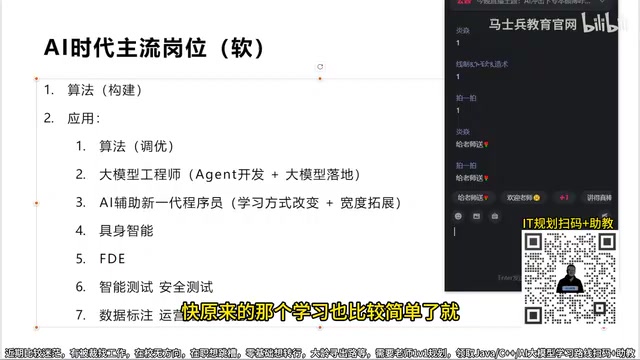
Large model development is currently the direction that is accessible to the most people and most welcomed by the market, and can be divided into two tiers.
Agent Development: Can Get Started in One Month
AI Agents are intelligent systems capable of autonomously perceiving environments, making plans, and executing actions. Early Agents were primarily based on the ReAct (Reasoning + Acting) paradigm, having large models alternate between reasoning and tool invocation to form a "think-act-observe" loop. Agent development is relatively straightforward, and even those with community college or lower-tier university backgrounds can enter the field. However, note that Agent development isn't as simple as "training something to answer common questions" — the real challenge lies in integrating with specific business workflows, building knowledge bases, adjusting parameters, and exposing appropriate APIs.
The recently popular Loop Agent (trackable, self-looping, self-enhancing Agent) is a typical example — building on ReAct, it further introduces self-cycling mechanisms where the Agent can evaluate, reflect on, and correct its own output, forming a closed-loop optimization. How to track and monitor black-box Agents is a current core technical challenge. Observability tools like LangSmith were created precisely to solve this problem, tracking every step of an Agent's reasoning process, tool invocations, and token consumption, allowing developers to "see" the Agent's decision chain.
Large Model Deployment: Overlapping with Algorithm Tuning
Large model deployment includes fine-tuning, local/cloud deployment, building enterprise knowledge bases, and mastering tool chains like Ollama, LangGraph, and LangSmith. LangGraph is a stateful multi-Agent orchestration framework developed by the LangChain team, supporting the construction of complex workflow graphs where developers can define collaboration relationships, conditional branches, and loop logic between Agents. Ollama is a lightweight tool that supports one-click local execution of open-source large models like Llama and Mistral, significantly lowering the barrier to model deployment. This area overlaps with algorithm tuning, is notably more difficult than pure Agent development, and is harder for those with community college or lower-tier university backgrounds to access.
AI+Programming Languages: The Birth of Next-Generation Programmers
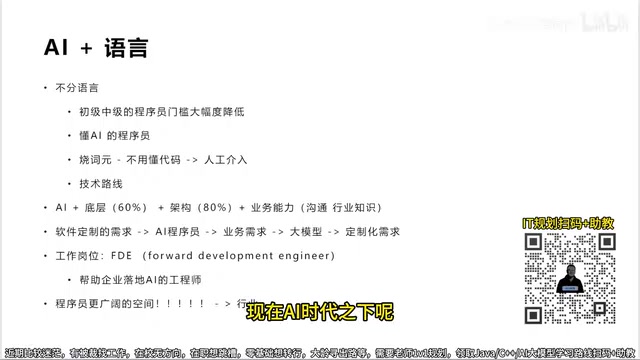
This represents the most far-reaching transformation for traditional programmers — AI+Java, AI+C++, AI+PLC, AI+FPGA — essentially a comprehensive overhaul of the traditional programmer.
5x Learning Efficiency Improvement
With AI assistance, the way programmers learn has fundamentally changed. Previously, a single misplaced character in a configuration file could mean hours of debugging; now you can simply hand it to AI for error correction and generation. Based on observations, getting started with a new language takes only about one-fifth of the original time (20% of the time to reach nearly 100% proficiency). While foundational knowledge may not be as solid as before, the barrier to entry has been dramatically lowered.
The Dialectics of Lowered Barriers
Lowered barriers are both an opportunity and a challenge. On one hand, competition intensifies — you need to reach what was previously considered "senior programmer" level just to enter the field. On the other hand, massive new demand will emerge — in the past, small and medium businesses couldn't afford programmers and custom software was too expensive; now AI-era costs have plummeted, and demand increases accordingly. This aligns with the pattern of every historical technological revolution: ATMs didn't eliminate bank tellers; instead, banks opened more branches and tellers transitioned to financial advisory and other high-value services.
Interestingly, leading AI companies currently derive most of their revenue from the AI coding space, validating this track's commercial value. The explosive subscription revenue growth of AI coding assistants like Cursor, GitHub Copilot, and Windsurf proves developers are willing to pay for productivity gains.
Core Competencies of Next-Generation Programmers
To reach an advanced level, next-generation programmers need to master:
- Solid understanding of underlying principles: When AI identifies subtle bugs, you need to understand and precisely fix them (such as high-precision code controlling missiles). This means foundational computer science courses like operating systems, computer networks, and data structures & algorithms are not only still relevant but more important than ever — because you need to judge the correctness and efficiency of AI-generated code.
- Architecture design ability: Setting the technical direction for AI from the start to avoid multiple iterations still missing the target. Good architecture design is like a good building blueprint — AI is an efficient construction crew, but the faster they build in the wrong direction, the greater the loss.
- Harness engineering: The ability to "harness" AI under WebCoding, controlling code from running wild. This concept is an extension of Prompt Engineering — beyond writing prompts, you need to set constraints, acceptance criteria, and coding standards to ensure AI-generated code meets engineering requirements.
With these skills, one person can do the work of 5-10 people. Moreover, since underlying principles are transferable, switching from Java to Golang might take only three days with AI assistance.
Embodied Intelligence: Where AI Meets Hardware
Embodied intelligence is essentially AI + embedded systems, typically built on the ROS2 robotics platform, consisting of a "brain" (large language model) + "cerebellum" (machine learning, reinforcement learning, path-following algorithms, machine vision). ROS2 (Robot Operating System 2) is the mainstream middleware framework in robotics, with significant improvements over its predecessor in real-time performance, security, and multi-robot collaboration, using DDS (Data Distribution Service) as the underlying communication middleware to support efficient and reliable data transmission between multiple nodes.
SLAM (Simultaneous Localization and Mapping) is a key algorithm enabling robots to simultaneously build maps and locate themselves in unknown environments, widely applied in robotic vacuum cleaners, drones, and autonomous driving. Reinforcement learning is used to train robot motion control policies through extensive trial-and-error learning in simulation environments (such as NVIDIA Isaac Sim, MuJoCo), then transferring to real hardware for execution (a process called Sim-to-Real Transfer).
Here's a pragmatic assessment: Actual humanoid robot positions and prospects aren't as promising as marketed. A more accurate term would be "machine intelligence" — specialized intelligent robotic arms and non-humanoid robots for specific work scenarios, where demand is actually greater. Machine vision technology is relatively mature; the main difficulty lies in the lack of suitable training data — collecting high-quality operational data for robot grasping, assembly, and locomotion in the real world is far more expensive than text and image data, which is the core bottleneck in current embodied intelligence development.
FDE (Forward Deployed Engineer): The Golden Track for Experienced Programmers
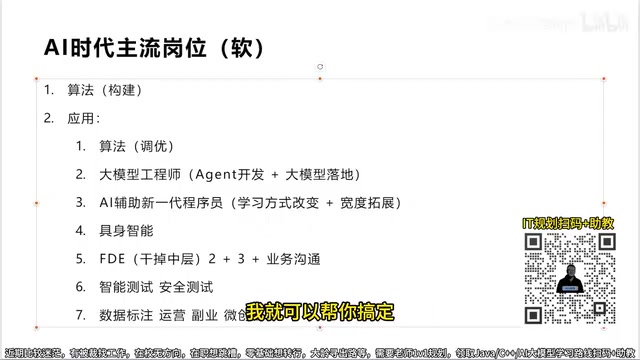
FDE (Forward Deployed Engineer) is an extremely hot direction right now, referring to engineers who help enterprises implement AI transformation. This concept was originally defined and promoted by data analytics company Palantir Technologies, describing engineers deployed at client sites to deeply integrate the company's technical products with client business operations. In the AI era, the FDE role has expanded to "AI transformation consultant + engineering implementer." Unlike traditional pre-sales/post-sales engineers, FDEs need to deeply understand client business process pain points, design AI solutions, and complete end-to-end delivery.
From Tool-ification to AI Native
Enterprise AI adoption currently remains mostly at the "tool-ification" stage — adding AI tools into human-driven processes (such as automated article writing or intelligent foreign trade inquiry reception). A more advanced form is "eliminating middle management": replacing middle managers who serve an information relay function with an AI steward, where upper management sets strategy, AI coordinates resources, and frontline staff executes. One company cut 70% of middle management after implementing this approach, and efficiency actually improved. This aligns closely with the management theory trend of "organizational flattening" — AI can handle information aggregation, task allocation, and progress tracking that traditionally fell to middle managers, similar to how enterprise ERP systems once compressed management layers, but AI's understanding and decision-making capabilities enable far more aggressive compression.
The ideal form is an AI Native company — where the entire enterprise is operated by AI, humans are auxiliary, and when humans are needed, AI actively recruits them. The concept of AI Native, analogous to Cloud Native, refers to enterprises built from inception with AI as the core operating logic, rather than layering AI tools onto traditional processes. Typical characteristics include: AI-driven decision chains, on-demand elastic staffing (similar to a "talent-as-a-service" model), and core business processes automatically orchestrated by multi-Agent systems.
Why It's Friendly to Experienced Programmers
FDE requires a combination of "large model engineering + programming + business communication" capabilities. Young programmers often gravitate toward pure technology while lacking business understanding and communication skills, whereas experienced programmers with industry backgrounds actually have a competitive advantage — they're both business experts and technical experts. In actual projects, FDEs need to complete the entire chain of requirements research, solution design, technology selection, development delivery, and effectiveness evaluation. This "T-shaped capability" (technical depth + business breadth) is precisely the core competitive advantage of seasoned practitioners.
Regarding compensation, Hangzhou generally offers 30-70K RMB monthly, with large model vendors (like DeepSeek) paying FDEs up to 70K, because vendors need people to help AI-unfamiliar enterprises complete implementation — similar to Huawei's logic when it invested heavily in bringing in IBM consultants for process transformation. In 1998, Huawei spent hundreds of millions of dollars hiring IBM consultants to implement IPD (Integrated Product Development) processes, which was essentially a commercial precedent for the "forward deployment" model.
Low-Barrier Tracks: Intelligent Testing & Data Annotation
Intelligent Testing/Automotive Testing: A High-Value-for-Money Choice That's Education-Friendly
For those with lower educational backgrounds facing employment difficulties, automotive testing (testing new energy vehicle hardware/software and autonomous driving systems) is a high-value-for-money choice. The explosive demand for automotive testing is directly related to China's rapidly developing new energy vehicle industry. As of 2024, China's new energy vehicle fleet exceeded 30 million, and the increasing complexity of intelligent cockpit and ADAS (Advanced Driver Assistance System) software functions has generated massive testing job demand. Automotive testing involves HIL (Hardware-in-the-Loop) simulation testing, CAN/LIN bus protocol analysis, OTA upgrade verification, and other specialized areas:
- Low education requirements: Basically no barrier above associate degree level
- Short learning cycle: Can enter the field in 1.5-2 months (far less than the 3-6 months for Java backend)
- High entry success rate: Reportedly above 95%
- Salary: 7-8K RMB in third/fourth-tier cities, ~10K in second-tier, ~12K in first-tier
The downside is that it requires hands-on practice with "test benches" (with steering wheels, requiring physical vehicle access) and cannot be learned purely online. The "test bench" mentioned refers to HIL test benches that simulate a real vehicle's electronic control system, where testers verify ECU (Electronic Control Unit) functionality and performance on the bench — this explains why this track requires in-person training. Career progression paths include AI-assisted embedded development, PLC/HMI programming, or test management roles.
Data Annotation: The Lowest-Barrier IT Job
Data annotation requires only 2-3 days of learning, accepts technical secondary school graduates, and essentially involves human calibration of AI training data (such as labeling cats and dogs in images, marking entity relationships in text, or performing preference ranking of large model outputs). Data annotation is an indispensable part of the machine learning pipeline — supervised learning depends on large volumes of high-quality labeled data, and RLHF (Reinforcement Learning from Human Feedback) similarly requires human judgment and ranking of model outputs. It's essentially labor-intensive work: interns earn 3-4K RMB, team leads 7-8K. It's suitable as a transitional income source, with the recommendation to simultaneously learn advanced skills in spare time.

Operations & Side-Hustle Micro-Entrepreneurship
Operations roles (content promotion, community management, customer operations) have low barriers with high variance — top vendors hire overseas-educated operations staff at annual salaries of 400-500K RMB, while regular operations pay 3-4K monthly. For side hustles, AI comics (some have invested 5,000 RMB and earned hundreds of thousands in return), self-media operations, and similar ventures have seen dramatically lowered barriers thanks to AI assistance — essentially applications of Agent development.
Conclusion: Match Your Track with Probabilistic Thinking
The core methodology of this article is probabilistic thinking: Don't simply think "I have this degree so I can only choose this path." Taking an associate degree holder as an example: building algorithms has less than 1% probability of success, large model engineering about 20-30%, AI-assisted programming about 40-50%, FDE (with business foundation) about 40-50%, intelligent testing about 95%, and data annotation/operations approaching 100%.
The general principle is: the higher your education, the higher you should aim (salary differences are significant); if you have lower educational credentials and need income urgently, start with the direction offering the highest probability of success, then push upward in your spare time. Regardless of which path you choose, building your career around AI is the certainty direction for decades to come.
A note to readers: The perspectives in this article come from IT training industry practitioners, and some content carries recruitment marketing elements (such as promises of free tuition, employment guarantees, etc.). Readers should maintain rational discernment regarding training promotions when referencing career direction advice.
Related articles

Bilibili's Hit Dify Tutorial: A Practical Guide to Building 20+ AI Apps from Scratch
A distilled guide to Bilibili's top-rated Dify tutorial: Windows + Docker deployment, MySQL connection, five app types, model integration strategy, and publishing.

Agent Skills Beginner's Guide: From Concepts to Multi-Agent Collaboration in Practice
A comprehensive guide to Agent Skills: core concepts, components, the importance of Description, standardization, beginner learning paths, and multi-agent collaboration.

One Neuron Detects Both Cats and Cars? We Reproduced It and Found a New Explanation
The cat-car neuron reinterpreted: researcher Cammarata argues it distinguishes pointy from round, not cats from cars. We reproduced the experiment and found the new explanation holds on most inputs—but cars are the exception. The interpretability debate continues on language models.