Composio Instant: A New Paradigm Where AI Agents Pay for Their Own Tool Calls

Composio Instant lets AI Agents call and autonomously pay for third-party tools on demand, with no subscription or sign-up.
Composio launched Instant on Product Hunt, aiming to let AI Agents call and pay for third-party tools without subscriptions or sign-ups, covering web search, business contact lookup, voiceover, and audio transcription. The article notes its real value lies not in tool count but in moving the payer from developers to the Agent itself: trial-and-error costs drop structurally and tool combinations are no longer limited by existing subscriptions. But autonomous payments also raise unresolved issues around budget caps, cost auditing, and anomaly circuit breakers, with no production-grade guardrails detailed. The article argues this model could push the API economy from account-based billing toward metering per Agent instance, best suited in the short term to independent developers and multi-tool orchestration teams.
For AI Agents to actually get work done, they can't avoid a practical problem: calling tools costs money. Whether it's searching the web, looking up business contacts, generating speech, or transcribing audio, third-party services are billing behind the scenes. The traditional approach is for developers to set up accounts, bind payment cards, and manage a pile of API Keys on the Agent's behalf—tedious and hard to scale. Composio's Instant product, launched on Product Hunt, tries to flip this entirely: let the Agent pay for its own tools, with no subscription and no sign-up.
A tool-calling layer with "no subscription, no sign-up"
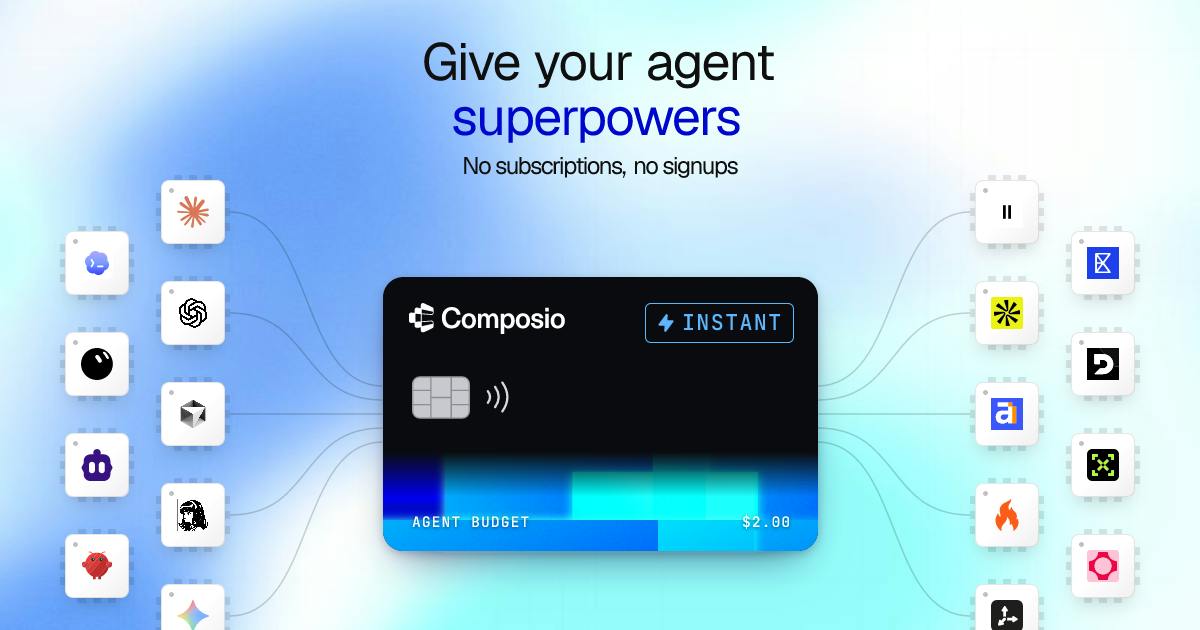
Composio Instant's positioning is very direct—give Agents "superpowers." The capabilities listed in the official description include web search, finding business contacts, creating voiceovers, and audio transcription. The key is the barrier to use: no upfront subscription, and no need to register a separate account for each tool—the Agent can call tools directly when needed and complete payment.
What does this mean for developers? In the past, integrating a search API meant going through the full flow of registration, verification, topping up, getting a Key, and writing authentication logic—repeated every time you switched tools. Instant compresses these steps into a single call, with the Agent paying on demand at runtime, so developers no longer have to maintain a massive list of bills and keys. The product received 134 votes and 27 comments on Product Hunt and ranked second for the day, showing that quite a few people recognize this pain point.
Agent payments: from "humans pay for machines" to "machines pay for themselves"
What's really worth discussing about Composio Instant isn't how many tools it integrates, but the payment model it's trying to establish. In the vast majority of current Agent frameworks, the payer is the developer or end user, and the Agent is merely the executor. Instant moves the payer down to the Agent itself, which brings two direct changes.
The first is a structural drop in trial-and-error costs. Developers can get an Agent running first and pay based on actual consumption, rather than buying a stack of monthly plans before validating an idea. The second is greater flexibility in tool combinations. When every tool is pay-as-you-go, an Agent's tool choices are no longer limited to "what's already subscribed," but depend on what the task needs at that moment.
However, this model also raises unresolved governance questions: who sets the limit on an Agent's autonomous payments? How are budgets allocated and audited? Once an Agent repeatedly calls paid tools in a loop, which layer is responsible for cost control? There are 27 discussions in the Product Hunt comment section, and these questions are likely what developers care about most. Composio's current answer is "no subscription, free trial," but the original text doesn't elaborate on budget guardrail mechanisms for production environments.
Agent autonomous payments and budget guardrails
Agent autonomous payments refer to an Agent deciding on and completing payments to third-party services on its own at runtime, rather than the developer subscribing in advance or confirming manually. It typically relies on three types of infrastructure: programmable payment channels (such as per-call API gateways or micropayment protocols), fine-grained usage metering, and budget guardrails. Budget guardrails include per-call caps, cumulative limits per unit time, task-level budget ceilings, and circuit breakers for anomalous calls, used to prevent runaway spending when an Agent loops or reasons incorrectly. Without these mechanisms, autonomous payments shift cost risk from procurement to runtime, so production deployments typically require audit logs and traceable call records.
Potential impact on the developer tool ecosystem
If Agent autonomous payments become the norm, it won't just affect Agent frameworks themselves. The API economy has long been built on the basic unit of the "developer account," with billing, quotas, and risk control all designed around accounts. When callers become temporary Agent instances one after another, service providers need to rethink identity verification and billing granularity.
Composio's choice to start from SDKs and developer tools is a pragmatic path: get developers using it first, then gradually push upstream services to adapt. The tool types it lists—search, contact data, speech synthesis, speech transcription—are precisely high-frequency steps in Agent workflows, covering both information acquisition and content production.
The API economy and metered billing
The API economy refers to the business model in which service providers charge by call volume, data volume, or feature tier through public application programming interfaces. Traditionally, APIs use developer accounts as the smallest billing unit, with accounts tied to business qualifications, payment methods, and quota policies, on which providers base risk control and revenue recognition. When the caller becomes a large number of short-lived Agent instances with no fixed identity, the account-based billing model faces challenges: how to verify identity, how to aggregate calls, and how to block abuse. Common transitional approaches in practice include prepaid credit pools, issuing short-term tokens per call, and post-hoc settlement based on usage—these mechanisms determine whether autonomous Agent payments can be accepted by upstream service providers.
Who should try it now
In the short term, Composio Instant is best suited to two groups. One is independent developers and small teams rapidly validating Agent product forms, who need to integrate multiple capabilities without committing to long-term costs. The other is teams building multi-tool orchestration workflows that want to outsource the operational burden of tool integration.
For enterprises that already have mature procurement processes and fixed suppliers, Instant's value lies more in supplementing long-tail tool needs than replacing existing contracts. As for budget control, call auditing, and anomaly circuit breakers for Agent autonomous payments in production, these still need to be validated in real projects. Composio has pointed out the direction; the remaining engineering details are for the first batch of people who seriously use it to answer.
One-line Summary
Composio Instant lets AI Agents call and autonomously pay for third-party tools on demand, with no subscription and no sign-up.
Paragraph Summary
Composio launched Instant on Product Hunt, aiming to let AI Agents call and pay for third-party tools without subscriptions or sign-ups, covering high-frequency capabilities such as web search, business contact lookup, voiceover, and audio transcription. The article points out that its real value isn't in the number of tools, but in moving the payer from the developer down to the Agent itself: trial-and-error costs drop structurally, and tool combinations are no longer limited by existing subscriptions. But autonomous Agent payments also bring unresolved issues such as budget caps, cost auditing, and anomaly circuit breakers, and the original text doesn't elaborate on production-grade guardrail mechanisms. The article argues this model could push the API economy from account-based billing toward metering per Agent instance, and in the short term is best suited to independent developers rapidly validating products and multi-tool orchestration teams.
Related articles
WorkBuddy in Action: How AI Agents Automate Batch File Conversion and Archiving
Bilibili creator Teacher Shanyao tests WorkBuddy vs. Doubao on batch file conversion, showing how AI Agents move from "giving solutions" to "direct execution," with a full workflow and credit cost reference.
High-Frequency AI Agent Interview Topics: RAG, Multi-Agent Systems, and Token Optimization
Based on a Bilibili Agent interview video, this article covers high-frequency AI Agent interview topics: RAG evaluation, single vs. multi-agent selection, token cost control, infinite loop troubleshooting, and project presentation techniques.

The Complete AI Agent Development Workflow: From Technical Build to Compliant Launch
A full AI agent development workflow for education: architecture, four teaching modules, deep synthesis and large model filings, high-concurrency deployment, and operations.