High-Frequency AI Agent Interview Topics: RAG, Multi-Agent Systems, and Token Optimization
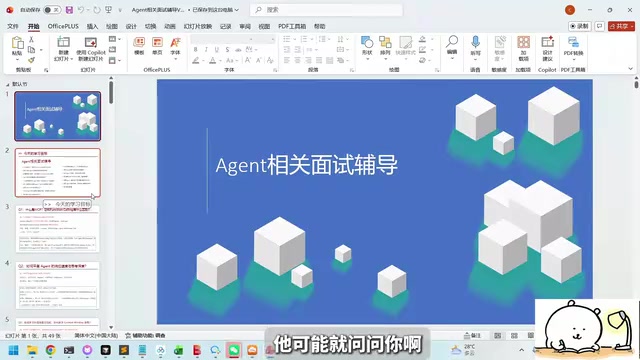
Breakdown of high-frequency Agent interview topics: solution trade-offs, runtime stability, and project retrospective skills.
Based on a Bilibili creator's Agent interview video, this article outlines core assessment points for AI Agent roles. The interview has two segments: the first involves scenario-based questions on inference speed vs. quality trade-offs, RAG measurement, prompt injection defense, and single vs. multi-agent selection—focused on trade-off reasoning rather than standard answers. The second is the candidate's guided project presentation, an "open-book exam" that must withstand data-driven follow-ups. Runtime stability is the most differentiating topic, covering self-repair, token cost control, and infinite loop troubleshooting. The article summarizes a three-layer capability profile and cautions against quick-success rhetoric.
Title
High-Frequency AI Agent Interview Topics: RAG, Multi-Agent Systems, and Token Optimization
Meta Description
Based on a Bilibili Agent interview experience video, this article outlines high-frequency topics in AI Agent development interviews: RAG evaluation, single vs. multi-agent selection, token cost control, infinite loop troubleshooting, and project presentation techniques, helping readers understand the capability dimensions interviewers truly assess.
Article Content
Interviews for AI Agent roles are shifting from testing algorithmic trivia to assessing engineering implementation capability. In a "Agent interview experience" video on Bilibili, a creator breaks down two core segments of the interview: interrogation of knowledge systems and solution approaches, and the candidate's own guided presentation of their projects. The former involves the interviewer asking questions based on the resume and business scenarios, while the latter is an "open-book exam" the candidate prepares in advance. This article, based on the video content, organizes the high-frequency topics repeatedly probed in Agent development interviews and supplements necessary technical background to help readers understand what interviewers are truly trying to assess.
Interview Segment One: Business-Scenario-Driven Solution Design
According to the creator, interviewers typically browse the resume first, then pose questions tied to their own business scenarios. These questions don't seek standard answers but test the candidate's ability to weigh trade-offs in Agent solutions. For example, "how do you balance speed and thinking" is essentially asking about the trade-off between inference latency and result quality—whether to use streaming output, whether to set a maximum number of reflection rounds, whether to use a lightweight model for routing. RAG-related questions focus on "how to measure" knowledge base effectiveness, which points to designing evaluation metrics such as retrieval recall and answer faithfulness, rather than simply listing vector database choices.
Questions at the agent design level are more practical: "What if someone tries to extract its content" corresponds to prompt injection defense, while "single agent or multi-agent" tests the basis for architectural choices—whether the task requires role division, whether the context exceeds a single model's window, and how to isolate error propagation. None of these questions have a unique answer; the interviewer is looking at whether the candidate can articulate the reasoning behind trade-offs.
ReAct and the Agent Reasoning Loop
The "reflection rounds," "maximum iteration count," and "chain of thought" mentioned in the article are all built on the classic ReAct (Reasoning + Acting) paradigm. ReAct has large models alternately output "thought" and "action": the model first reasons about the current state, then decides which tool to call, and after receiving the tool's return result, reasons again—looping until a final answer is given. This loop is the source of an Agent's autonomy, but it is also the root cause of latency, token consumption, and infinite loop risk—each round must reinsert historical thoughts and tool results into the context, so the more rounds, the higher the cost, and the model may waver back and forth between two actions. Understanding this mechanism is essential to understanding why interviewers fixate on seemingly trivial parameters like "maximum reflection rounds" and "iteration limits."
Prompt Injection and Indirect Injection
"What if someone tries to extract its content" corresponds to prompt injection, a core threat to Agent security. Direct injection refers to users embedding instructions in their own input to induce the model to bypass original constraints; more insidious is indirect injection—attackers hide malicious instructions in external content the Agent reads, such as web pages, documents, or tool return results. After the Agent retrieves this text, it treats it as trusted instructions and executes it. For RAG and web-connected Agents, indirect injection is especially dangerous because the retrieved content itself is untrustworthy. Common defenses include: distinguishing trust levels between system instructions and external data, marking tool return content with isolation tags, restricting permissions for high-risk tools, and content review on the output side.
Agent Runtime Troubleshooting: Self-Repair, Tokens, and Infinite Loops
The second category of high-frequency questions revolves around post-launch stability. The creator mentions that interviewers ask "can the Agent self-repair when it encounters problems" and "is token consumption high, and what do you do if it is." The former involves the design boundaries of reflection mechanisms and retry strategies, while the latter directly targets cost control—common answer directions include context compression, caching repeated calls, dynamically switching models based on task complexity, and truncating tool return results.
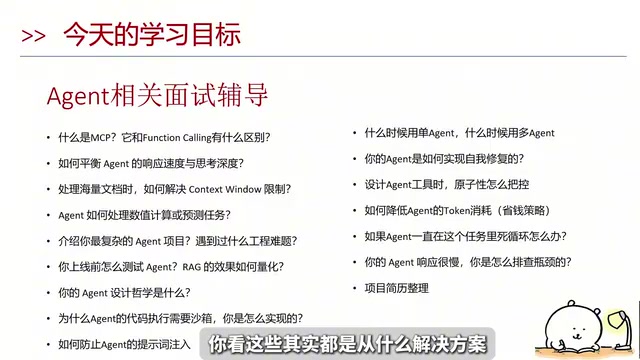
"Will infinite loops occur, and how do you troubleshoot slow responses" is another named test point. Infinite loops are not uncommon in ReAct-type Agents, and troubleshooting approaches typically include setting a maximum iteration count, logging each step's tool calls and chain of thought, and identifying repetitive action patterns. These questions best distinguish candidates who have "run a demo" from those who have "actually deployed to production," because only those who have stepped in the pit will mention monitoring and circuit breaking.
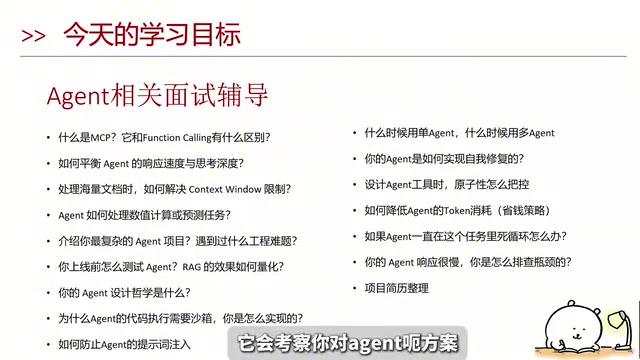
These questions collectively point to one capability dimension: solution capability. Interviewers don't expect candidates to recite the optimal architecture; they want to hear the specific decision-making process—for example, why multi-agent was chosen over single-agent in a certain scenario, or why a particular token optimization introduced side effects.
Context Compression and Cost Control
An Agent's token consumption grows linearly or even super-linearly with conversation rounds and tool call counts, because each round must carry the full history. Context compression is the primary means of cost control, with common approaches including: sliding windows retaining the most recent rounds, summarizing early conversations before re-injecting them, truncating or structurally extracting lengthy tool return results, and feeding stable system prompts and few-shot examples into prompt caching for reuse. Another approach is model routing—using lightweight models for low-complexity subtasks like intent classification and simple Q&A, calling large models only at key reasoning nodes. These methods all have side effects: summaries lose details, truncation may delete critical fields. Therefore, in interviews, being able to clearly explain "what cost the optimization introduced" is often more appreciated than merely reporting numbers.
Interview Segment Two: Taking Control Through Project Presentation
The creator calls the latter half of the interview an "open-book exam"—the interviewer will dig into projects on the resume, and the candidate can organize and moderately package their project experience in advance to take the lead in the Q&A. This judgment has its merits: only those who lived through the project details know them, and a well-prepared candidate can steer the conversation toward familiar deep waters.
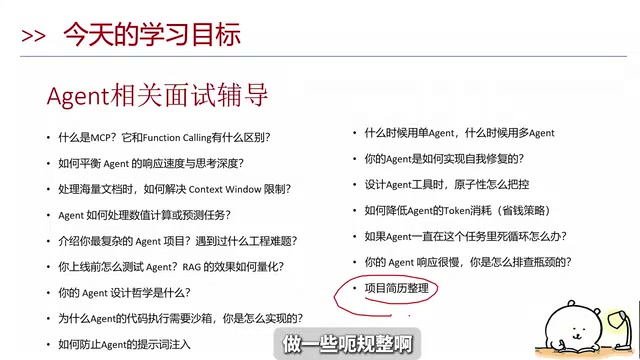
However, a reminder: the boundary of "packaging" lies in being able to withstand follow-up questions. If a candidate claims to have done token optimization, the interviewer will likely probe the specific numbers before and after optimization, how monitoring metrics were collected, and what adverse effects were encountered. Presenting a project as a story with data, trade-offs, and retrospectives is more effective than piling up technical jargon.
The Agent Role's Capability Profile as Seen from Interview Experience
Combining the questions listed in the video, the capabilities assessed for Agent development roles can be summarized in three layers: the solution design layer focuses on architectural choices and trade-off reasoning; the engineering implementation layer focuses on stability, cost, and observability; the project expression layer focuses on whether the candidate can clearly review their own decisions. This largely aligns with actual industry requirements for Agent engineers—being able to build something is only the starting point; controlling costs, troubleshooting failures, and articulating trade-offs are the real dividing lines.
It should be noted that this content comes from a single creator's experience sharing, and promotional rhetoric such as "learn it and get a job" clearly has a lead-generation nature. Readers should focus on the value of the technical questions themselves and remain cautious about quick-success promises.
One-line Summary
Breakdown of high-frequency Agent interview topics: solution trade-offs, runtime stability, and project retrospective capability.
Paragraph Summary
Based on a Bilibili creator's Agent interview experience video, this article outlines the core assessment points for AI Agent roles. The interview has two segments: the first involves the interviewer asking questions based on the resume and business scenarios, covering the balance between inference speed and quality, RAG effectiveness measurement, prompt injection defense, and single vs. multi-agent selection—the focus is not on standard answers but on trade-off reasoning. The second segment is the candidate's guided presentation of their own projects, an "open-book exam" that can be prepared in advance, but packaging must withstand data-driven follow-ups. Runtime stability is listed as the most differentiating test point, including self-repair mechanisms, token cost control, and infinite loop troubleshooting. The article thus summarizes a three-layer capability profile—solution design, engineering implementation, and project expression—and reminds readers that the content contains lead-generation rhetoric, so quick-success promises should be treated with caution.
Related articles
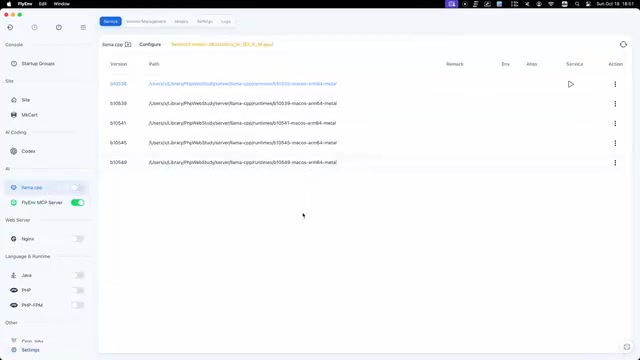
FlyEnv Plugin Review: Visually Running llama.cpp and Managing GGUF Models
FlyEnv launches the official llama.cpp plugin with side-by-side Metal runtime management, public GGUF repository indexing with file type labels, and visual configuration of context, threads, and GPU layers—saving templates and speculative decoding with each model for one-click local LLM inference.
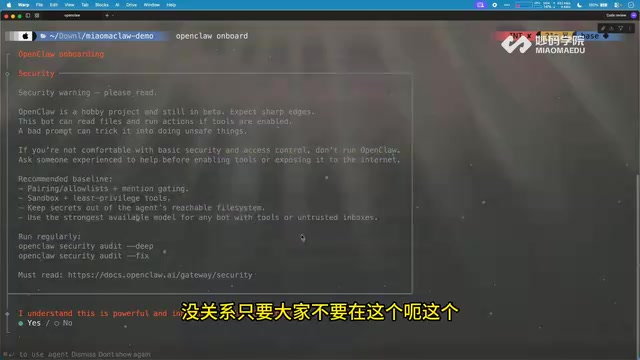
How Can Frontend Developers Advance into AI Agent Development? Deconstructing System-Level Agent Architecture from OpenClaw
Starting from the OpenClaw demo in a Bilibili open class, this article breaks down the three-layer architecture and universal formula of system-level AI agents, and analyzes the path for frontend developers to enter agent development based on TypeScript, including plugin-based design and security/memory layer challenges, with an interview answer framework.
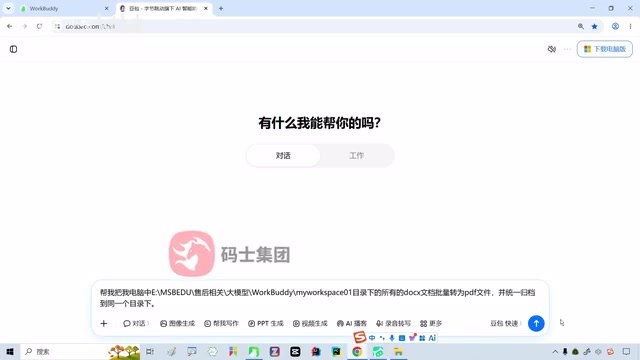
WorkBuddy in Action: How AI Agents Automate Batch File Conversion and Archiving
Bilibili creator Teacher Shanyao tests WorkBuddy vs. Doubao on batch file conversion, showing how AI Agents move from "giving solutions" to "direct execution," with a full workflow and credit cost reference.