Free Open-Source Linear Algebra & Machine Learning Textbooks: Self-Study Notes from a Student's Perspective
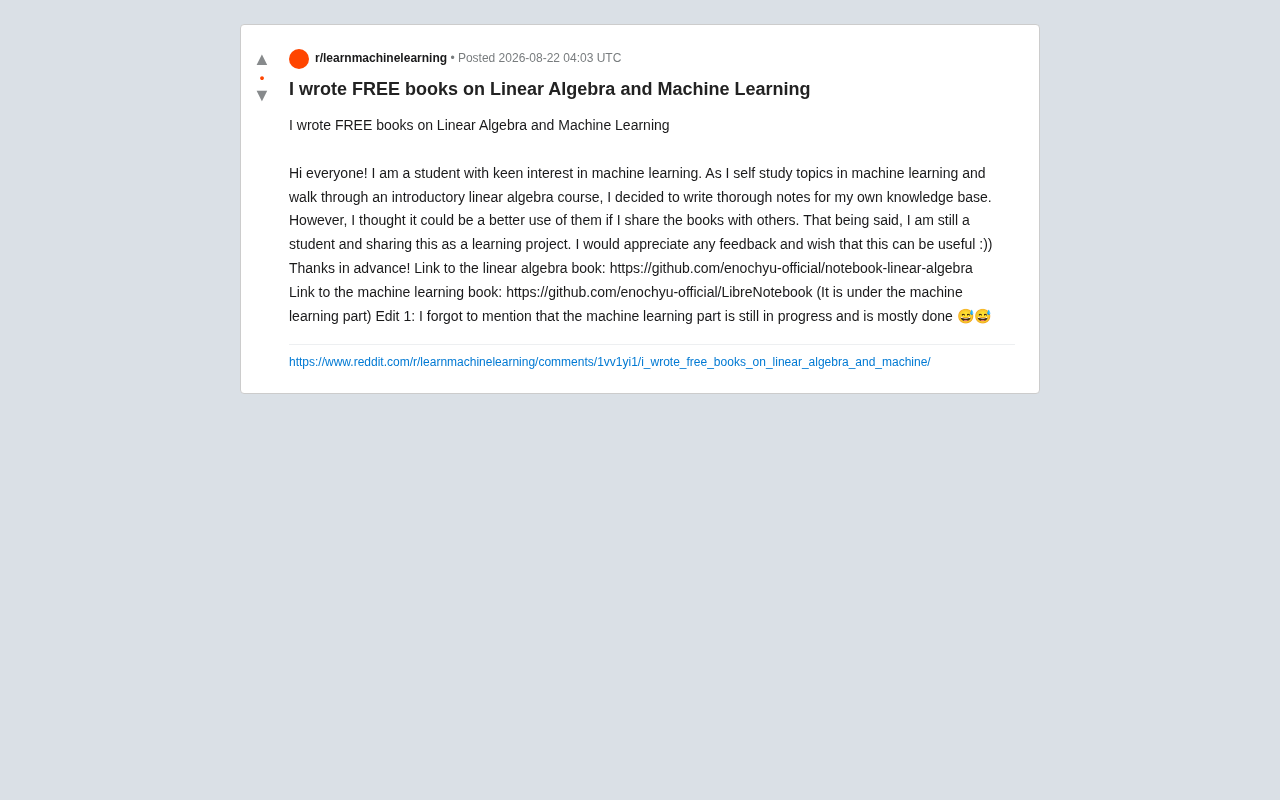
A student shares two free open-source textbooks on linear algebra and machine learning on GitHub.
A student named Enoch Yu has published two free, open-source textbooks on GitHub — one covering linear algebra and another on machine learning — compiled from his self-study notes. Written from a learner's perspective, these resources aim to lower the barrier to entry for beginners. The machine learning portion is still being actively updated, and the author welcomes community feedback and contributions through GitHub's collaborative features.
A Student's Open-Source Study Notes
In the field of machine learning, high-quality introductory textbooks often come with hefty price tags, making systematic free learning resources especially valuable. Recently, a student shared two free textbooks he wrote on Reddit — one on linear algebra and another on machine learning — sparking widespread interest in the community.
The author, who goes by Enoch Yu, says he has a deep passion for machine learning. While self-studying machine learning topics and systematically working through an introductory linear algebra course, he decided to compile a thorough set of study notes to build his personal knowledge base. He then realized that sharing these notes might help others with similar learning needs.
"I'm still a student, sharing this as a learning project. I really welcome any feedback and hope it can be useful to everyone."
Content and Scope of the Two Free Textbooks
Linear Algebra Notes: The Mathematical Foundation of Machine Learning
The first book focuses on linear algebra and is hosted on GitHub (notebook-linear-algebra). Linear algebra is one of the mathematical cornerstones of machine learning — from vectors and matrix operations to eigenvalue decomposition and singular value decomposition, virtually all machine learning algorithms are built on these concepts.
Linear algebra is considered the mathematical bedrock of machine learning because the underlying computations of nearly all mainstream algorithms can be boiled down to matrix and vector operations. For example, the forward pass in each layer of a neural network is essentially a matrix multiplication followed by a nonlinear activation; Principal Component Analysis (PCA) relies on eigenvalue decomposition to find the principal directions of variation in data; and collaborative filtering in recommendation systems makes heavy use of matrix factorization techniques. Singular Value Decomposition (SVD) is ubiquitous across natural language processing, image compression, dimensionality reduction, and more. Understanding these linear algebra concepts not only helps learners read algorithm papers but also enables them to make informed decisions when debugging models and optimizing performance, rather than relying solely on black-box framework calls.
For self-learners, the abstract nature of linear algebra is often the first major hurdle. Notes written from a student's perspective tend to offer intuitive explanations and derivation details that are closer to a beginner's way of thinking — something many classic textbooks lack.
Machine Learning Notes: A Continuously Updated Open-Source Project
The second book is part of the author's LibreNotebook project (under the machine learning section). It's worth noting that the author has acknowledged in supplementary remarks that the machine learning section is still being actively updated and is currently "mostly complete."
This means the resource is a dynamically growing project rather than a finished product. For readers who want to follow along with the author's learning pace and participate in providing feedback, this actually offers a more interactive way of learning.
Why Free Open-Source Textbooks Like These Deserve Attention
Textbooks Written from a Learner's Perspective Are Easier to Get Into
Textbooks written by students have a natural advantage: the author has just navigated the confusion and breakthroughs on the learning curve, making it easier to identify beginners' pain points. Compared to comprehensive but high-barrier classic works written by seasoned professors, these "peer-style notes" tend to use more accessible language and approach topics from angles closer to real learning struggles.
Of course, this comes with trade-offs: student-authored work may fall short of mature textbooks in rigor, breadth of coverage, and error rates. The author himself clearly positions this as a "learning project" and proactively solicits feedback — an open attitude that is precisely the key to the healthy development of open-source learning resources.
The Value of Open-Source Collaboration and Community Co-Creation
Hosting study notes on GitHub itself embodies the open-source spirit. GitHub was originally designed as a code hosting and version control platform for software developers, built on the Git distributed version control system. In recent years, however, it has far transcended the scope of code repositories, becoming an important vehicle for open-source educational content. Through the Issue feature, readers can submit corrections, raise questions, or suggest new topics; through Pull Requests, anyone can directly submit modifications for the author to review and merge. This workflow allows personal notes to iteratively evolve just like open-source software. Many successful educational projects on GitHub already use this model, such as the "free-programming-books" project with over 300,000 stars, as well as various community notes for machine learning courses. Version control also means every modification has a complete history, allowing readers to trace how content has evolved.
For the machine learning learning ecosystem as a whole, an increasing number of free, open resources like these are lowering the barrier to entry. Whether it's Andrej Karpathy's instructional videos or various open-source course notes, they are all driving the democratization of quality educational resources.
It's worth mentioning that Andrej Karpathy is a former Tesla AI Director and one of the founding members of OpenAI. After leaving the industry, he produced a series of teaching videos on building neural networks from scratch (such as the "Neural Networks: Zero to Hero" series), explaining core concepts like backpropagation and the Transformer architecture in an extremely intuitive manner, garnering millions of views on YouTube. Similarly, Stanford University's CS229 (Machine Learning), CS231n (Computer Vision), and other course materials — complete lecture notes and videos — have long been freely available online. fast.ai founder Jeremy Howard advocates a "top-down" teaching approach, letting students first run through a complete deep learning project before gradually diving into the underlying principles. Together, these free resources form an increasingly robust self-study ecosystem, enabling learners — even those without an acceptance letter from a top university — to systematically master cutting-edge technologies.
Tips for Self-Learners
If you're currently self-studying machine learning, these free textbooks are worth a try, but here are some suggestions for how to use them effectively:
- Cross-reference: Since this is student-authored work still being refined, it's advisable to read it alongside classic textbooks for complementary verification. Among them, Gilbert Strang is a legendary professor in MIT's Mathematics Department — his Introduction to Linear Algebra and the linear algebra open course (18.06) on MIT OpenCourseWare are regarded by millions of self-learners worldwide as the gold standard for introductory linear algebra. Professor Strang is renowned for his geometry-intuition-driven teaching style and his ability to connect abstract mathematical concepts with practical applications. Professor Zhihua Zhou is a scholar in Nanjing University's Department of Computer Science. His book Machine Learning (affectionately nicknamed the "Watermelon Book" due to its cover) is one of the most influential introductory machine learning textbooks in Chinese, systematically covering core topics from decision trees and support vector machines to ensemble learning and deep learning, distinguished by rigorous mathematical derivations and clear conceptual exposition.
- Hands-on practice: Understanding machine learning is inseparable from coding implementation — notes should be combined with actual programming exercises.
- Active feedback: The author explicitly welcomes feedback. Reader participation not only helps improve the content but also deepens one's own understanding.
Conclusion
A student organizing his study notes into books and releasing them as free open-source resources — it may seem like a small gesture, but it reflects the most inspiring side of the open-source community: sharing knowledge doesn't require waiting until you become an expert. As the author puts it, this is a "learning project" — it is both the fruit of his own knowledge accumulation and a sincere contribution back to the community. For any self-learner hovering at the doorstep of linear algebra and machine learning, this is a free resource well worth bookmarking.
Related articles

GPT-Next Leak, Gemini 4 Argon Imminent: AI News Roundup
GPT-Next leak suggests extreme efficiency; OpenAI's 28-day shipping pledge boosts speed 50%; Gemini 4 Argon nears release; Anthropic subscription value report sparks debate.

GPT-Next Leaked, Gemini 4 Argon Speeds Up, Fable 5.5 May Launch Today
OpenAI's GPT-Next model leaks, expected to be extremely low-cost and possibly part of the 28-day release plan; Gemini 4 Argon internal testing accelerates, NanoBanana 2.1 is live; Semi Analysis tests show Claude Max's equivalent API value is about 5 times that of ChatGPT Pro; Fable 5.5 may launch today.

Gemini 4 Argon Launches Globally: Key Highlights from the AI Daily Brief
Google opens Gemini 4 Argon globally across Pro and Ultra subscriptions and the API, and demonstrates robot control. This article rounds up open-source models, Agent infrastructure, cost transparency, and safety governance updates.