Computers Are Being Redefined in the AI Era — Has Your Understanding Kept Up?
AI is redefining computers from passive tools to intelligent collaborators — and cognitive lag is the real risk.
Generative AI is fundamentally reshaping what a personal computer is — evolving it from a passive execution tool into an intelligent collaborator capable of understanding intent and proactive assistance. With NPUs enabling on-device AI inference and natural language replacing traditional interfaces, the productivity gap now hinges not on hardware specs but on whether users have adapted to AI-augmented workflows. Cognitive lag is the biggest threat in this revolution.
A Single Tweet That Sparked Deeper Thinking
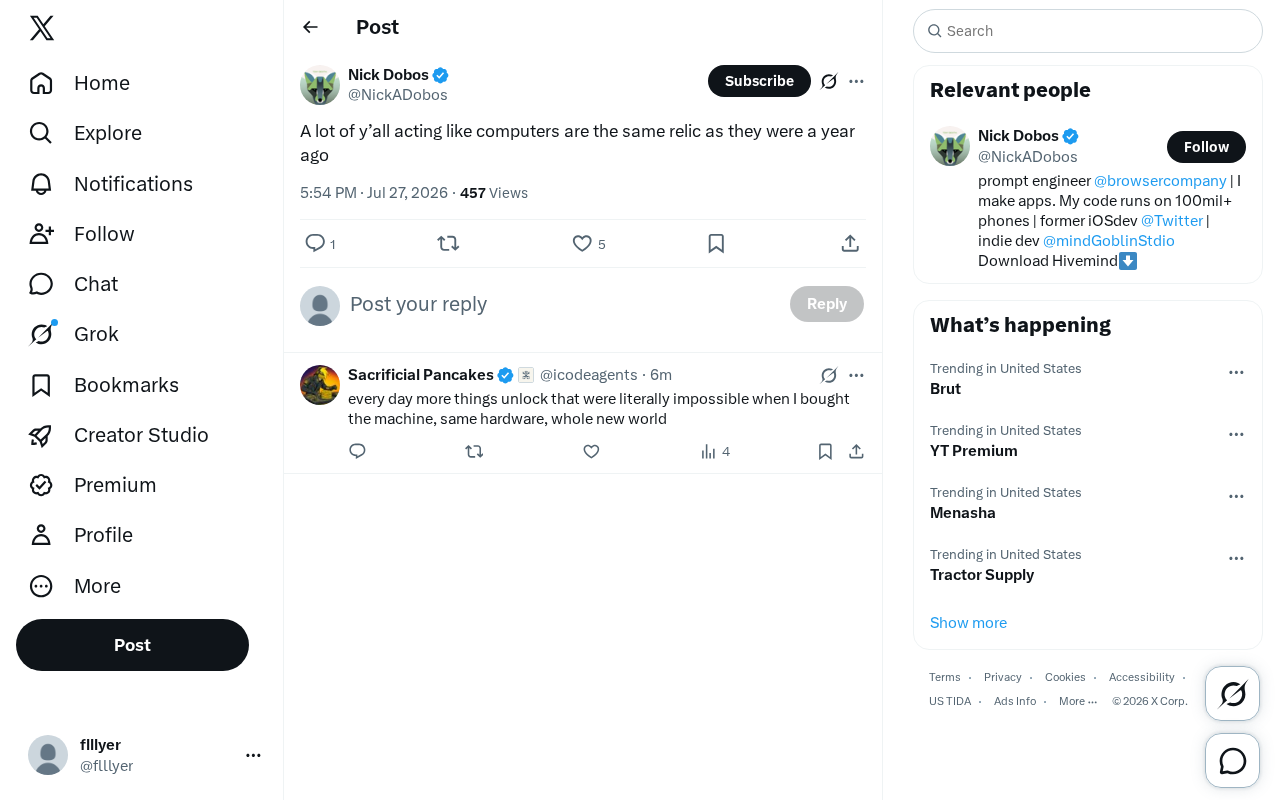
A quote has been making the rounds on social media recently: "Most people still look at their computers as if they're relics from a year ago." What seems like a casual quip actually hits on a reality that's being massively underestimated — under the force of generative AI, the very concept of a "computer" is undergoing a profound transformation.
Many people's understanding of personal computing devices is still stuck in the traditional paradigm of "open a browser, edit a document, run some software." But in just over a year, the explosive growth of AI capabilities has quietly altered the fundamental nature of computers as productivity tools. Our mental models tend to lag behind technological evolution, and that lag itself is precisely the issue most worth paying attention to right now.
How AI Reshaped Personal Computers in Just One Year
Rewind to just over a year ago, and you'll realize the capability boundaries of computing devices have been completely rewritten.
From Passive Tool to Intelligent Collaborator
Computers used to be fundamentally passive tools: you input a command, they execute an operation. Today, with large language models deeply integrated into operating systems and applications, computers are developing the ability to "understand intent" and "collaborate proactively." You no longer need to tell them precisely what to do at every step — just describe the outcome you want, and let the AI handle the rest.
Large Language Models (LLMs) are deep neural networks based on the Transformer architecture, trained on massive text datasets through pre-training to acquire the ability to understand and generate natural language. When these models are integrated into operating systems, they no longer run as standalone applications but become system-level services — capable of accessing contextual information across applications, understanding user workflows spanning different software, and providing a unified intelligent assistance experience. This deep integration means AI no longer requires users to actively switch to a specific tool; instead, it stands ready within their everyday workflows, proactively offering help.
This shift may seem subtle, but it represents a paradigm-level leap. From the deep integration of Windows Copilot, to the rollout of macOS Apple Intelligence, to the proliferation of various third-party AI assistants, computers are evolving from "execution tools" into genuine "intelligent collaborators." Microsoft's Copilot deeply hooks into the Windows system API and the Microsoft 365 ecosystem, providing context-aware intelligent suggestions while users edit documents, handle emails, and analyze data. Apple Intelligence, on the other hand, emphasizes a hybrid architecture of on-device inference and cloud collaboration, delivering personalized intelligent services while protecting privacy — including cross-app information understanding and smart summary generation.
The Rise of On-Device Computing Power and NPUs
Another easily overlooked change is happening at the hardware level. We used to evaluate computer performance based on CPU clock speed, memory size, and GPU model. Now, the NPU (Neural Processing Unit) has become the core metric for measuring a device's AI capability.
NPUs are hardware accelerators specifically optimized for matrix and tensor computations, with architectures specialized for the massively parallel multiply-accumulate operations found in deep learning inference. Unlike general-purpose CPUs and graphics GPUs, NPUs offer a significant advantage in power efficiency — they can complete AI inference tasks of comparable scale at far lower power consumption than GPUs. All major chipmakers have invested in NPUs: Qualcomm's Snapdragon X series integrates the Hexagon NPU (with over 45 TOPS of compute), Intel's Core Ultra series features a dedicated AI engine, and Apple's M-series chips have been iterating on their Neural Engine for years. The industry widely uses TOPS (Tera Operations Per Second) as the standard measure of NPU performance, and Microsoft has set 40 TOPS as the threshold for Copilot+ PCs.
The term "AI PC" is no longer a marketing gimmick — it has genuinely changed the feasibility of running AI models locally. Inference tasks that previously required cloud servers can now run smoothly on a laptop. This means both privacy protection and offline AI experiences have seen qualitative improvements. Users' data can be analyzed and processed without being uploaded to the cloud, and AI capabilities remain available on airplanes, in remote areas, and in any scenario without a network connection.
Cognitive Lag Is Creating a Massive Productivity Gap
Why does the phenomenon of "people treating their computers like relics" exist? The root cause lies in the human tendency to become desensitized to gradual change.
When transformation happens at exponential speed, our intuition remains linear. Research in evolutionary psychology shows that the human brain, over its long evolutionary history, adapted to linearly changing natural environments — the speed of prey, the cycle of seasons, the rise and fall of rivers are all linear or sub-linear. This evolutionary legacy leaves us inherently lacking intuitive grasp of exponential growth. The renowned futurist Ray Kurzweil calls this phenomenon the "intuitive linear view" and points out that when technology evolves exponentially, people tend to overestimate change in the short term (because expectations are inflated by hype) while drastically underestimating change in the long term (because the latter half of an exponential curve grows far beyond imagination).
Each small incremental update isn't enough to trigger alarm, but looking back and comparing with where things stood a year ago, the gap is staggering. The most direct cost of this cognitive lag is a massive disparity in productivity.
The Efficiency Gap Between Those Who Use AI and Those Who Don't
Today, the real gap is no longer about what hardware configuration you're running — it's about whether you've mastered the new way of working in collaboration with AI.
With the exact same device, someone who skillfully leverages AI can multiply their efficiency in writing, programming, data analysis, and content creation several times over. Meanwhile, someone clinging to old habits is essentially operating "this era's" machine with "last era's" methods. It's like holding a smartphone but only using it to make phone calls — the device's potential is severely wasted.
This efficiency gap is showing up across industries: in software development, engineers using AI coding assistants can increase their code-writing speed by over 55%; in content creation, creators who use AI for material gathering, outline generation, and first-draft writing achieve 3-5x the output of traditional methods; in data analysis, non-technical staff can use natural language to describe analytical requirements to AI and accomplish work that previously required professional analysts. The gap in tools themselves is narrowing — how you use those tools is becoming the core competitive advantage.
What Computers Are Becoming
Looking ahead at where this transformation is heading, the definition of a computer is extending in several key directions.
From Deterministic Computation to Probabilistic Reasoning
Traditional computing is deterministic: the same input always produces the same output. AI-driven computing introduces probability — it reasons, generates, creates, and even "makes mistakes."
From a technical perspective, the traditional Von Neumann computer architecture is based on deterministic logic gate operations, where a program's execution path is entirely determined by its input and algorithm. AI inference based on LLMs, however, is fundamentally a probabilistic sampling process: at each step when predicting the next token, the model generates a probability distribution and then selects output through sampling strategies (such as top-k, top-p/nucleus sampling, temperature adjustment, etc.). This means that even given the exact same input, the model may produce different outputs. This probabilistic nature isn't a flaw — it endows the system with creativity and flexibility, enabling it to handle open-ended questions with no standard answers, generate multiple possible solutions, and make reasonable inferences from ambiguous instructions.
This shift from deterministic to probabilistic gives computers, for the first time, the ability to handle ambiguous, open-ended problems — precisely the domain that was previously exclusive to humans. It also introduces a new usage paradigm: users need to learn to evaluate and filter AI outputs rather than blindly trusting every result. The optimal model of human-AI collaboration combines AI's probabilistic creativity with human judgment.
Natural Language Is Replacing Traditional Interfaces
The graphical user interface (GUI) has dominated personal computing for forty years. In the AI era, natural language is becoming the new interaction layer. Future computer operations may rely more on conversation and intent expression than on clicking menus and memorizing keyboard shortcuts.
The concept of natural language interfaces isn't an AI-era invention. As early as the 1960s, MIT's ELIZA program attempted to interact with users through natural language, but its practical value was limited by its rule-matching approach. Over the following decades, the command-line interface (CLI) gave way to the GUI, which in turn evolved into touch interfaces and voice assistants. However, it wasn't until large language models achieved breakthroughs that natural language interfaces gained the ability to truly understand complex intent for the first time. The current trend isn't about fully replacing GUIs, but rather forming a hybrid "natural language + GUI" interaction model — users can describe high-level intent through conversation, and the system decomposes it into specific GUI operation sequences for automatic execution. This model is known as an "AI Agent" or "Computer Use Agent."
This "dissolution" of interfaces will dramatically lower the barrier to technology adoption, allowing more people to unlock the full potential of their computing devices. Users who were previously shut out by complex software operations — whether new employees unfamiliar with Excel formulas or entrepreneurs who can't use professional design software — will gain equal access to advanced tools through natural language interaction.
Update Your Understanding of Computers — Now
The value of that tweet isn't in any profound technical insight. It's in the reminder it delivers: technology has already raced far ahead — has your understanding kept up?
Treating your computer as a static tool from a year ago isn't just a misreading of technological evolution — it could leave you behind in this productivity revolution. The truly smart move is to actively embrace these changes and relearn how to collaborate with the machine in your hands.
Concretely, this means a few things: regularly explore new AI features added to your devices and frequently used software; invest time in learning effective prompt-writing techniques; try integrating AI into your daily workflows rather than treating it as a novelty you use occasionally; and maintain an open mind toward new tools and new paradigms. Updating your understanding isn't a one-time event — it's an ongoing habit.
Because computers are no longer what they were a year ago — and a year from now, they'll be even more different.
Related articles

Qwen3 27B In-Depth Review: A Powerful Reasoner That Overthinks — and How to Fix It
In-depth review of Qwen3 27B's reasoning capabilities and overthinking problem. Analyzes performance advantages, causes of overthinking, and provides practical optimization solutions.

RL for Reasoning Only Changes 1-3% of Tokens? The Truth and Controversy Behind the Claimed 1000x Compute Savings
RL training for LLM reasoning only changes 1-3% of output tokens, with researchers claiming 1000x compute savings. We analyze the deep implications, non-uniform token distribution issues, and the gap between benchmarks and real usability.

AI Algorithm Engineer Self-Study Roadmap: A Complete Plan from Zero to Landing Your First Offer
A detailed AI algorithm engineer self-study roadmap covering foundations, core algorithms, CV/NLP direction selection, and career transition strategies for landing offers.