Connecting LangChain Agents to Structured External Data: Three Patterns and Core Challenges

LangChain agents connecting to structured data: three patterns, three-dimensional decisions, and layered decoupling.
The article discusses LangChain agents accessing structured external datasets such as SEC filings, census data, scientific publications, and Wikipedia. Community practices have distilled three main patterns: custom tool wrapping, MCP server intermediate layers, and retrieval pipeline preprocessing. The choice between real-time queries and vector ingestion depends on data change frequency, query precision requirements, and latency budget. Developers agree the real pain point is data normalization and freshness management. The consensus favors a layered decoupled architecture over a monolithic solution.
Why Structured Data Is the Weak Spot for LangChain Agents
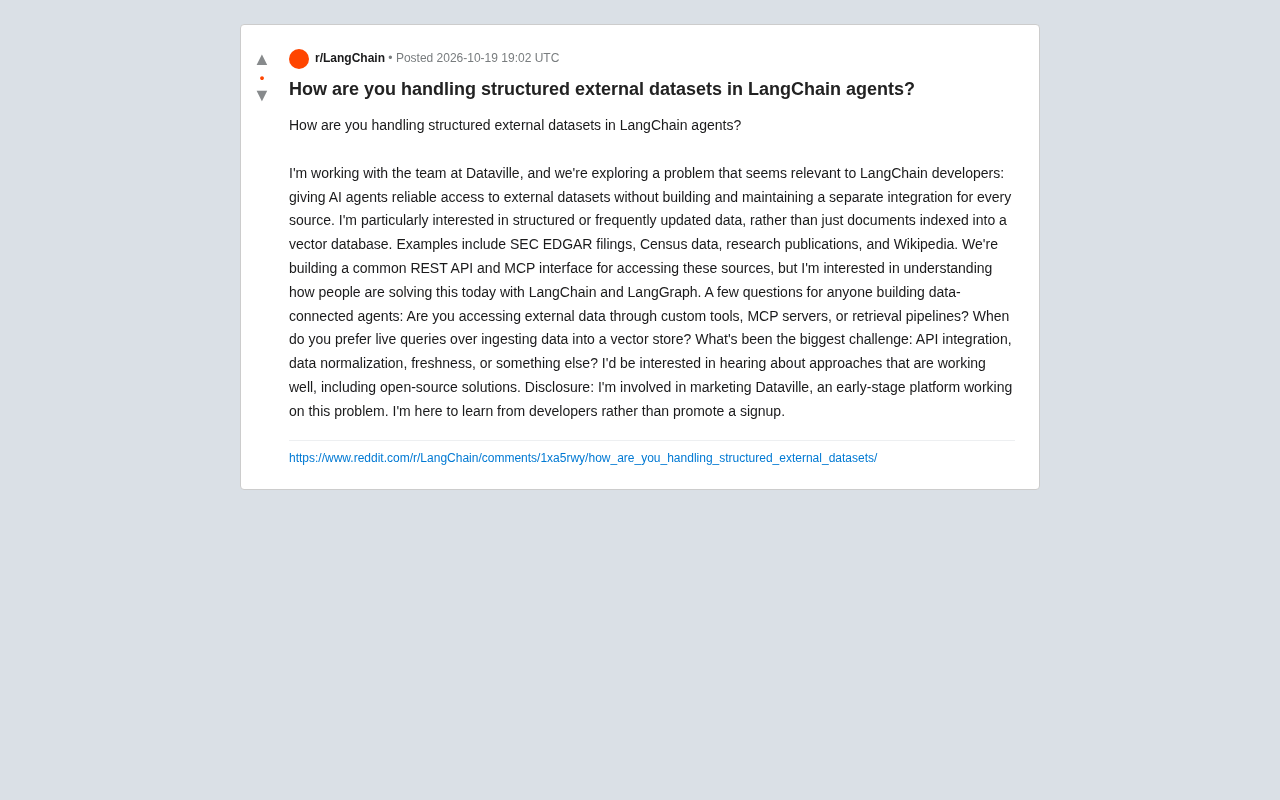
In the LangChain ecosystem, loading documents into a vector database for RAG is already a mature path. But when agents need to access structured, frequently updated external datasets like SEC EDGAR filings, census data, scientific publications, or Wikipedia, developers often face a dilemma: build a separate integration for each data source, or find a more general access layer?
A developer from the Dataville team raised this question on Reddit, admitting they are building a unified REST API and MCP interface to connect these data sources. The post quickly sparked discussion, with the core disagreement not being "whether to connect" but "how to connect without burying yourself in a maintenance quagmire."
Three Main Access Patterns: Custom Tools, MCP Servers, and Retrieval Pipelines
From community feedback, LangChain developers currently handle external structured data mainly through three paths, each with its own applicable boundaries.
Custom Tool Wrapping
The most direct approach is writing @tool-decorated functions for each data source, handling API calls, pagination, and error retries internally. The advantage is fine-grained control, allowing field trimming and caching strategies specific to each data source. The downside is also clear: N data sources mean N sets of authentication, rate limiting, and schema parsing logic, and the agent's tool list quickly balloons, leading to declining LLM accuracy in tool selection.
MCP Servers as an Intermediate Layer
The rise of the Model Context Protocol has led some developers to turn to MCP servers to uniformly expose data sources. One respondent mentioned that MCP's value lies in decoupling "data access" from agent logic—LangGraph nodes only handle orchestration, while data fetching is delegated to MCP. This is exactly what the Dataville team is doing, but the community still has doubts about its maturity, especially MCP's expressiveness in complex query parameters and transactional scenarios.
Retrieval Pipeline Preprocessing
For data with low update frequency and fixed query patterns (such as archived regulatory documents), many teams still choose offline ingestion into vector stores or SQL tables, with agents accessing them through retrievers or SQL tools. This approach offers low latency and controllable costs but sacrifices data freshness.
Model Context Protocol (MCP) is an open protocol proposed and open-sourced by Anthropic to standardize communication between LLM applications and external data sources and tools. It uses a client-server architecture: the agent side acts as an MCP client, interacting with one or more MCP servers via JSON-RPC, while servers encapsulate specific data source or tool capabilities and expose unified resource, prompt, and tool interfaces. For LangChain developers, MCP's significance lies in decoupling "how to connect to data" from "how the agent reasons," enabling the same access layer to be reused across different frameworks and models, reducing repetitive code for authentication, pagination, and schema parsing for each data source. Currently, the MCP ecosystem is still in its early stages, and its expressiveness and production maturity under complex query parameters, transaction semantics, and large-scale concurrency are key observation points for the community when assessing whether it can be relied upon.
Real-Time Queries vs Vector Ingestion: What Are the Criteria
The question in the original post about "when to prefer real-time queries over vector ingestion" elicited the most concrete experience sharing. Based on judgments from multiple developers, the decision typically depends on three dimensions:
Data change frequency is the primary factor. SEC filings update quarterly and census data annually—such low-frequency data is perfectly suited for pre-ingestion; while Wikipedia entries may be edited hourly, making real-time queries more reasonable.
Query precision requirements determine the architecture. Vector retrieval is essentially semantic approximation. When agents need precise numerical comparisons (e.g., "companies with revenue over $1 billion") or structured filtering, real-time querying of the original API is almost the only reliable choice.
Latency budget is an engineering constraint. The network latency and rate-limiting risks introduced by real-time API calls may be unacceptable in interactive agents, but are much more tolerable in batch or asynchronous scenarios.
One developer summed it up bluntly: "If the answer depends on precise fields, don't use embeddings to guess."
To determine whether a type of data is suitable for real-time queries or pre-ingestion, it's often helpful to first create a data profile: record the dataset's update cycle, the degree of field dependency in single queries, and the frequency and concurrency of agent calls to that data. If the update cycle is much longer than the usage window (e.g., annually published census data), pre-ingestion with periodic incremental synchronization yields the highest benefit; if field dependency is strong and precise filtering or aggregation is required, real-time querying of the original API is more reliable; if queries are frequent and some staleness is tolerable, a retrieval pipeline with a short TTL cache is a compromise. In practice, a hybrid approach can also be adopted: hot-cache frequently accessed subsets, pre-ingest low-frequency or historical data, and fall back to real-time APIs for queries requiring strong consistency, thereby balancing cost, latency, and freshness.
The Biggest Pain Point Isn't Integration, but Normalization and Freshness
When asked about the biggest challenge, the community's answers were strikingly consistent—API integration is just manual labor; data normalization and freshness are the real pitfalls.
Schemas vary greatly across data sources: date formats, currency units, missing value representations, and nesting levels all differ. After agents receive raw JSON in the tool call chain, they often need additional LLM steps for field mapping, which increases token costs and introduces uncertainty. Some developers suggest completing normalization at the MCP or tool layer, so agents see a unified abstract schema.
Freshness management is equally tricky. Caching strategies need to balance cost and timeliness, and invalidation detection (how to know upstream data has changed) often lacks standard mechanisms. Dataville's unified interface approach targets exactly this, but community feedback indicates that early platforms still need to be watched regarding data coverage depth and SLAs.
A detail worth noting: several developers mentioned that open-source solutions have already accumulated in this area, such as dbt-based schema transformation layers, Airbyte's incremental synchronization, and caching plugins for various API gateways—these can be combined with LangGraph orchestration layers rather than reinventing the wheel.
Data normalization refers to mapping raw fields from different sources into a unified, predictable abstract schema, including unified date and time formats (e.g., ISO 8601), currency units and precision, representation of missing values and empty strings, boolean and enum values, and flattening rules for nested structures. For LLM agents, normalization not only reduces the additional reasoning steps and token consumption required for field mapping but also lowers uncertainty in the tool call chain. A common practice is to perform alignment using declarative mappings or lightweight transformation layers after the access layer and before entering the agent context, with schema validation intercepting anomalous data before it reaches the agent. Freshness management relies on observable invalidation detection mechanisms, such as upstream-provided ETags, Last-Modified headers, or change logs, combined with cache TTLs and incremental synchronization strategies tiered by data change frequency; when standard invalidation signals are lacking, sampling comparison or checksum polling can serve as fallbacks.
Practical Advice: Layered Decoupling Rather Than a Monolithic Solution
From the consensus in the discussion, rather than pursuing a one-size-fits-all data access solution, it's better to layer the architecture:
- Access layer uses MCP or a lightweight API gateway for unified authentication and rate limiting
- Normalization layer completes schema alignment before entering the agent context
- Cache layer sets TTLs tiered by data change frequency
- Orchestration layer has LangGraph route to real-time queries or retrieval pipelines based on query type
This layering allows each component to evolve independently and prevents data source details from leaking into the agent's prompts and tool definitions. For teams building data-connecting agents, this may be a more pragmatic path than waiting for some "standard answer."
One-line Summary
LangChain agents connecting to structured data: three patterns, three-dimensional decisions, and layered decoupling.
Paragraph Summary
The article discusses LangChain agents accessing structured external datasets such as SEC filings, census data, scientific publications, and Wikipedia. Community practices have distilled three main patterns: custom tool wrapping, MCP server intermediate layers, and retrieval pipeline preprocessing, each with applicable boundaries. The choice between real-time queries and vector ingestion depends on three dimensions: data change frequency, query precision requirements, and latency budget. Developers generally agree that the real pain point is not API integration but data normalization and freshness management. The final consensus favors a layered decoupled architecture—access layer, normalization layer, cache layer, and orchestration layer each fulfilling their roles—rather than pursuing a monolithic solution.
Related articles

WorkBuddy Full Guide: How an AI Coworker Takes Over Workplace Automation
What is WorkBuddy? This article analyzes the core capabilities of this full-scenario AI agent: autonomous execution with deliverable results, local file processing, multi-agent parallelism, and workplace automation workflows, helping you judge its essential difference from ordinary AI chat tools.

The Truth About AI Agents: A Hundred Lines of Code + an LLM, Deconstructing the Agent's Underlying Logic
AI agents aren't a new AI species—just a language model plus tools, a loop, and a goal. Here's the underlying logic: how 100 lines of Python hit a 75% fix rate, why the harness beats the model, and Gartner's "agent washing."

AI Agent Deployment: Three Things Developers Should Do
AI Agent deployment doesn't require rushing into multi-agent systems. This article outlines an actionable deployment path and engineering acceptance thresholds for developers, covering human baselines, bounded single-agent scope, and a controlled code-modification loop.