Construct Computer: Give Your AI Employee a Computer, Get Your Day Back
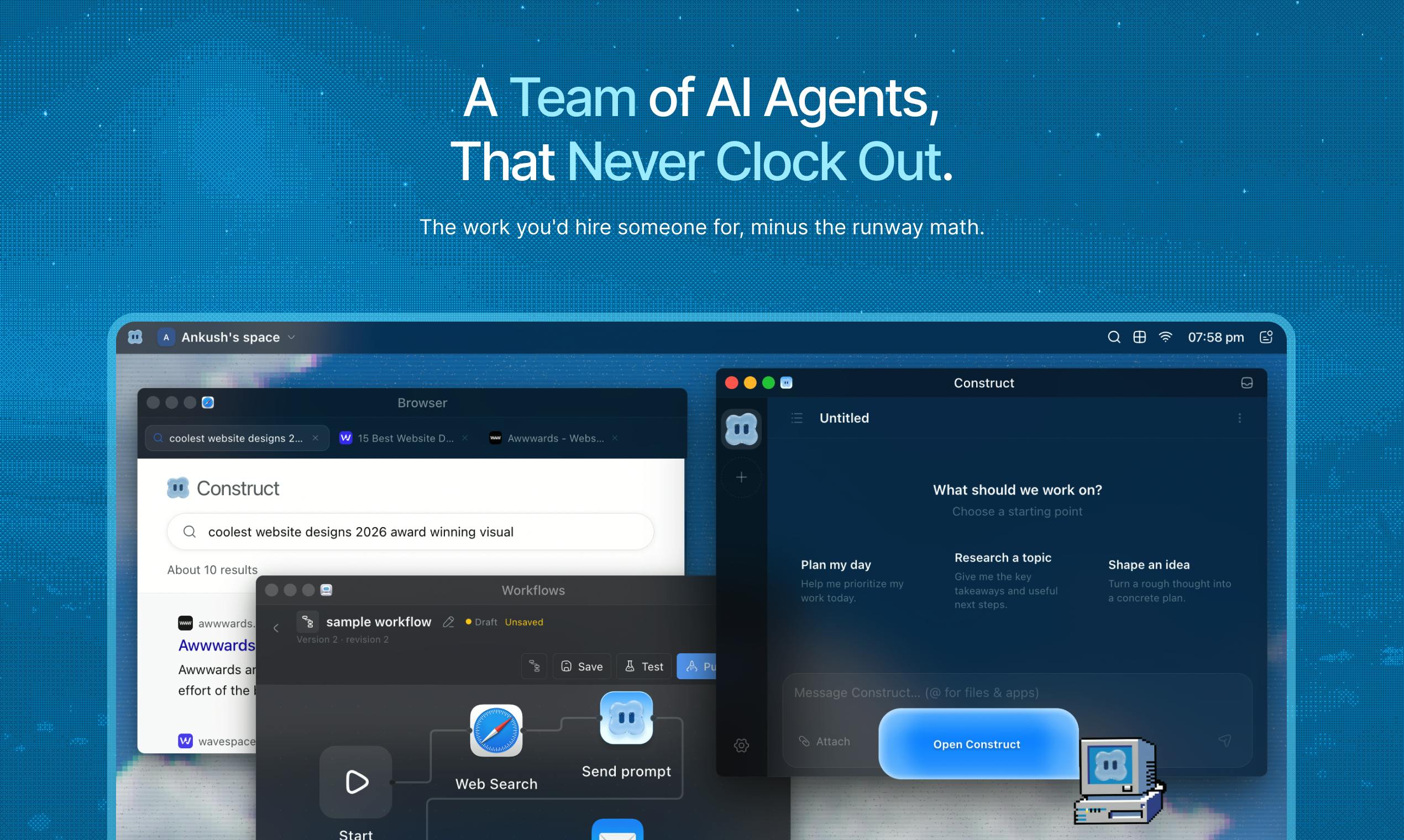
Construct Computer gives AI employees their own computer to handle work so you don't have to.
Construct Computer topped Product Hunt's daily chart by offering AI "digital employees" with their own computing environments. The platform lets users install capabilities via MCP, enables Agents to build their own tools when needed, and converts successful operations into reusable deterministic workflows. Targeting solo founders and small teams, it aims to replace repetitive labor by balancing probabilistic AI with deterministic business needs.
When AI Moves Beyond Chat Assistants
Recently, a product called Construct Computer topped the Product Hunt daily chart with 134 votes. Its slogan is hard to miss: "Your AI coworker gets a computer. You get your day back." Product Hunt is the world's most influential platform for discovering new tech products, where the community votes daily to select the best from hundreds of new launches. Topping the daily chart signals strong endorsement from early technology adopters — many well-known products like Notion and Figma gained their initial growth momentum through this very platform.
Behind that slogan lies a paradigm shift already underway: AI is evolving from a "conversational tool" into a "digital employee." We've grown accustomed to treating AI as a Q&A assistant — you ask, it answers. Construct Computer, however, aims to give AI its own "workstation" — a virtual computer capable of installing applications, building tools, and executing tasks.
The product has a clearly defined target audience: solo founders and small teams. These users typically wear many hats and lack dedicated personnel to handle repetitive operations, data processing, and tool-building work. Construct Computer aims to fill precisely this gap — the space where there's no budget to hire, but the work still needs to get done.
Core Philosophy: Building an AI Workforce
Unlike most AI Agent products on the market, Construct Computer emphasizes building an "AI workforce" rather than a single intelligent agent. An AI Agent refers to an AI system capable of perceiving its environment, making autonomous decisions, and executing actions. The core difference from traditional chatbots is that an Agent can proactively plan multi-step tasks, invoke external tools, and adjust strategies based on intermediate results — rather than merely answering questions passively. Construct Computer's product logic can be broken down into several key design elements:
Installing Capabilities Like Apps
The product description mentions that any MCP (Model Context Protocol) or skill can be installed like an app. This means users can equip their AI employees with new capabilities without writing complex integration code — whether it's connecting to a database, calling third-party APIs, or operating a SaaS tool.
MCP is an open protocol released by Anthropic in late 2024, designed to standardize how AI models interact with external tools and data sources. Before MCP, every AI application that wanted to connect to external services (like Slack, Google Sheets, databases, etc.) required custom integration code, resulting in massive amounts of redundant development work. MCP defines a unified communication specification that enables AI models to discover, invoke, and use external tools in a standardized way — its design philosophy is similar to how the USB protocol enables plug-and-play for various peripherals. Major AI vendors including OpenAI and Google have also announced MCP support, making it a de facto industry standard. Construct Computer productizes MCP into an "app store"-style experience, lowering the barrier for everyday users to access advanced Agent capabilities.
When a Tool Doesn't Exist, the Agent Builds It
Even more imaginative is another key claim: when a needed tool doesn't exist, the Agent builds it itself. The platform handles deploying and managing these AI-generated tools, which can be shared across the entire team.
This effectively transforms "Agent capability expansion" from a static plugin marketplace into a dynamic, self-growing system. When a team encounters a specific, niche workflow requirement, there's no need to wait for a vendor to develop a solution or write code themselves — the AI employee can build the tool on the spot, and once built, it can be retained for the entire team to reuse. This "AI self-built tools" capability technically relies on the increasingly mature code generation abilities of large models — the most advanced models currently achieve pass rates exceeding 90% on code generation benchmarks. Combined with automated testing and sandbox environments, AI-generated tools already have production-ready viability in specific scenarios.
From "Thinking" to "Doing": The Efficiency Flywheel of Workflow Reuse
The most noteworthy aspect of Construct Computer's product design is how it handles workflow reuse:
"Any Agent action you're satisfied with gets converted into a reusable workflow, so the Agent spends less time thinking and more time doing."
This statement highlights a core pain point of current AI Agents: every task execution requires fresh "reasoning," which is slow, expensive, and inconsistent. Large model inference is billed by the number of tokens consumed — a token is the smallest unit of text processing, roughly equivalent to 3/4 of an English word. When an AI Agent performs complex tasks, it needs multiple rounds of reasoning: analyzing the task, formulating a plan, selecting tools, executing operations, and verifying results — each round consuming substantial tokens. With GPT-4-class models, for example, a single complex task's inference cost can reach several dollars. If you run dozens of similar tasks per day, costs quickly accumulate to staggering levels. Furthermore, large model outputs have inherent randomness (controlled by parameters like temperature) — the same input may produce different outputs, posing a fundamental challenge for business scenarios requiring consistent results.
Construct Computer's solution is to solidify "verified successful paths" into workflows. The first time a task is performed, the Agent needs to think through it. Once you confirm the result is satisfactory, the operation sequence gets recorded as a deterministic workflow. The next time a similar task arises, the Agent executes the established process directly, without re-reasoning.
This is essentially replacing probability with determinism — trading a one-time "thinking cost" for long-term "execution efficiency." In software engineering, a deterministic system is one that always produces the same output given the same input — this is the foundation of enterprise trust in software. Large models are inherently probabilistic, which poses a fundamental challenge for production deployment — enterprises need predictable, auditable results. Solidifying verified AI operations into deterministic workflows essentially strikes an elegant balance between probabilistic AI capabilities and deterministic business requirements. For solo entrepreneurs who repeatedly handle similar tasks, this "faster and cheaper with use" flywheel effect may have more practical value than raw conversational ability alone.
Positioning and Competition: Differentiation in a Crowded Space
It must be acknowledged that "AI employees" and "AI Agent platforms" represent one of today's most crowded spaces. From Devin-style AI programmers to various automation workflow platforms, the field is packed with players. Devin was released by Cognition Labs in March 2024 and was dubbed the "first AI software engineer," capable of independently completing the entire development process from requirement understanding to code writing, debugging, and deployment. Its emergence marked the transition of AI Agents from proof-of-concept to actual productization. The major players in this space currently span multiple sub-categories: coding-focused Devin and Cursor, automation workflow-focused Zapier AI and Make, browser operation-focused Multion and Browserbase, and comprehensive framework platforms like LangChain and CrewAI.
For Construct Computer to stand out, its differentiation manifests in three dimensions:
- Giving the Agent a "computer": Emphasizing that AI has an independent execution environment (typically a cloud-based virtual machine or containerized environment), rather than operating solely within a chat window. This design grants the Agent full computing capabilities including file system access, application installation, and persistent storage — more closely approximating the complete form of a "digital employee";
- Agent self-built tools: Not dependent on a fixed plugin ecosystem, with self-expansion capabilities — when existing tools can't meet requirements, the Agent can autonomously write, test, and deploy new tools;
- Team collaboration and sharing: Installed skills, generated tools, and accumulated workflows can all be shared within the team, creating a degree of network effect — the larger the team and the longer it's been in use, the richer the reusable assets, and the higher the marginal efficiency for each member.
However, these compelling product narratives come with questions yet to be validated: How reliable are AI self-built tools? How robust are deterministic workflows when facing business changes — for instance, when API interfaces update or data formats change, can solidified workflows adapt automatically? And most critically — for non-technical solo founders, is the actual learning curve truly low enough? After all, balancing "low barrier" and "high capability" has always been the greatest design challenge in productizing AI tools.
Conclusion: The Next Stop for AI Collaboration
Construct Computer topping the Product Hunt charts reflects strong market demand for "AI that can actually get work done." The vision it paints — AI employees with their own computers, capable of installing abilities, building tools, and accumulating workflows — represents the direction of AI applications evolving from "assisting humans" to "replacing repetitive labor."
From a broader perspective, this trend is closely connected to the "Agentic AI" wave. Multiple research institutions and investment firms predict that 2025 will be the inaugural year of large-scale AI Agent deployment, with enterprise demand for AI systems capable of autonomously completing end-to-end tasks growing rapidly. Gartner predicts that by 2028, at least 15% of day-to-day work decisions will be made autonomously by AI Agents.
For resource-strapped solo entrepreneurs and small teams, the real value of products like this isn't about showcasing technology — it's about whether they can truly "give you your day back." Whether Construct Computer can deliver on that promise still needs to be tested in real-world work scenarios. But regardless, the "AI workforce" paradigm it proposes deserves the attention of anyone following AI productivity tools.
Related articles

Chain of Thought Isn't Just for AI: How Humans Can Use CoT to Improve Thinking Quality
Chain of Thought isn't just a prompt trick for large models. Starting from a Hacker News discussion, this article analyzes why CoT works for human thinking too, breaks down actionable ways to transfer it, and highlights the key differences between human CoT and machine CoT.
Cloudflare Teams Up with OpenAI: Closi…
Cloudflare Teams Up with OpenAI: Closing the Loop from Vulnerability Discovery to Defense with AI
Cloudflare uses OpenAI Daybreak to investigate security vulnerabilities and generate reviewable remediation plans, while developers use Codex to boost coding efficiency and quality.

Orca Multi-Agent Orchestration in Practice: A Guide to Parallel Collaboration with Claude and Codex
Orca is Stable AI's free open-source agent workbench supporting 34 agents like Claude Code and Codex in parallel. Learn its Git worktree isolation, multi-model orchestration, and mobile management.