context-mode: The Context Window Optimizer Built for AI Coding Agents

context-mode sandboxes tool output, persists session memory, and uses MCP routing to optimize AI coding agent context windows.
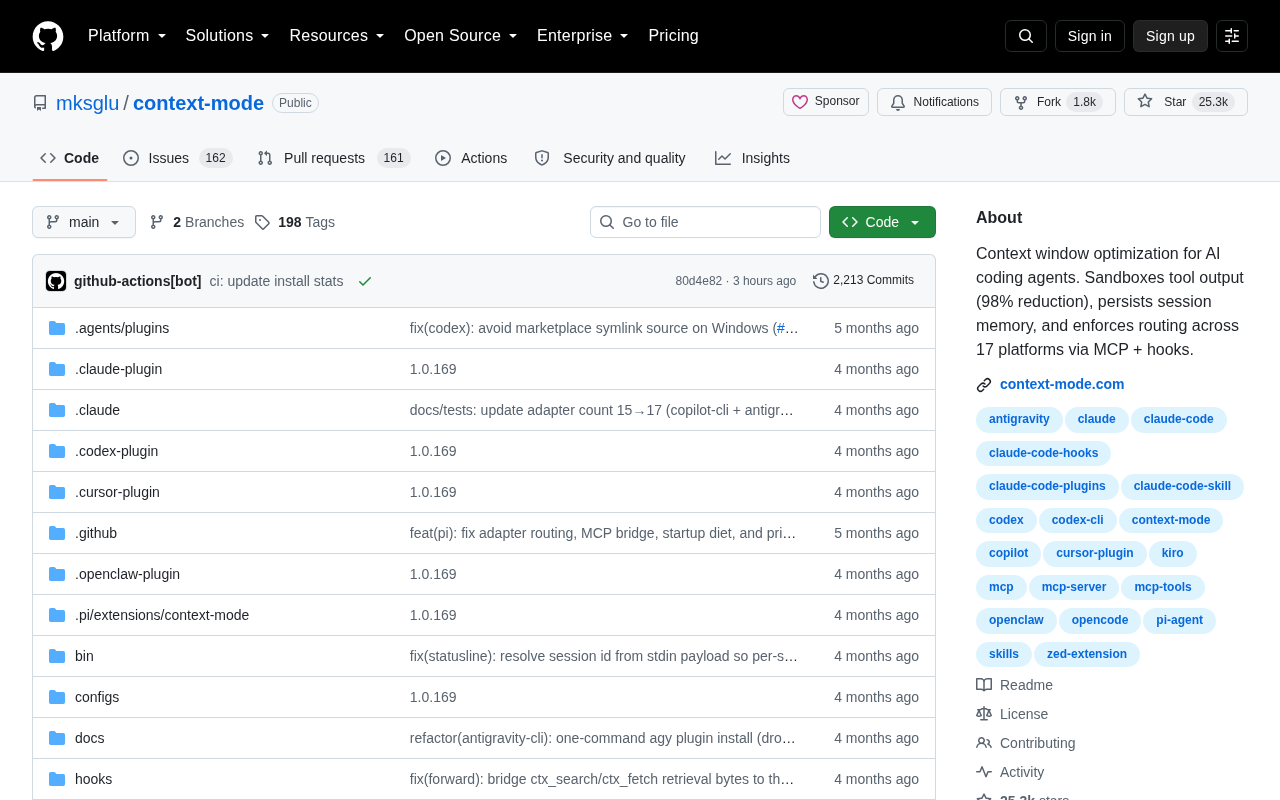
AI coding agents face a core challenge: tool calls generate massive output that rapidly exhausts the context window, causing task interruptions. The open-source project context-mode addresses this with three capabilities: sandboxing tool output for a claimed 98% size reduction, persisting session memory for continuity across long multi-step tasks, and using MCP with hooks to unify tool call routing across 17 platforms. Written in TypeScript and positioned as an optimization middleware layer for existing AI coding agents, it has accumulated over 25,000 GitHub stars. Note that the 98% reduction figure is scenario-specific — real-world results will vary, and hands-on testing is recommended.
Why AI Coding Agents Need Context Optimization
There's an unavoidable pain point in real-world AI-assisted development: the context window is a finite resource. Whether you're working with Claude, GPT, or any other large language model, there's a hard cap on the number of tokens each conversation can process. When a coding agent repeatedly calls tools, reads files, and executes commands, the sheer volume of tool output quickly fills up that context — causing the model to "forget" earlier content, slow down, or hit the window limit and abort the task entirely.
The open-source project context-mode was built specifically to address this problem. It positions itself as a "context window optimization solution for AI coding agents," with a core approach built around three ideas: sandboxing tool output, persisting session memory, and enforcing routing rules across up to 17 platforms. The project has already earned over 25,000 stars on GitHub, gained 256 new stars in a single day, and racked up 1,807 forks — a strong signal of community interest.
Three Core Capabilities, Explained
Tool Output Sandboxing: 98% Context Reduction
The most eye-catching claim from context-mode is its sandboxed handling of tool output, which the project says achieves a 98% reduction in context size. In a typical coding agent workflow, a single grep search, directory listing, or log dump can easily span hundreds or thousands of lines. Most of that content plays little role in the model's actual decision-making, yet it still burns through valuable token budget.
Through its sandboxing mechanism, context-mode isolates verbose raw output and feeds only distilled, relevant information back to the model. If that 98% figure holds up in real-world scenarios, it means a context that would previously support only a few rounds of interaction could now sustain dozens — dramatically extending an agent's effective "runtime" within a single session.
"Sandboxing" here doesn't mean security isolation. It refers to routing tool output through a controlled processing environment where it's refined before being passed to the model. The underlying logic resembles summarization or relevance filtering in information retrieval: if a tool returns a 10,000-line log file, the agent may only need the 20 lines containing error messages. The sandbox performs this filtering before raw content ever enters the context window, rather than letting it consume token budget upfront. This "tool output preprocessing" approach shares its DNA with re-ranking and truncation in RAG (Retrieval-Augmented Generation) pipelines — both are fundamentally about reducing noise before information reaches the model, increasing the information density per token.
Persistent Session Memory
The second capability is persistent session memory. Coding tasks typically span many steps, and an agent needs to retain prior decisions, track which files have been modified, and keep a running list of unfinished items. context-mode persists this memory across sessions, so the agent doesn't need to be "caught up" from scratch every time — a particularly significant advantage when working with large codebases or long-running tasks.
Enforced Routing Across 17 Platforms
The third capability is enforced routing across up to 17 platforms, implemented via MCP (Model Context Protocol) and hooks. MCP has been gaining traction as a standard protocol in the AI tooling ecosystem, providing a structured way for models to interact with external tools and data sources. By combining MCP with hook mechanisms, context-mode centrally manages tool-calling behavior across different platforms, ensuring that calls are dispatched and handled according to defined rules.
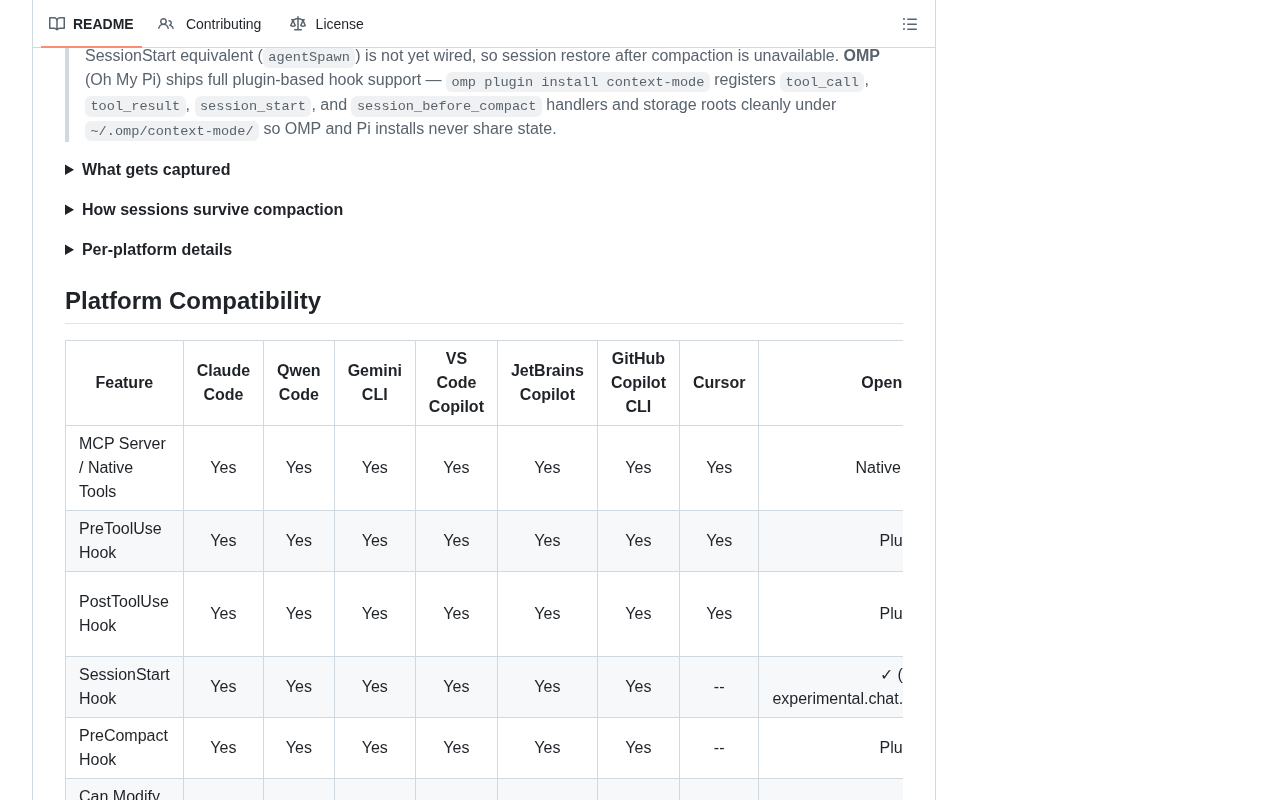
MCP (Model Context Protocol) is an open standard protocol open-sourced by Anthropic in late 2024, designed to solve the fragmentation problem in how AI models connect to external tools and data sources. Before MCP, every AI application had to write custom integration code for each data source and tool, making maintenance costly. MCP defines a standardized client-server architecture: the model acts as the client, and various tools (file systems, databases, browsers, code execution environments, etc.) act as servers, all communicating through a unified protocol. This is analogous to how HTTP works in web development — any tool that speaks the protocol can be plugged in without per-model adaptation. The hooks mechanism allows custom logic to be inserted at specific points in a tool call's lifecycle (before the call, after the call, on error, etc.). context-mode leverages this to intercept and compress tool output before it's returned to the model.
Tech Stack and Ecosystem Positioning
context-mode is written in TypeScript, making it a natural fit for the Node.js-based AI toolchain ecosystem and lowering the barrier for frontend and full-stack developers to contribute or extend it. Its choice of MCP as the underlying protocol signals an intent to integrate with the open tool protocol standards being driven by Anthropic and others, rather than building a proprietary closed system.
In terms of positioning, context-mode is not a standalone coding agent — it's an optimization middleware layer for existing coding agents. It addresses the universal problem of "how do you keep an agent running longer and more reliably within a constrained context?" and is theoretically applicable to a wide range of AI coding tools. That broad applicability likely explains why it's accumulated such notable community traction so quickly.
Practical Value for Developers
For developers who rely heavily on AI coding assistants day-to-day, context-mode targets a real efficiency bottleneck. Having the context filled up by tool output is a common frustration when using AI agents — a task gets partway through and the model starts "forgetting" earlier context, forcing the user to repeatedly re-explain what's already been established.
If the sandboxing and memory persistence work as described, the direct benefits include: fewer task interruptions caused by context overflow, lower token consumption (and therefore lower API costs), and more consistent agent behavior across long tasks. For teams, unified cross-platform routing also helps standardize how AI tools are used organization-wide.
A word of caution: claims like "98% reduction" are typically measured in specific scenarios, and real-world results will vary depending on agent type, task complexity, and configuration. Developers who are interested should run their own tests within their actual workflows before committing to a full adoption.
Conclusion
context-mode targets a concrete and widespread pain point in the deployment of AI coding agents, addressing it through three levers: tool output sandboxing, session memory persistence, and protocol-based routing. A community response of over 25,000 stars suggests this direction resonates with a large number of developers. For teams and individuals who are regularly running up against context window limitations, it's worth adding to your evaluation list — and validating its claimed optimizations through real-world testing.
Related articles

CSS Anchor Positioning: A New UI Positioning Approach Without JavaScript
A deep dive into CSS Anchor Positioning: from anchor-name and position-anchor to the anchor() function, position-area shorthand, position-try-fallbacks, anchor-size, and upcoming anchor queries.

New AI Chart Interaction: Continuous Follow-up Questions and Visualization in Conversation
Explore a new AI interaction method for continuously generating charts in conversation. Use the /visualize command to ask follow-up questions and visualize answers in the same chat window, improving data analysis efficiency.

Cursor Merges Into X Subscription: Paid Plans Share Unified Usage Pool, Grok Model Coding Usage Doubled
Cursor joins The X Subscription with a unified usage pool and doubled Grok coding quota. Third-party models shift to API pricing. Existing users can keep or migrate plans.