ContextsBase: Context Infrastructure That Gives Coding AI Agents a Memory
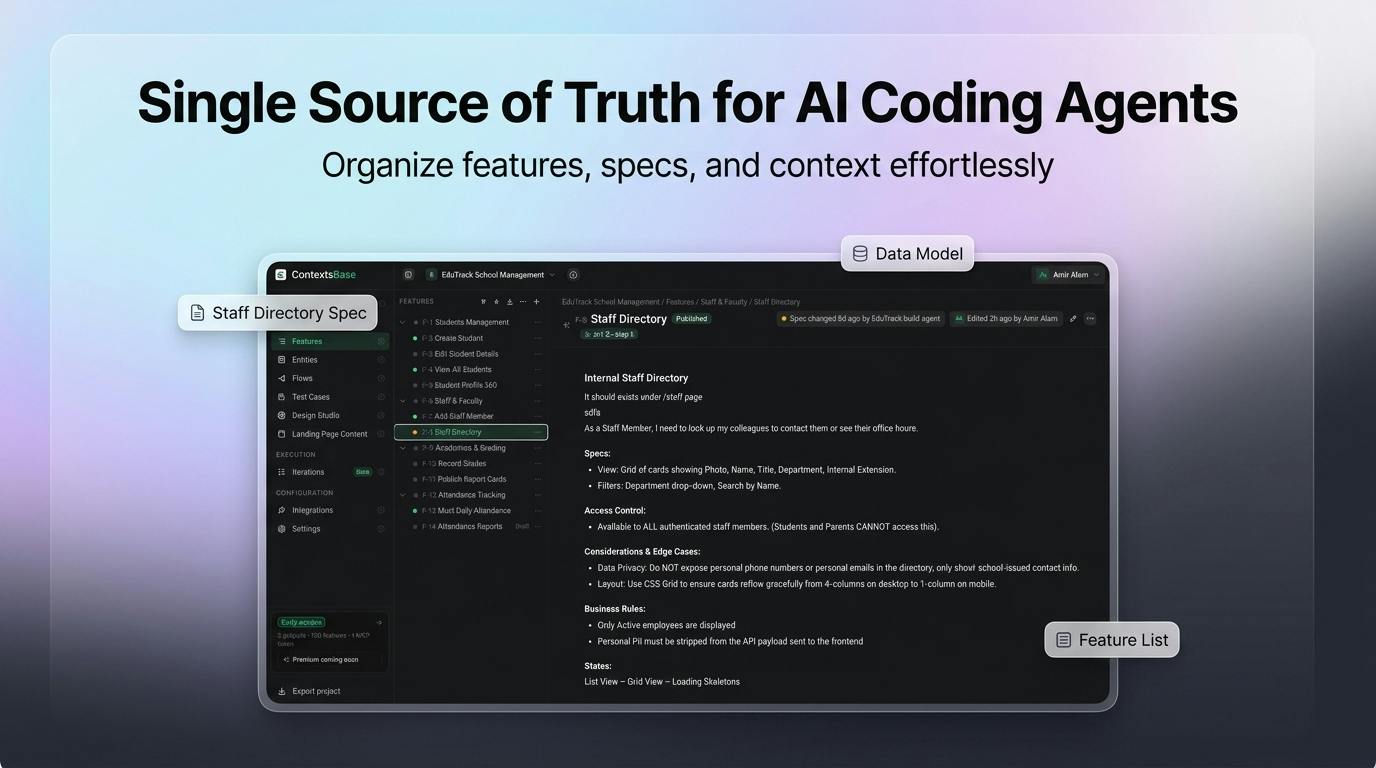
ContextsBase uses MCP to give coding AI agents persistent, structured context — solving the session memory problem.
Coding AI assistants universally suffer from cross-session memory loss, forcing models to relearn project context on every conversation. ContextsBase addresses this by consolidating project features, business rules, data models, tests, and design into a structured context library, exposed via the open MCP protocol so Claude, Cursor, Copilot, and other tools can all tap the same source. The approach reflects a broader layering trend in AI coding toolchains, shifting competition from raw model capability to context quality. The product launched on Product Hunt with 67 upvotes and remains in early validation, with context sync and multi-user collaboration details still to be refined.
The "Amnesia" Problem in Coding AI — And How to Fix It
Today's coding assistants are impressively capable — Claude, Cursor, and Copilot can all understand requirements, generate code, and fix bugs. But they share a common weakness: no persistent memory of your project. At the start of every session, the model often has to re-learn the entire codebase, business rules, and data structures from scratch. This context fragmentation leads to redundant effort and inconsistent output.
ContextsBase, which recently launched on Product Hunt, targets exactly this pain point. Its positioning is straightforward: Context Infrastructure for Coding Agents. Built by maker Amir Alam, it earned 67 upvotes on launch day, landing at #20 on the daily leaderboard under the Developer Tools and Artificial Intelligence categories.
What Does It Actually Provide?
The core philosophy of ContextsBase can be summed up in the team's own words: "We supply what they build from." In other words, the coding AI handles the writing — ContextsBase handles the feeding — organizing key project context in a structured way and making it available to the model.
According to the product description, the context it manages spans several dimensions:
- Features: A catalog of capabilities the project needs to implement
- Business rules: The constraints that govern code logic
- Data model: Data structure and relationship definitions
- Tests: Test cases that validate expected behavior
- Design: Architecture and UI design information
Rather than staying scattered across documents, comments, or developers' heads, all of this is consolidated into a structured "memory bank" that AI agents can query.
MCP Protocol Is the Key Interface
The most noteworthy technical decision in ContextsBase is its use of MCP (Model Context Protocol) as its external interface. MCP is an open protocol that has seen rapid adoption recently, designed to standardize how external data sources and tools are connected to large language models.
This design means ContextsBase isn't locked to any single model or IDE. Whether you're using Claude, Cursor, or Copilot, you can "Bring your own agent" and connect it to the same context source. For developers, this reduces the risk of tool lock-in — your context assets live in ContextsBase, while the coding assistant at the front end can be swapped freely based on your needs.
From a product strategy perspective, this reflects a broader layering trend in the AI coding toolchain: the base layer is model capability, the middle layer is connectivity protocols like MCP, and ContextsBase is staking its claim at the "context hub" layer.
What is MCP? The Model Context Protocol was proposed and open-sourced by Anthropic in late 2024 to address the fragmented integration problem between large models and external tools or data sources. Before MCP, every AI application had to write custom adapter code for each data source — a maintenance nightmare. MCP defines a unified client-server architecture: the model or AI agent acts as the client, while external tools, databases, and file systems act as servers, communicating through a standardized message format. Developers implement an MCP server once, and in theory every MCP-compatible model or IDE can call it directly without re-implementation. Claude, Cursor, and other mainstream tools have already announced MCP support — which is exactly why ContextsBase chose it as its interface. Betting on a standard that the industry is converging around carries far less ecosystem risk than building a proprietary protocol.
Why "Context" Is Becoming the New Battleground
Over the past year, the competitive focus in coding AI has gradually shifted from "how powerful is the model" to "how much accurate context can the model access." Even the strongest model, if it doesn't understand a project's business rules and data structures, can only generate code that looks plausible but falls apart under scrutiny.
By packaging features, rules, data models, tests, and design into structured context, ContextsBase is fundamentally tackling two engineering challenges: AI hallucination and context loss. It makes the code agents generate more aligned with actual project constraints, rather than making things up.
This "context as infrastructure" mindset belongs to the same wave as vector databases and memory layers — everyone is trying to fill in the missing piece of long-term memory and domain knowledge for AI.
Vector Databases and Memory Layers are important background for understanding this trend. Vector databases (such as Pinecone, Weaviate, and pgvector) convert unstructured content like text and code into high-dimensional numerical vectors, enabling models to find relevant context through semantic similarity rather than keyword search — a core component of RAG (Retrieval-Augmented Generation) architectures. Memory layers go a step further, attempting to give AI agents persistent memory across sessions; representative projects include Mem0 and LangMem. Where ContextsBase differs is in its entry point: vector databases and memory layers tend toward general-purpose infrastructure, while ContextsBase focuses specifically on the coding scenario, pre-structuring context into semantically clear categories like features, rules, and data models to reduce ambiguity during retrieval. Essentially, it does more engineering work at the "raw material processing" stage.
Observations and Caveats at This Stage
It's worth noting that ContextsBase is still an early-stage product. The 67 upvotes and 1 comment on Product Hunt indicate it's still in the validation phase, and public information on the actual user experience, context update mechanisms, and multi-person collaboration scenarios remains limited.
For developers, a few questions are worth watching: How does the context stay in sync with the codebase? How high is the maintenance cost of structured upkeep? And what meaningful advantage does it offer over simply dropping markdown documents directly in the repo? These questions can only be answered after real hands-on use.
Wrapping Up
ContextsBase represents a clear direction in the evolution of AI coding tools: upgrading context from "a one-time input fed to the model" to "a sustainably maintained piece of infrastructure." By leveraging the MCP protocol to stay open and compatible, it's positioning itself as a shared memory layer behind various coding agents.
The concept is compelling, but the product still needs time to mature. For teams frustrated by their AI assistants' "poor memory," it at least offers a solution worth keeping an eye on.
Related articles
Free Open-Source Tool Rejected: The Community Controversy Sparked by r/DnD's AI Ban
A free open-source DnD campaign tool was rejected by r/DnD's AI ban — yet the same tool was approved a year ago. The case highlights the blurry line between AI tools and AI-generated content.

What LLMs Can You Run with 1.9TB of RAM? Exploring the Ceiling of Local AI Deployment
A Reddit user with 1.9TB of RAM sparked debate about local LLM deployment. We break down what massive RAM enables, where CPU inference falls short, and the real bottlenecks.
Researchers Use Claude to Hack OpenAI Systems: A New Wake-Up Call for AI Security
Security researchers used Anthropic's Claude to breach OpenAI systems, taking over employee accounts and accessing internal repos. What this means for AI security.