Contract-Explicit Evaluation: Issuing Scoped Certificates for Model Evaluation

The paper proposes a contract-explicit evaluation protocol that quantifies ranking reversals caused by changes in evaluation contracts and certifies reliable comparisons.
Leaderboard rankings are highly dependent on evaluation contracts—gold-standard versions, scoring functions, and thresholds—and contract changes may cause ranking reversals, while existing methods cannot determine which comparisons still hold after reversal. An arXiv paper proposes a five-step "contract-explicit evaluation" protocol: Declare, Measure, Scope, Certify, Hedge, operationalizing Kendall's rank correlation decomposition to delineate certifiable regions for model comparisons and provide distribution-free census certificates. In a DocRE audit, 44 training runs yielded a census certificate with a Clopper–Pearson upper bound of 0.146; in an LLM judge census covering 17 judges and 49,938 battles, 12.25% of leaderboard comparisons required hedging, and 65% of disputed battles were attributed to judge errors. The paper releases the protocol, maps, ledgers, and per-instance artifacts, advocating for more honest scoped claims rather than a single precise ranking.
Model evaluation rankings often look set in stone, but a new study points out that these rankings are highly dependent on the "evaluation contract"—the gold-standard version, scoring function, and thresholds. Change the contract, and rankings may reverse outright. More troublesome is that existing methods cannot determine which comparisons still hold after such reversals.
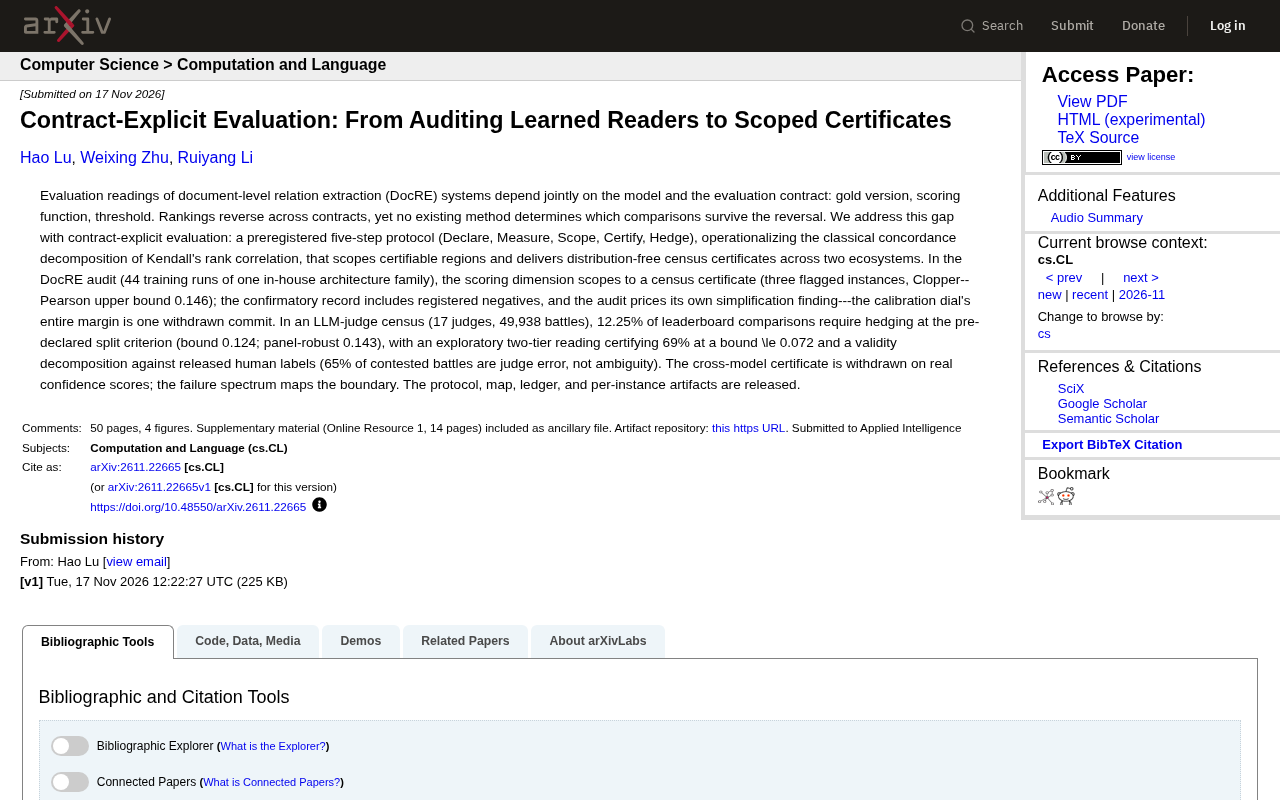
A paper on arXiv, Contract-Explicit Evaluation: From Auditing Learned Readers to Scoped Certificates, proposes a "contract-explicit evaluation" protocol that attempts to delineate certifiable regions for model comparisons and provides distribution-free census certificates.
Why Contract-Explicit Evaluation Is Needed
The evaluation readings of document-level relation extraction (DocRE) systems depend simultaneously on the model and the evaluation contract. Which version of the gold standard is used, how the scoring function is chosen, and where thresholds are set all affect the final score. The paper points out that ranking reversals genuinely occur under different contracts.
The problem is that existing evaluation practice typically reports a single number, assuming the contract is fixed. When the contract changes, readers cannot know whether the original conclusions still hold. This research brings this uncertainty to the forefront and quantifies it with a preregistered five-step protocol.
Document-level relation extraction (DocRE) is a task in information extraction whose goal is to identify semantic relations between entities across an entire document, rather than judging only within a single sentence. Because relational evidence may be spread across multiple sentences, models need cross-sentence reasoning capability, and annotation results are often ambiguous due to document length and entity density. DocRE evaluation typically relies on human-annotated gold-standard relation sets and uses metrics such as precision, recall, and F1. Different annotation versions, different entity boundary definitions, and different negative sampling strategies all significantly change how these metrics are computed, making DocRE a typical setting for observing "evaluation contract sensitivity."
The Five-Step Protocol: From Declaration to Hedging
The protocol consists of five steps: Declare, Measure, Scope, Certify, and Hedge. It operationalizes the classic consistency decomposition of Kendall's rank correlation, aiming to delineate certifiable regions and provide distribution-free census certificates across two ecosystems.
The core idea of this pipeline is: rather than pursuing a global ranking, explicitly specify "under what contract which comparisons are reliable." For comparisons that cannot be certified, the protocol requires hedging rather than forcing a conclusion.
Kendall's rank correlation measures the degree of agreement between two rankings, with values ranging from -1 to 1, where 1 indicates perfect agreement and -1 indicates complete opposition. In model evaluation, if the same set of models produces two rankings under different contracts, Kendall's rank correlation can quantify the severity of ranking reversal. The coefficient can also be decomposed into the proportion of concordant and discordant pairs, thereby locating exactly which model pairs have undergone comparison reversals. The contract-explicit evaluation protocol leverages this decomposition to transform the global ranking consistency problem into a certifiable problem of pairwise comparisons, and accordingly delineates which comparisons are stable at a given confidence level.
Case One: DocRE Audit
In the DocRE audit, the authors conducted 44 training runs within the same internal architecture family. The scoring dimension was ultimately narrowed to a census certificate: three flagged instances, with a Clopper–Pearson upper bound of 0.146. The confirmation record included registered negative results, and the audit also priced its own simplified findings—the entire margin of the calibration knob came from one retracted submission.
This case demonstrates that even within the same architecture family, the stability of evaluation conclusions needs careful delineation. The audit not only validated the protocol's operability but also exposed the fragility of simplifying assumptions.
The Clopper–Pearson interval is an exact confidence interval based on the binomial distribution that does not rely on normal approximation, making it more reliable than the Wald interval when sample sizes are small or proportions are near 0 or 1. In the paper, "upper bound 0.146" means that at a given confidence level, the true proportion of flagged instances does not exceed 14.6%. This distribution-free interval estimation provides a rigorous statistical guarantee for census certificates, ensuring that conclusions about "which comparisons are reliable" do not depend on parametric assumptions about the score distribution.
Case Two: LLM Judge Census
The second case is an LLM judge census covering 17 judges and 49,938 battles. Under preregistered splitting criteria, 12.25% of leaderboard comparisons required hedging (upper bound 0.124; panel-robust upper bound 0.143). An exploratory two-level reading certified 69% of comparisons under a boundary of ≤ 0.072.
The paper also performed a validity decomposition against released human labels, finding that 65% of disputed battles were judge errors rather than ambiguity. Cross-model certificates were retracted on true confidence scores, and the failure spectrum mapped where the boundaries lie.
LLM-as-a-judge refers to using large language models in place of human reviewers to perform pairwise comparisons of model outputs and provide preference judgments. This paradigm is widely used in chatbot leaderboards and generation quality assessment, but judge models themselves may exhibit position bias, length bias, and self-preference bias. In the paper, "65% of disputed battles are judge errors" means that in cases where human labels and judge judgments disagree, most can be attributed to judge misjudgment rather than ambiguity in the problem itself. This finding has direct cautionary implications for practices that rely on LLM judges for model selection.
Implications for Evaluation Practice
This research sends a clear signal: a single number on a model leaderboard may mask contract sensitivity. For teams relying on DocRE or LLM judges for decision-making, contract-explicit evaluation offers an auditable alternative.
The protocol, maps, ledgers, and per-instance artifacts have all been released, meaning other researchers can reproduce and extend to new evaluation scenarios. The future of evaluation may not be more precise rankings, but more honest scoped claims.
Related articles

Pure-Code Video Generation Tested: Which AI Model Actually Follows Instructions?
A Bilibili creator tested three AI models' pure-code video generation with unified prompts and three revisions each: Xiaonaomao has a high ceiling but lacks stability, GPT 6.2 Extra models well but only follows half the instructions, and OPAS 5.5 remains the benchmark.

GPT-6 Six-Tier Hands-On Test: Astra Ultra Dominates but Bills Double
GPT-6 six-tier test: Astra Ultra sweeps 3:0 in 3D tasks thanks to sub-agents and runs 14% faster, but hidden backend bills make its real cost 2.6x single-threaded.

GPT-6.2 Astra vs Fable 5.2: Huge Cost-Efficiency Gap Across 12 Real-World Tests
Bilibili creator tests GPT-6.2 Astra vs Fable 5.2 across 12 real tasks: Fable wins 7-5 but costs 7.2x more and takes nearly 5x longer. Token efficiency emerges as the key selection metric.