Contrive: A Deep Dive into the Unified Cross-App Search and Instant Action Tool for Enterprises

Contrive bridges the gap between finding information and taking action across enterprise apps via an AI-powered command bar.
Contrive is a keyboard-first enterprise productivity tool that unifies search across Slack, Notion, Google Drive, Jira, and other workplace apps while enabling users to take immediate action on results. Built on AI capabilities like RAG and agent-based execution, it synthesizes cross-tool context, preserves source traceability to combat hallucinations, and respects workspace permissions for enterprise-grade security.
From "Finding Information" to "Taking Action Instantly"
In modern enterprises, employee work data is scattered across dozens of SaaS tools—Slack, Notion, Google Drive, Jira, CRM... Every time someone needs to "find something," it means repeatedly switching between multiple applications, searching, copying, and pasting. According to Asana's "Anatomy of Work" report, knowledge workers switch between 9-10 apps on average per day, wasting approximately 58% of their work time annually on "work about work" (such as searching for information, status syncing, and tool switching). This phenomenon is known as "App Fatigue" or "SaaS Sprawl." Research from Harvard Business School further shows that each context switch increases cognitive load, requiring an average of 23 minutes to return to a previous state of focus. Traditional enterprise search tools can help you find links, but what happens after that? You still need to open the corresponding app and manually complete the follow-up actions.
Contrive aims to break this deadlock. As a productivity tool that recently launched on Product Hunt, it positions itself as a "unified search and action layer for enterprise knowledge." Its core proposition is straightforward: don't just return search results—bridge the gap between "finding" and "doing."
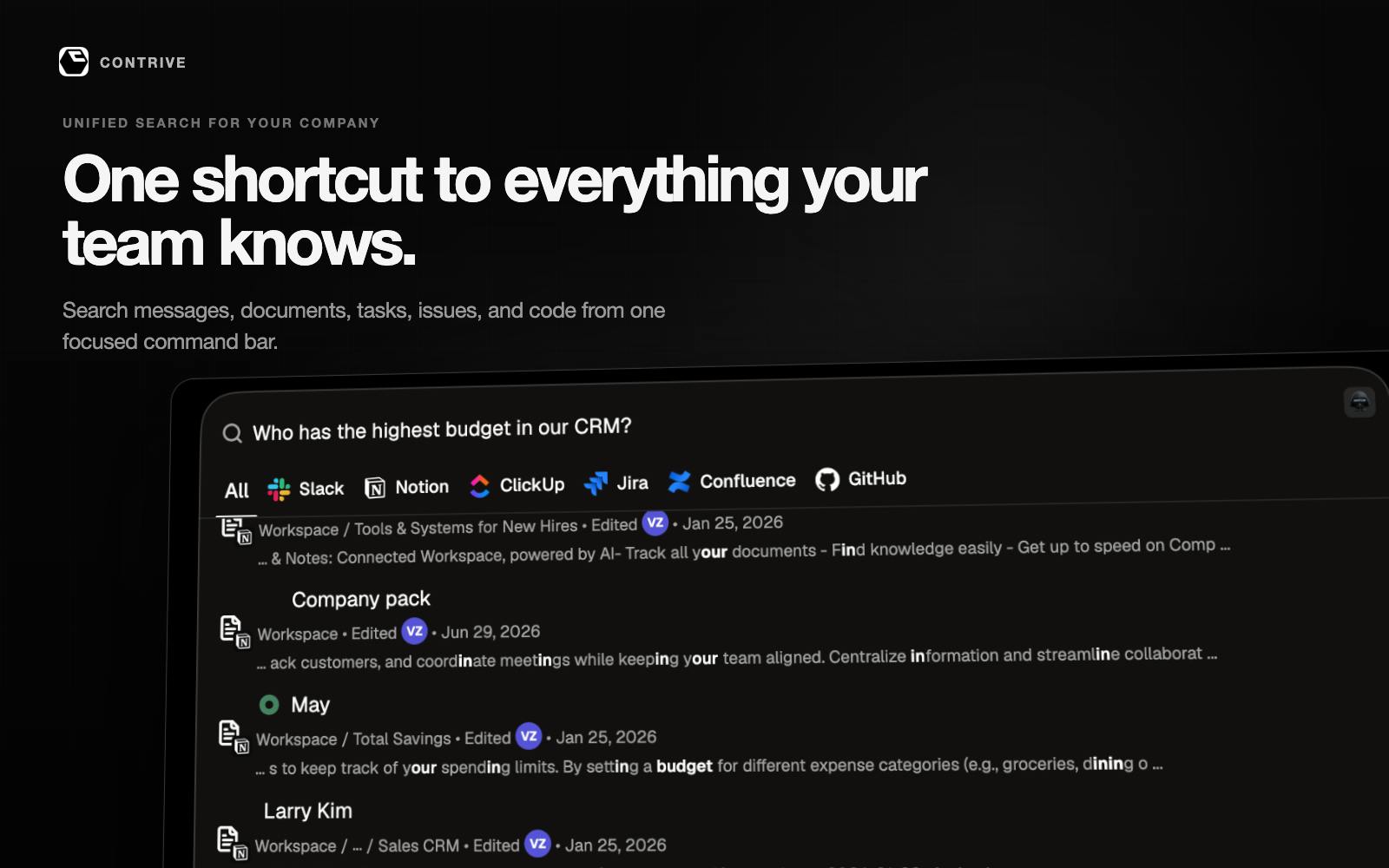
The product currently has 78 upvotes and 3 comments on Product Hunt, ranking #13, categorized under Productivity, Artificial Intelligence, and Search. It was built by Venceslav Zlatev.
Core Features of Contrive
Based on official descriptions, Contrive's product logic can be broken down into several key capabilities that collectively form its moat against similar enterprise search products.
Cross-Tool Context Synthesis
Unlike search tools that only return links, Contrive synthesizes context across connected tools. This means when you search for a project, it doesn't just tell you where relevant documents are—it integrates information fragments scattered across different apps into one coherent answer. This is precisely the core value of "AI search" compared to traditional keyword retrieval—moving from information fragments to knowledge synthesis.
Technically, this capability likely relies on a Retrieval-Augmented Generation (RAG) architecture. The basic principle of RAG is: first, enterprise knowledge is semantically indexed through a vector database; when a user submits a query, the system retrieves the most relevant document chunks, then passes these chunks as context to a large language model, which synthesizes, reasons, and generates a coherent answer. The key challenges of this architecture include: how to create unified representations of heterogeneous data formats across different SaaS tools, and how to avoid information loss while maintaining semantic accuracy.
Preserving Source Traceability
In the AI era, "hallucinations" and information unreliability are the biggest concerns enterprises have when adopting AI assistants. AI Hallucination refers to large language models generating information that appears plausible but is actually incorrect or fabricated. In enterprise scenarios, hallucinations can lead to wrong decisions—for example, AI incorrectly citing a contract clause or inventing a non-existent customer communication record. According to a 2023 Stanford University study, even the most advanced LLMs can have hallucination rates of 3-15% on factual tasks.
Contrive emphasizes that it preserves source traceability, allowing users to verify the original source of every synthesized piece of information. This is particularly important for enterprise scenarios requiring compliance and auditing—every conclusion provided by AI can be traced back to its source, rather than being a black-box output. Source traceability is typically implemented through a "citation annotation" mechanism: when generating answers, the system marks the original document, paragraph, or even specific sentence corresponding to each assertion, and users can jump to the original source with one click for verification. This design borrows from the citation paradigm of academic papers, has been maturely applied in products like Perplexity AI, and is considered an infrastructure-level capability for enterprise AI tools to gain user trust.
Keyboard-First Command Bar Interaction
Contrive adopts a keyboard-first desktop command bar design, similar to the efficient interaction paradigm championed by Raycast, Alfred, or Superhuman. This paradigm stems from a deeper product design philosophy: reducing the friction distance between "intent and execution." The core idea is that high-frequency operations should not rely on visual searching and clicking with a mouse, but should be instantly accessible through keyboard shortcuts and fuzzy search.
Raycast founder Thomas Paul Mann has stated that the essence of a command bar is "unifying the capabilities of the operating system and applications as searchable commands." In enterprise scenarios, this design is particularly suited for handling high-frequency, multi-step workflows—users don't need to leave their current interface; they invoke the command bar with a shortcut key, type in natural language, and complete cross-app operations, compressing what would normally be a 5-8 step process into 1-2 steps. For knowledge workers, this purely keyboard-driven search and action experience significantly reduces operational friction and improves workflow continuity.
From Search Results to Immediate Action
This is Contrive's most differentiated feature: it can turn results into immediate actions. The traditional flow is "search → find → switch apps → act," while Contrive attempts to compress it into "search → execute directly." This "search and do" philosophy upgrades the tool from a passive information retriever to an active action hub.
From a technical perspective, this is essentially a concrete manifestation of AI Agent capabilities. AI Agent is one of the most central development directions in AI in 2024—unlike traditional AI assistants that can only "answer questions," Agents have complete closed-loop capabilities of perception, planning, execution, and feedback. They not only understand user intent but can autonomously call tools, execute multi-step operations, and handle exceptions. However, cross-app execution faces multiple technical challenges: first, the fragmentation of API authorization—each SaaS product has different OAuth flows, permission granularities, and rate limits; second, state synchronization—when an Agent creates a task in Jira, how to ensure linked updates to Slack notifications, Google Calendar events, and related documents; finally, error handling—cross-system operations need reliable rollback mechanisms when they fail. These challenges explain why the "search and do" philosophy, while concise and powerful, has engineering implementation complexity far exceeding pure search products.
Permissions and Index Control: Essential Requirements for Enterprise-Grade Security
Any tool that attempts to connect enterprise internal data must directly confront an unavoidable issue: data security and permission management. Contrive explicitly states that it respects workspace permissions and gives teams precise control over what gets indexed.
This is crucial. When a search tool can access data from all company applications, it must strictly adhere to the existing permission system—employees should only be able to find content they have access to, rather than bypassing the organization's information barriers because of the tool's existence. At the same time, letting teams decide "what data gets indexed" serves both privacy protection needs and lowers the psychological barrier to enterprise adoption. In practice, this typically means the product needs to synchronize in real-time with the permission system of each connected app—when a user loses access to a folder in Google Drive, the search results should immediately remove related content. This real-time requirement places very high demands on system architecture.
How Contrive Differentiates from Competitors
In its description, Contrive actively draws boundaries from two categories of products:
- Compared to "search-only" products (such as Glean's early form, traditional enterprise search engines): Contrive adds the "action" component, not stopping at returning results.
- Compared to "general AI assistants" (such as ChatGPT, general Copilots): Contrive deeply integrates with enterprise tool chains, with source traceability and permission control, better fitting real enterprise workflows.
In other words, Contrive wants to occupy the intersection of "enterprise search" and "AI Agent"—combining the precise retrieval of search with the execution capability of Agents, while maintaining enterprise-grade security compliance.
Observations and Reflections
From a market perspective, "unified enterprise knowledge search + action" is becoming a hot direction. The Enterprise Search track is undergoing its third AI-driven transformation: the first generation was traditional solutions based on keyword matching (such as Elasticsearch enterprise edition); the second generation added semantic understanding to AI search (represented by Glean, valued at $4.6 billion in 2023, founded by former Google search engineer Arvind Jain, backed by top VCs including Sequoia and Kleiner Perkins, covering over 400 enterprise connectors); the third generation integrates Agent execution capabilities into "search + action" products. Dashworks similarly positions itself in AI enterprise search but focuses more on deep integration with communication tools like Slack. Additionally, Microsoft's Copilot and Google's Gemini for Workspace are also embedding search + action capabilities into their respective office ecosystems.
With the rise of the AI Agent concept, the philosophy of "find it and execute it" is being adopted by an increasing number of products. Contrive's differentiation bet is on keyboard-first extreme efficiency interaction and seamless transition from search to action.
However, as an early-stage product, Contrive still faces several practical challenges: first, the breadth and depth of integrations—whether it can cover mainstream enterprise tool stacks; second, the actual usability of its "action" capabilities—cross-app execution often involves complex API authorization and state synchronization; third, how to find its market niche under pressure from mature competitors like Glean. In this competitive landscape, early-stage products typically need to either go deep in vertical scenarios (such as focusing on engineering teams or sales teams) or form strong differentiation in interaction experience to find survival space.
For knowledge workers who have long been exhausted from juggling multiple SaaS tools, the vision Contrive paints of "one command bar to handle everything" is undeniably appealing. Whether it can deliver on this promise still needs to be tested in real work scenarios.
Key Takeaways
Related articles
Qwen 3.8 Flash Next Deep Dive: A Hybrid Architecture That Surpasses DeepSeek V4 with Half the Active Parameters
Deep analysis of Qwen 3.8 Flash Next: how its hybrid architecture surpasses DeepSeek V4 Flash with half the active parameters, its deployment value, and what it signals for Qwen 4.

Vois 2.0 Review: Unlimited Voice Synthesis for $10/Month — Can It Replace ElevenLabs?
Vois 2.0 is a desktop AI voice synthesis tool offering unlimited generation with no per-character fees, 100+ voices, voice cloning, multi-speaker timeline, and 600+ languages for $10/month.
The Fascinating Real-World Counterparts of OpenAI Gym Reinforcement Learning Environments
Exploring how OpenAI Gym RL environments map to real-world scenarios, from CartPole to MountainCar, covering design principles and the sim-to-real transfer challenge.