Coolpad's $150 Budget Phone Leaks: A Wide-Screen Non-Folding Design, Bringing iPhone Duo Design Language Downmarket

Coolpad's $150 wide-screen slab phone strips the wide-screen form from foldables and brings it to the entry-level market.
Using Coolpad's new Cool X Wide as a starting point, the article discusses the trend of wide-screen design moving from foldables to slab phones. Priced at just $150, the Cool X Wide uses a non-folding wide panel with a design approach close to the Huawei Pura X View, while iPhone Duo rumors further amplify industry attention. The article notes that the essence of a wide-screen slab phone is decoupling the wide-screen look from high-cost structures like hinges and flexible panels to achieve a lower price; the cost is a larger horizontal footprint and reduced portability. This is a typical entry-level design-following strategy. The author views it as more of a low-cost design experiment whose success depends on whether the experience gains can offset the loss of portability.
Wide-Screen Design Moves From Foldables to Slab Phones
The Samsung Galaxy Z Fold, Huawei Pura X View, and the yet-to-be-released iPhone Duo have pushed "wide screen" — a form-factor label once exclusive to foldables — into the territory of traditional slab phones. The latest to join this trend is Coolpad, whose new Cool X Wide brings a wide-screen aspect ratio to the entry-level market at a price of $150.
According to the original report, the Cool X Wide's display is considerably wider than that of a conventional slab phone, with a design approach similar to the Huawei Pura X View launched in China this August. The difference is that it doesn't fold: the wide-screen form is fixed directly onto a non-folding panel. That choice alone is worth pondering.
Wide-Screen Slab Phone: Compromise or New Category?
The foldable wide-screen experience is built on hinges and flexible panels, entailing high cost and structural complexity. Coolpad's approach essentially strips the "wide-screen look" away from the foldable form and achieves a similar ratio with a slab structure. For budget-conscious users, this is a more realistic way to try something new.
The trade-offs are equally obvious. A wide screen means a larger horizontal footprint, which affects one-handed grip and portability. Coolpad has clearly judged that in the $150 price bracket, immersion in video and reading scenarios matters more than one-handed operation. This follows the same product logic as the Huawei Pura X View, which likewise emphasizes the content-consumption experience enabled by a wide screen.
It's worth noting that rumors of the iPhone Duo have further amplified industry attention on this design direction. Although Apple's product has yet to materialize, "wide screen" as a differentiating selling point is already being borrowed by mid- and low-end manufacturers.
The reason foldables can achieve a wide screen lies in flexible OLED panels and hinge structures: the screen expands to a near-tablet ratio when unfolded and returns to a conventional phone size when folded. This brings two direct consequences — low panel yield and numerous precision hinge components — with the overall device cost often hundreds of dollars higher than a slab phone with the same specs. By removing the folding form and using only a fixed-ratio wide panel, Coolpad sidesteps the barriers of flexible substrates, hinge durability, and crease control — which is key to hitting $150. In other words, the wide-screen slab phone retains the "result" of the foldable while swapping out the "means"; it is essentially a re-trade-off of the cost structure, not a breakthrough in display technology.
Phone screen ratios have long been based on 16:9, gradually stretching over the past decade to 18:9, 19.5:9, and even 21:9 — the direction being narrower and longer to facilitate one-handed grip and adapt to portrait content. Wide screens go the opposite way: horizontal dimensions increase, approaching a 4:3 or squarer ratio. This clearly helps with watching 16:9 video, reading PDFs, and two-column layouts, but it also introduces more black bars or blank space in high-frequency scenarios like vertical short videos and chat, while improving the usability of split-screen multitasking. So a wide screen isn't universally better — it tilts screen area toward specific content formats, and a product's success depends on whether the target users' content-consumption habits match it.
Design-Following Strategy in the Entry-Level Market
The $150 price point dictates that the Cool X Wide won't compete on performance or imaging. Its core narrative is form-factor differentiation: when products at the same price are highly homogenized in specs, a wider screen creates an intuitive visual memory point.
This strategy is nothing new in the phone industry. Manufacturers often quickly cascade a new form factor down to entry-level product lines after it has been validated by high-end products, trading a "looks like a flagship" design for attention. Coolpad's move here essentially translates the wide-screen language of foldable flagships into a low-cost slab version.
The risk is that a wide-screen slab phone lacks the "unfold and it gets bigger" narrative support of a foldable, so users may just see a phone with an odd aspect ratio. Whether this product succeeds depends on whether the actual experience gains from the wide screen can offset the loss of portability.
Editor's Take
The Coolpad Cool X Wide is more of a low-cost design experiment than a mature category. What it tests is whether the appeal of a wide screen can exist independently of the foldable form. If market feedback is positive, more wide-screen slab phones may appear in the mid- and low-end market; if the response is lukewarm, this direction will likely retreat to the foldable camp. For readers interested in the evolution of phone form factors, this $150 product offers a window for observation.
One-line Summary
Coolpad's $150 wide-screen slab phone strips the wide-screen form from foldables and brings it to the entry-level market without the hinge.
Paragraph Summary
Using Coolpad's new Cool X Wide as a starting point, the article discusses the trend of wide-screen design penetrating from foldables to slab phones. Priced at just $150, the Cool X Wide uses a non-folding wide panel with a design approach close to the Huawei Pura X View, while rumors of the yet-to-be-released iPhone Duo further amplify industry attention on this direction. The article notes that the essence of a wide-screen slab phone is decoupling the wide-screen look of foldables from high-cost structures like hinges and flexible panels, trading the slab form for a lower price; the cost is a larger horizontal footprint and reduced one-handed grip and portability. This is a typical entry-level market design-following strategy — after a new form factor is validated by high-end products, competing for attention with a differentiated appearance that "looks like a flagship." The author views the product as more of a low-cost design experiment, whose success depends on whether the experience gains of the wide screen can offset the loss of portability.
Related articles

M&M's Spent Millions Replacing Artificial Blue Dye — Why Is It So Hard?
Mars spent millions trying to replace artificial blue dye in M&M's with spirulina, but thick material clogs pipes and residue risks mold, forcing a full production-line rebuild. Here's the engineering behind the reformulation.

Teammate Wanted for Meta Global AI Developer Hackathon: Computer Vision & Medical AI
A Reddit developer seeks teammates for the Meta Global AI Developer Hackathon, focusing on computer vision and medical AI. This article analyzes the track logic, skills-complementarity needs, and topic selection strategy behind this teaming signal.
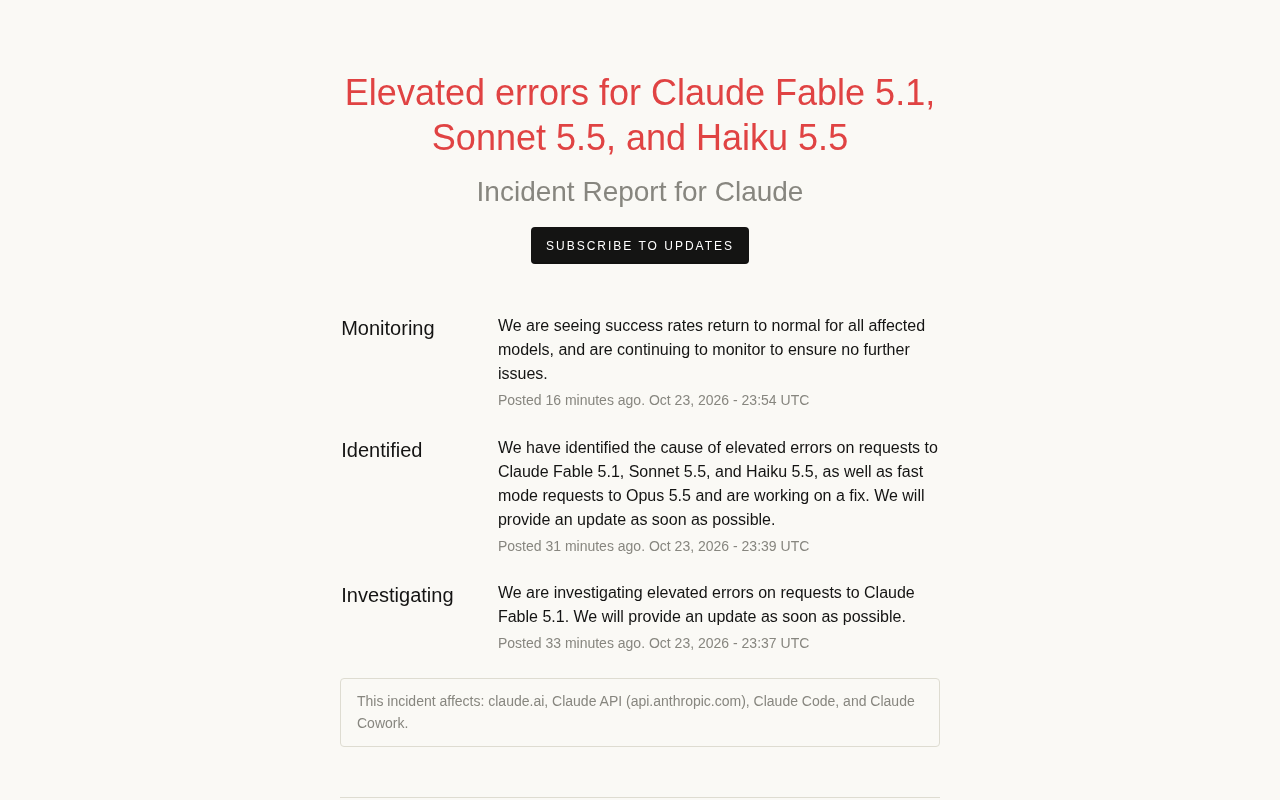
Multiple Claude Models Hit by Errors: A Postmortem of Fable 5.1, Sonnet 5.5, and Haiku 5.5
Claude Fable 5.1, Sonnet 5.5, Haiku 5.5, and Opus 5.5 fast mode saw elevated errors; Anthropic identified and resolved the issue in 17 minutes. This postmortem covers the timeline, the technical reasons for the multi-model cascading failure, and practical lessons for retry and degradation strategies.