Core Course in Agent Development: A Practical Path with Python and Large Model Agents
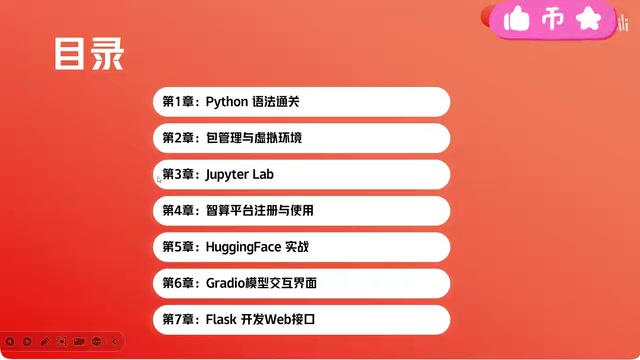
The Bilibili agent course uses seven chapters to connect the complete development pipeline from the Python environment to model serving.
The article breaks down the seven-chapter structure of a core agent development course on Bilibili: the first three chapters cover Python syntax, package management, virtual environments, and Jupyter to solve dependency conflicts and debugging environment issues; chapter four uses intelligent computing platforms to bypass the high-end GPU barrier and unify the runtime environment; chapter five uses Hugging Face as an entry point to practice model retrieval, downloading, and usage; the final two chapters use Gradio to build an interactive interface and Flask to provide external APIs, completing delivery from demo to product. The article argues that the core value of this path lies in "getting the full pipeline running first, then digging into details," suitable for beginners who want to build a complete understanding; those with existing Python foundations can skip the first three chapters and focus on compute, model community, and delivery.
The barrier to developing large-model agents (Agents) often lies not in the algorithms themselves, but in the "environment" and the "pipeline." A core agent development course on Bilibili pierces through this veil: rather than starting with complex Agent frameworks, it walks through the complete loop from Python syntax to model serving in seven modules. For developers who want to build large-model applications but get stuck on environment configuration and toolchains, this path is worth examining.
Why Start with Python and Virtual Environments
The first three chapters of the course all focus on Python fundamentals: a quick syntax walkthrough, package management and virtual environments, and getting familiar with Jupyter Notebook. This arrangement may seem like a "step backward," but it actually hits the real pain points of large-model development. Agent projects typically depend on a large number of third-party libraries, and version conflicts are commonplace; if virtual environments are poorly managed, one project runs fine while another breaks. Jupyter plays the role of experimentation and debugging—model calls, prompt iteration, and intermediate result inspection all happen in this interactive environment.
Only by solidifying these three areas can all subsequent steps have a stable foundation to run on. Many tutorials skip this step and go straight to frameworks; when learners copy code and hit errors one after another, the root cause is often here.
Virtual environments are a mechanism in Python for isolating project dependencies. Different projects may depend on different versions of the same library; if everything is installed in the system-wide global environment, version conflicts are nearly unavoidable. Tools such as venv and conda can create an independent interpreter and package directory for each project, so installed libraries are visible only to that project. For large-model projects, libraries such as transformers, torch, and gradio iterate quickly and have complex interdependencies, making virtual environments an almost essential piece of infrastructure.
Jupyter Notebook is an interactive programming environment organized in "cells." Code can be executed in blocks, variables persist in memory, and outputs (text, tables, images) are displayed directly below the code. It is particularly well suited to exploratory work with model calls: change a prompt once and see the result immediately, without rerunning the entire script.
Intelligent Computing Platforms: Running Large Models Without High-End GPUs
Chapter four introduces intelligent computing platforms, addressing the compute barrier. Even if your local machine lacks a high-end GPU, you can still call various large models through cloud compute, while also eliminating environment differences between different computers—situations where the same code won't run on a teammate's machine are greatly reduced.
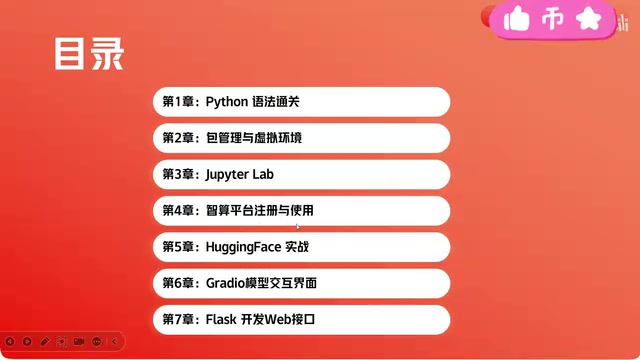
This is especially critical for learners and small-to-medium teams. The VRAM requirements of large-model inference keep many people out, while intelligent computing platforms turn "buying a GPU" into "renting one," significantly lowering the cost of trial and error. The course places this before hands-on model work, logically so that subsequent model downloads and calls have a unified runtime environment.
VRAM is the key metric that determines whether a large model can run locally. Model weights reside in VRAM as parameters; roughly estimated, at FP16 precision each 1 billion parameters takes about 2GB of VRAM, so a 7-billion-parameter model alone requires over ten GB just to load, plus intermediate activations during inference—consumer-grade GPUs are often insufficient. Intelligent computing platforms provide professional cards such as A100 and V100 through GPU rental, billed by the hour, so developers don't need to spend tens of thousands of yuan upfront on hardware.
Common intelligent computing platforms usually provide pre-installed environment images, Jupyter access, and persistent storage, essentially bringing the local development experience to the cloud.
Hugging Face: The GitHub of the Large-Model World
Chapter five moves into hands-on work with Hugging Face. The course likens it to "the GitHub of the large-model world," and the analogy is quite accurate: the community hosts a large number of models uploaded and shared by companies and individual enthusiasts, and developers can search, download, and try them directly without training from scratch.
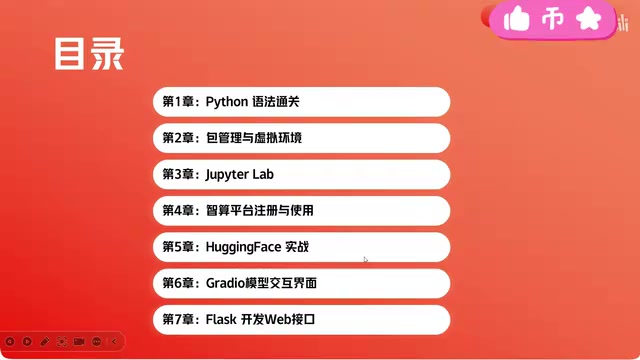
For agent development, the value of Hugging Face is not just as a model repository but as an entry point for understanding the model ecosystem—how to choose among models of different parameter sizes and task types, how to read model cards, how to load weights—these practical experiences are accumulated here. The course lists it as a standalone chapter, indicating that the author considers "finding models and using models" itself a skill that requires dedicated practice.
Model Cards are the documentation attached to each model on Hugging Face, typically including a model overview, training data, suitable and unsuitable scenarios, bias and risk notes, and example usage code. Learning to read model cards is the first step in judging whether a model can be used for your task.
Hugging Face's core utility library is transformers, which provides a unified from_pretrained() interface to load model weights and tokenizers, abstracting away differences between model architectures; the companion datasets library handles data loading, and spaces allows hosting and trying out demos directly on the web. Access to Hugging Face from mainland China may be restricted; in practice, mirror sites (such as hf-mirror) are often used, or the mirror address is specified via the HF_ENDPOINT environment variable.
Gradio and Flask: Giving Models an Interface and Making Them Serve Externally
The final two chapters turn to delivery. Chapter six uses Gradio to develop an interactive interface for large models, turning model calls in the command line into a clickable, input-capable web application, suitable for rapid validation and demonstration; chapter seven uses Flask to develop external APIs for large models, enabling the model to provide services as an API—this is the key step in turning a demo into a product.
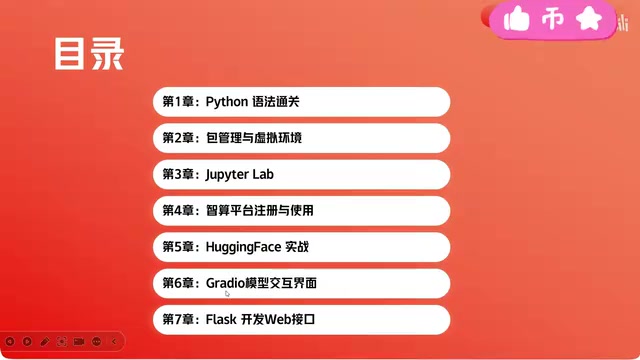
Gradio leans toward rapid front-end interaction setup, while Flask leans toward server-side API design; together they cover the transition from "using it yourself" to "letting others use it." The course says that by mastering these seven chapters, the core processes of the AI ecosystem have all been practiced, and the remaining details can be learned on the job.
Gradio centers on two construction approaches: Interface and Blocks. The former maps a function to input and output boxes with a few lines of code, while the latter supports more flexible multi-component layouts. Its typical usage is to wrap "receive user input → call model → return result" into a function; Gradio automatically generates a web interface and starts a local or public service via launch().
Flask is a lightweight Python web framework that maps HTTP requests to handler functions through route decorators (such as @app.route('/chat', methods=['POST'])). When wrapping model inference as a REST API, you need to pay attention to request body parsing, returning JSON format, timeout control, and concurrency handling—single-process Flask handles requests serially by default, and under real traffic it needs to be deployed with a WSGI server such as gunicorn.
Who This Path Is For
Judging from the course structure, it targets beginners who want to quickly build a complete understanding, rather than advanced developers who want to go deep into a particular framework. The seven chapters cover syntax, environment, compute, model community, interface, and API, forming a runnable pipeline in which each link can independently produce visible results. This "get it running first, then dig deeper" approach is more pragmatic than diving straight into agent framework papers.
It should be noted that the course is released in video form, with accompanying materials obtained via private message; specific content details should be based on the actual course. For developers already familiar with Python, the first three chapters can be quickly skipped, concentrating time on the three segments of intelligent computing platforms, Hugging Face, and Gradio/Flask.
The barrier to agent development is shifting from "can you write code" to "can you connect the entire pipeline." The value of this course lies precisely in demonstrating this pipeline in its entirety.
One-line Summary
The Bilibili agent course uses seven chapters to connect the complete development pipeline from the Python environment to model serving.
Paragraph Summary
The article breaks down the seven-chapter structure of a core agent development course on Bilibili: the first three chapters cover Python syntax, package management, virtual environments, and Jupyter to solve dependency conflicts and debugging environment issues; chapter four uses intelligent computing platforms to bypass the high-end GPU barrier and unify the runtime environment; chapter five uses Hugging Face as an entry point to practice model retrieval, downloading, and usage; the final two chapters use Gradio to build an interactive interface and Flask to provide external APIs, completing delivery from demo to product. The article argues that the core value of this path lies in "getting the full pipeline running first, then digging into details," suitable for beginners who want to build a complete understanding; those with existing Python foundations can skip the first three chapters and focus on compute, model community, and delivery.
Related articles
Bilibili's 748-Episode AI Agent Development Course: A Complete Guide from Zero to Real-World Projects
A comprehensive review of Bilibili's 748-episode AI Agent development course: from ReAct, planning, and memory to LangChain, AutoGen, and enterprise projects like customer service and data analysis agents, with learning path and resource advice for beginners.

LangChain from Scratch: A Deep Dive into a Hands-On RAG and Agent Tutorial
A deep dive into a Bilibili zero-foundation LangChain tutorial: analyzing the learning path around RAG and Agent scenarios, from basic calls to complete deployable projects. Suitable for students, career changers, and side-project developers.

From Zero to Agent Developer in 7 Days: A Deep Dive into Bilibili's 748-Episode Tutorial Series
A deep dive into Bilibili's 748-episode Agent app development tutorial: from zero foundation to enterprise deployment, covering how Agents differ from ordinary AI chat, MCP integration, customizing open-source projects, and the full deployment pipeline, with a learning roadmap and hands-on cases to help you get started with AI agents in seven days.