From Zero to Agent Developer in 7 Days: A Deep Dive into Bilibili's 748-Episode Tutorial Series

Bilibili's 748-episode tutorial reveals Agent app development as the top AI transformation choice for 2026, covering the full path from concept to enterprise deployment.
The article centers on a 748-episode Agent application development tutorial series on Bilibili, arguing that Agent app development is the top direction for AI transformation in 2026. Its core point: "something that can chat is a tool; something that can do the work for you is productivity" — Agents can plan autonomously, invoke tools, and interact with their environment to complete end-to-end tasks, unlike ordinary chat models. The tutorial covers the full path from understanding the Agent loop, writing your first program, and extending capabilities via MCP, to reading and customizing open-source projects into a personal assistant, and finally deploying to enterprise-grade usability. It stresses that the real barrier is taking action, not technology, while cautioning that "expert in seven days" is marketing and the 748-episode volume demands sustained hands-on practice to avoid the "save it and you've learned it" trap.
Why Agent App Development Has Become the Top Choice for AI Transformation
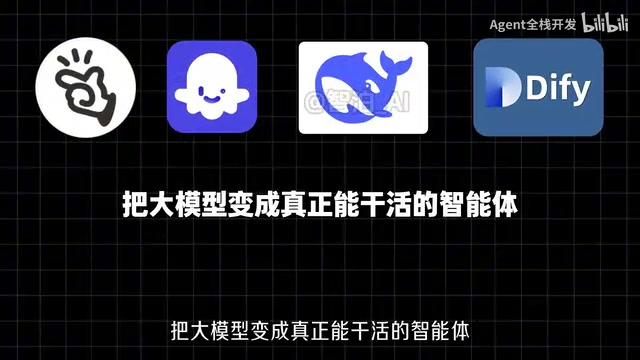
What's the most worthwhile direction to invest in within the AI space in 2026? A 748-episode Agent application development tutorial series on Bilibili gives a clear answer: Agent app development. The series lays out its core logic right from the opening — "something that can chat is a tool; something that can do the work for you is productivity." From Manus's explosive rise at the start of the year, to the recent Cos and DeFi hype, to the DeepSeekAd that stunned everyone, what's really behind all of it is the same thing: turning large models into intelligent agents that can genuinely get work done.
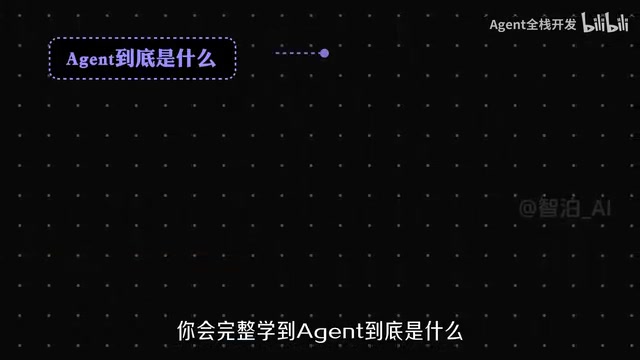
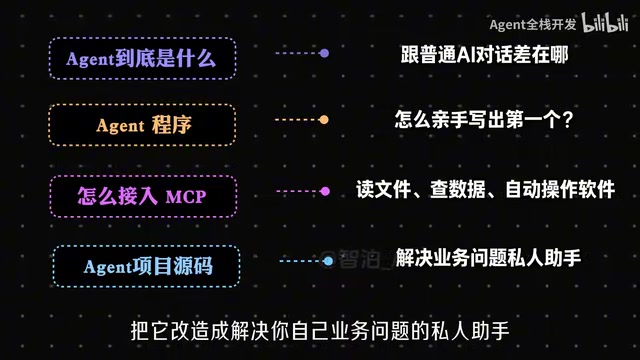
This tutorial series positions itself as "learnable even from zero foundation," claiming to contain all the essential material and to take you from beginner to expert in seven days. It covers the complete chain from conceptual understanding to enterprise-grade deployment, including what an Agent actually is, how it differs from ordinary AI chat, writing your first Agent program by hand, integrating MCP to enable file reading and data queries, reading the source code of open-source Agent projects and customizing them into a personal assistant, and finally deploying it live.
The Essential Difference Between Agents and Ordinary AI Chat
The tutorial distinguishes the two in a single sentence: ordinary AI chat is "can chat," while an Agent is "can work." Specifically, ordinary conversational models can only generate text responses based on input, whereas Agents possess the ability to plan autonomously, invoke tools, and interact with their environment — they can read files, query databases, and automatically operate software to complete end-to-end tasks.
This difference determines where each applies. Chatbots are suited to Q&A and content generation, while Agents are suited to automated workflows, data analysis, business system operations, and other scenarios that require "hands-on" action. The tutorial stresses that the real barrier has never been technology — it's whether you take the first step. There's less code than you think, and AI can write it alongside you the whole way.
From Zero to One: Your First Agent Program and MCP Integration
The hands-on portion of the tutorial begins with writing your first Agent program. Although the promotional material doesn't spell out the specific code, the roadmap is clear: first understand the Agent's basic loop (perceive–plan–act), then extend the Agent's capabilities through MCP (Model Context Protocol). MCP allows an Agent to connect to external tools and data sources, enabling functions like reading files, querying data, and automatically operating software.
The key here is "hands-on." The tutorial repeatedly emphasizes not to be intimidated by the word "development" — AI-assisted programming has dramatically lowered the coding barrier. Learners need to follow the videos step by step rather than just watching without practicing.
MCP (Model Context Protocol) is a standardized protocol proposed and open-sourced by Anthropic in late 2024, designed to establish a unified connection between large language models and external tools and data sources. You can think of it as the "USB-C port" of the AI world: whether the backend is a file system, a database, a search engine, or an enterprise's internal API, as long as an MCP server is implemented, the Agent can discover and invoke these capabilities in a consistent way. MCP uses a client-server architecture, defines three core primitives — Tools (executable actions), Resources (readable data), and Prompts (predefined interaction templates) — and communicates via JSON-RPC. Compared with writing adapter code separately for each tool, MCP dramatically lowers the integration cost of extending an Agent's capabilities and also lets the tool ecosystem of the open-source community be reused across projects — which is precisely why the tutorial treats it as a key step in extending Agent capabilities.
The Agent's basic loop (perceive–plan–act) originates from classic agent architecture and has been reinterpreted in the LLM era as the "ReAct" paradigm: the model first observes the current state and task goal (perceive), then decides what to do next through chain-of-thought reasoning (plan), then calls tools to execute actions and obtain returned results (act), looping until the task is complete. The key to this loop is that the model can dynamically adjust its plan based on the real feedback returned by tools, rather than generating the entire answer in one shot. In engineering terms, it usually requires maintaining the conversation history, tool invocation records, and termination-condition checks, as well as handling retries and fallbacks after failed tool calls. Understanding this loop is the foundation for reading the architecture of open-source projects later, because the vast majority of Agent frameworks are essentially different wrappers and optimizations of this loop.
Reading Open-Source Projects and Turning Them Into a Personal Assistant
After mastering the basics, the tutorial guides learners through reading the source code of open-source Agent projects. The goal of this step is to "read and customize" — understand the architectural design of excellent projects, then tailor them to your own business needs to build a personal assistant that solves specific problems.
The value of open-source projects lies in providing a reusable skeleton — learners don't have to reinvent the wheel but can iterate quickly by standing on the shoulders of giants. The hands-on case studies and e-book materials the tutorial provides (claim them by commenting "agent" in the comments section) should include supporting materials for this part.
Open-source Agent projects currently fall into a few main categories: first, orchestration frameworks such as LangChain, LlamaIndex, AutoGen, and CrewAI, which provide abstractions for tool calling, multi-agent collaboration, and memory management; second, open-source versions of general-purpose Agent products such as OpenHands and MetaGPT, which focus on end-to-end task execution; third, lightweight SDKs such as the OpenAI Agents SDK and Anthropic's Claude Agent SDK, which emphasize minimal abstraction and controllability. When reading source code, it's advisable to focus on four aspects: how the Agent loop is implemented, the abstraction layer for tool registration and invocation, the strategy for managing context and memory, and the mechanisms for error handling and human intervention. When customizing into a personal assistant, you usually only need to replace the toolset and adjust the system prompt and business knowledge base without rewriting the core loop — this is exactly what "standing on the shoulders of giants" means.
Deployment: From Toy to Enterprise-Ready
The final stage is deployment. The tutorial promises to teach learners to make their Agents enterprise-ready, which means addressing engineering concerns such as stability, scalability, and security. Although the promotional material doesn't reveal the specific tech stack, it typically involves containerization, API gateways, monitoring and logging, and so on.
For developers who want to transform their careers through AI, deployment capability is what separates a "demo" from a "product." Only when it's running live and serving real users can an Agent's value truly be unlocked.

Tutorial Resources and Learning Advice
The tutorial comes with a full learning roadmap, hands-on case studies, and an e-book, all obtainable by commenting in the comments section. For learners starting from zero, it's recommended to watch in order and focus on the hands-on sections; for experienced developers, you can skip straight to the MCP integration and source-code customization parts.
One caveat: a 748-episode volume means the content is very comprehensive, but it can also lead people into the "save it and you've learned it" trap. The "from beginner to expert in seven days" in the title is more marketing talk — actually mastering Agent development requires continuous practice. Still, as a systematic introductory resource, it can genuinely help you avoid detours.
Conclusion
Agent app development is the core direction for AI implementation in 2026, and this Bilibili tutorial series provides a complete path from concept to deployment. Whether you're a developer looking to pivot or a business professional hoping to use AI to boost efficiency, you can find an entry point here. There's only one key: start doing it.
One-line Summary
Bilibili's 748-episode tutorial reveals that Agent app development is the top choice for AI transformation in 2026, covering the full path from concept to enterprise-grade deployment.
Paragraph Summary
The article centers on a 748-episode Agent application development tutorial series on Bilibili, explaining why Agent app development has become the top direction for AI transformation in 2026. The core argument is that "something that can chat is a tool; something that can do the work for you is productivity" — that is, compared with ordinary conversational models, Agents can plan autonomously, invoke tools, and interact with their environment to complete end-to-end tasks. The tutorial covers the complete path from understanding the Agent's basic loop, writing your first program, and integrating MCP to extend capabilities, to reading open-source project source code and customizing it into a personal assistant, and finally deploying it live to reach enterprise-grade usability. The article emphasizes that the technical barrier is not the key — AI-assisted programming has already greatly reduced coding difficulty, and the real dividing line is whether you take action. At the same time, it reminds readers that "expert in seven days" is marketing talk, and the 748-episode volume requires continuous hands-on practice to avoid the trap of "saving it and calling it learned."
Related articles

Kimi K3.1 Pro Open-Source Model Matches GPT-6 Astra; China Releases AI Employment Policy
This week in AI: Moonshot open-sources Kimi K3.1 Pro with nearly 3T parameters, beating GPT-6 Astra on coding tests; Anthropic launches proactive agent Claude Duet; China's State Council issues AI and employment policy with 6 areas and 18 tasks.

The Most Comprehensive Agent Development Tutorial on Bilibili: From Zero to Expert in Seven Days
A Bilibili creator releases a 748-episode zero-foundation AI Agent tutorial in three parts: cognition, advanced, and hands-on, covering ReAct, LangChain, AutoGen, multi-Agent collaboration, and enterprise projects, with source code and a learning roadmap.
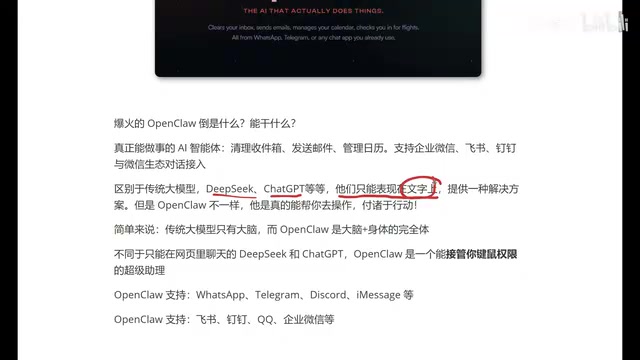
Deploy OpenClaw Locally on Windows and Connect It to Feishu: A Beginner's Guide to Building an AI Agent
OpenClaw is an AI agent that can take over keyboard and mouse permissions. This article explains the complete approach to deploying OpenClaw locally on Windows and connecting it to Feishu, analyzing its differences from traditional large models, core capabilities, and deployment risks—beginners can build a local AI project too.