Corgi: A Terminal Multiplexer for AI Agents
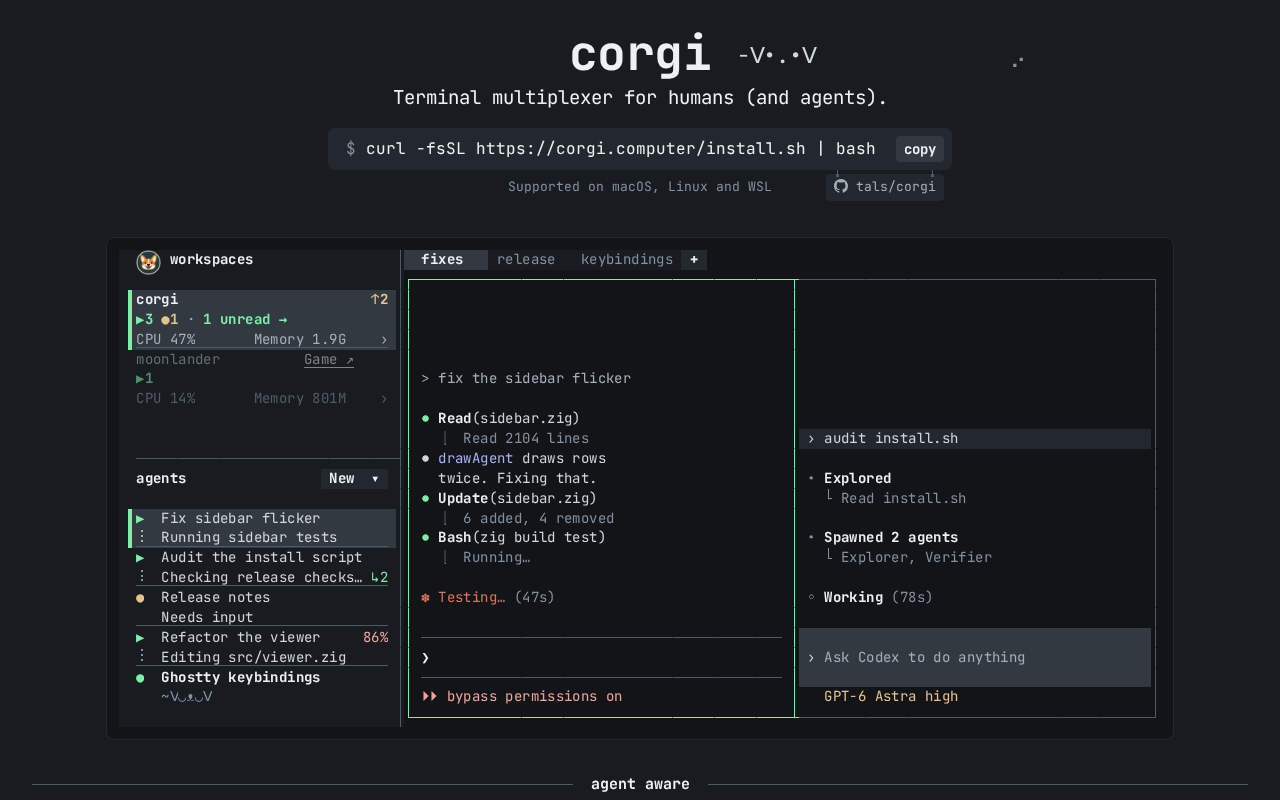
Corgi is a terminal multiplexer for AI agents, targeting session management when multiple agents run in parallel.
The article introduces Corgi, a new project published on the Hacker News Show HN section, positioned as a "helpful {agent, terminal} multiplexer" serving both AI agents and terminals. It notes that traditional terminal multiplexers like tmux and screen mainly address remote session persistence, whereas Corgi treats agents as first-class citizens and attempts to tackle the pain point of chaotic terminal windows when multiple AI coding agents run in parallel. However, the original submission is extremely concise, with only a one-line positioning statement, 4 points, and zero comments, indicating a very early stage. The article argues that terminal multiplexers are a reasonable vehicle for agent orchestration, but actual value depends on ecosystem integration, scriptable interfaces, and documentation completeness; developers are advised to add it to a watchlist rather than immediately using it in production.
Corgi: A Terminal Multiplexer for AI Agents
On the Hacker News Show HN section, a new project called Corgi was submitted, positioned as a "helpful {agent, terminal} multiplexer" — a multiplexer for both AI agents and terminals. The project attempts to solve an emerging problem: when developers run multiple AI coding agents simultaneously, terminal windows become difficult to manage.
Why We Need an Agent Terminal Multiplexer
In the past, terminal multiplexers (such as tmux and screen) primarily served operations and remote development scenarios: maintaining multiple sessions within a single connection, and recovering them after disconnection. Corgi takes a different angle — it treats "agents" as first-class citizens.
As AI coding tools evolve from single-turn conversations to multi-turn autonomous execution, a single task may launch multiple agents working in parallel: some writing code, some running tests, and some performing reviews. Each agent needs a terminal session, a log output, and an interrupt/resume mechanism. Manually opening a bunch of tabs is both inefficient and prone to chaos. Corgi's multiplexer positioning is precisely to let these agent sessions be orchestrated in a unified way.
A terminal multiplexer is a class of programs that allow managing multiple independent sessions within a single terminal window, with notable examples including tmux and GNU screen. Its core capabilities include: decoupling sessions from the physical terminal (after disconnecting SSH, sessions continue running in the background), quick switching between windows and panes, and scriptable key bindings and command interfaces. For AI agents, these features map directly to real needs — each agent can run in its own pseudo-terminal (pty) without interfering with others; developers can suspend an agent at any time, switch to another agent to check progress, or reconnect after a network interruption without losing context. Corgi migrates this mature paradigm to the agent scenario, essentially reusing the session isolation and recovery mechanisms that terminal multiplexers already have.
Product Form and Initial Observations
The original submission is extremely concise, containing only the project name, a one-line positioning statement, and the HN points (4) and comment count (0). This means Corgi is still at an early stage: the author is willing to share it publicly, but the community has yet to form a discussion. For readers following the AI development toolchain, this is more of a signal worth watching than a mature solution.
Judging from the name and description, Corgi provides terminal-level multiplexing capabilities and treats "agent" as an optional unit of work. Its differences from ordinary tmux may lie in session labeling, agent state awareness, or output aggregation, but these details are not elaborated in the available material.
Show HN is Hacker News's project launch section for creators; authors must submit in the format "Show HN: Project Name," usually accompanied by a brief description and a link. Community feedback mainly takes the form of votes (points) and comments, so points and comment counts are often used as rough signals of a project's early traction. It should be noted that Show HN's point algorithm is not a simple sum; a small number of early votes may correspond to a displayed value of around 4, and having no comments within the first few hours after posting is quite common for new projects and does not necessarily indicate poor quality. For Corgi, this signal should be understood as "just released, not yet in discussion" rather than a clear negative evaluation.
Potential Impact on AI Development Workflows
If Corgi evolves in the "agent orchestration" direction, it could fill a gap: most AI coding agents currently run in a single-session manner, lacking a standard for cross-agent session management. Terminal multiplexers happen to be a natural vehicle — they already have mature session isolation, window switching, and background execution mechanisms.
However, the success of such tools depends on ecosystem integration: whether they are compatible with mainstream agent frameworks, whether they provide scriptable interfaces, and whether they can preserve context when an agent crashes. A single positioning statement is not enough to judge Corgi's actual level of completeness.
Worth Watching but Treat with Caution
Corgi's appearance on Show HN indicates the author hopes for early feedback. For developers who regularly use multiple AI agents, it can be added to a watchlist; but without documentation, demos, or community discussion, it is not recommended to put it into production immediately. Signals worth watching going forward include: the update frequency of the project repository, whether it provides integration examples with other agent tools, and whether the author's technical notes appear in the HN comment section.
Key Takeaways
- Corgi is a new project positioned as an "agent + terminal" multiplexer, published on the Hacker News Show HN section.
- The pain point it targets: when multiple AI coding agents run in parallel, terminal session management becomes chaotic.
- The project information is extremely concise, with 4 HN points and no comments, placing it at a very early stage.
- Terminal multiplexers are a reasonable vehicle for agent orchestration, but actual value depends on ecosystem integration and the completeness of documentation.
- Developers are advised to keep an eye on it but not use it in production for now.
One-line Summary
Corgi is a terminal multiplexer for AI agents, targeting the pain point of session management when multiple agents run in parallel.
Paragraph Summary
The article introduces Corgi, a new project published on the Hacker News Show HN section, positioned as a "helpful {agent, terminal} multiplexer" — a multiplexer serving both AI agents and terminals. The article notes that traditional terminal multiplexers like tmux and screen mainly address the problem of maintaining remote sessions, whereas Corgi treats agents as first-class citizens and attempts to address the pain point of chaotic terminal windows when multiple AI coding agents run in parallel. However, the original submission information is extremely concise, with only a one-line positioning statement, 4 points, and zero comments, indicating that the project is at a very early stage. The article argues that terminal multiplexers are a reasonable vehicle for agent orchestration, but actual value depends on ecosystem integration, scriptable interfaces, and the completeness of documentation; developers are advised to add it to a watchlist rather than immediately using it in production.
Related articles

AI Digital Twin in Action: Using DOT to Automatically Track Bugs and User Feedback
DOTS engineers demonstrate how AI digital twin DOT collects cross-platform user feedback, categorizes issue themes, opens threads to investigate bug root causes, and submits PRs—showcasing a complete AI agent workflow for defect triage with auditable design.

Why Transistors Are No Longer Flat: The Evolution from Planar to Gate-All-Around
Transistor evolution from planar to FinFET to gate-all-around: why gates went from three-sided to four-sided wrapping to suppress short-channel effects and leakage current, extending Moore's Law.

Swarm Intelligence = a Single RL Agent? A Proof of Multi-Armed Bandit Equivalence
A paper proves that collective decision-making through local imitation in swarms is mathematically equivalent to single-agent reinforcement learning: N blind imitators act as N parallel environment samples, with an effective learning rate of 1/N. This article explains the derivation and implications of the Maynard-Cross Learning algorithm.