CounterDistill: An XAI Engineering Approach to Distilling Counterfactual Explanations into Global Rules

CounterDistill distills hundreds of local counterfactual explanations into a few global interpretable rules.
CounterDistill is an open-source XAI project that addresses the challenge of scaling local explanations to global insights. By combining SHAP for feature attribution with DiCE for diverse counterfactual generation, then clustering the resulting counterfactuals into intervention groups, it distills hundreds of individual explanations into a handful of actionable global rules — demonstrated by compressing 399 counterfactuals into 6 rules on the Adult Income dataset.
From Local to Global: An Engineering Attempt at Explainable AI
The field of Explainable AI (XAI) has long faced a fundamental contradiction: local explanation methods (such as SHAP, LIME, and counterfactual explanations) can precisely explain the reasoning behind individual predictions, but when faced with hundreds or thousands of such local explanations, humans simply cannot extract holistic, actionable insights from them. Recently, a developer shared his open-source project CounterDistill on Reddit, targeting exactly this pain point — it attempts to "distill" a large number of local counterfactual explanations into a handful of global, interpretable rules.
What Are Counterfactual Explanations?
Counterfactual explanations are a special class of explanation methods in explainable AI. Their core idea originates from counterfactual reasoning in philosophy: "If X had not occurred, would Y still have happened?" In a machine learning context, counterfactual explanations answer the question: "What is the minimum set of input feature changes needed to flip the model's prediction?" For example, if a loan approval model rejects an applicant, a counterfactual explanation might tell them: "If your annual income increased from $50,000 to $70,000, and your credit card debt decreased from $20,000 to $10,000, the model would approve your loan." This form of explanation has attracted widespread attention because it is inherently actionable — it not only tells users "why they were rejected" but also "what they need to do to be accepted." Wachter et al. formally proposed this framework in a 2018 paper, and it quickly became a research hotspot in XAI. This is especially true under the legal backdrop of the EU's GDPR "right to explanation," where counterfactual explanations are considered one of the explanation forms most aligned with regulatory requirements.
The project's core idea is clear: rather than having business stakeholders read through hundreds of individual counterfactuals like "if you raise your income by X and improve your education level by Y, the model prediction will flip," it's better to aggregate these explanations and distill them into global patterns of "which types of interventions are most effective at changing model decisions." This is an abstraction process that moves from the micro to the macro, from individual cases to general patterns.
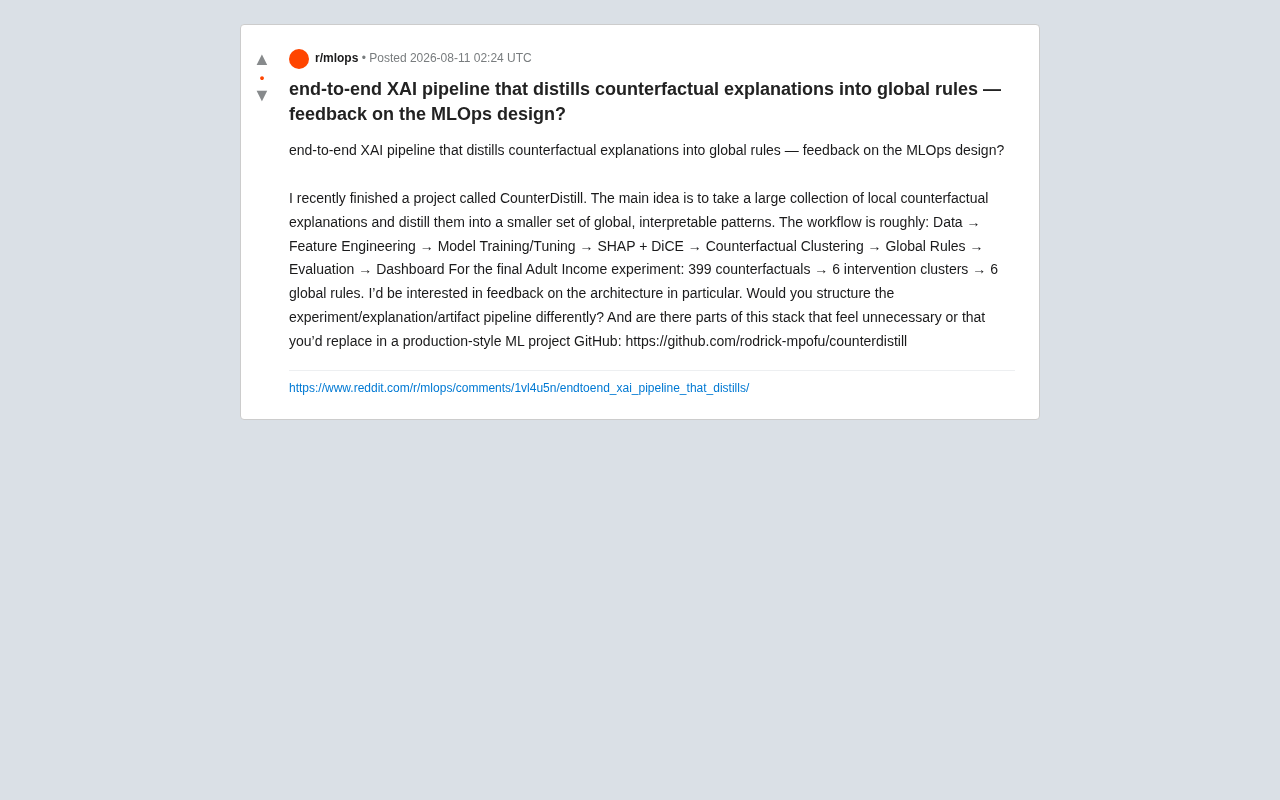
CounterDistill: Complete Pipeline Design Explained
The author provides a fairly comprehensive end-to-end workflow, covering the full chain from data to delivery:
Data → Feature Engineering → Model Training/Tuning → SHAP + DiCE → Counterfactual Clustering → Global Rules → Evaluation → Dashboard
The most interesting part of this pipeline is the design connecting the three middle stages.
The SHAP + DiCE Combination: Complementary Feature Attribution and Counterfactual Explanations
The author simultaneously uses SHAP (for feature attribution, explaining each feature's contribution to a prediction) and DiCE (Diverse Counterfactual Explanations, for generating diverse counterfactual samples). This combination is not redundant: SHAP answers "why did the model make this prediction," while DiCE answers "what needs to change to flip the prediction." The former is explanatory, the latter is actionable — together they provide a more three-dimensional characterization of model behavior.
SHAP's Theoretical Foundation: SHAP (SHapley Additive exPlanations) was proposed by Scott Lundberg at the University of Washington in 2017, with its theoretical roots in Shapley values from game theory. Shapley values were originally designed to solve the fair allocation problem in cooperative games: when multiple players cooperate to generate total revenue, how much should each player receive? SHAP transfers this idea to the feature attribution problem — the model's prediction is the "total revenue," the input features are the "players," and Shapley values calculate each feature's marginal contribution to the final prediction. SHAP's mathematical elegance lies in the fact that it is the only attribution method that simultaneously satisfies three axioms: local accuracy, missingness, and consistency. However, its computational complexity is exponential (requiring enumeration of all feature subsets), so practical applications typically use approximation algorithms such as TreeSHAP (an exact and efficient algorithm for tree-based models) or KernelSHAP (a model-agnostic sampling approximation method).
Technical Details of the DiCE Framework: DiCE (Diverse Counterfactual Explanations) is an open-source counterfactual explanation framework released by Microsoft Research in 2020. Traditional counterfactual explanation methods typically generate only a single "nearest" counterfactual sample, but this has obvious limitations: a single counterfactual might happen to land on an unstable decision boundary, or the suggested changes might be impractical for the user. DiCE's core innovation is generating multiple diverse counterfactual explanations simultaneously, using diversity constraints in the optimization objective (such as DPP — Determinantal Point Processes) to ensure that generated counterfactual samples cover different "flip paths." Additionally, DiCE supports feasibility constraints on features (e.g., age can only increase, not decrease; race cannot be changed), making generated counterfactuals more realistic. The framework supports a model-agnostic mode and can work with any black-box classifier.
Counterfactual Clustering: Distilling 399 Explanations into 6 Global Rules
The most innovative stage in the entire pipeline is counterfactual clustering. In experiments on the Adult Income prediction dataset, the author distilled 399 counterfactual explanations through clustering into 6 intervention clusters, which were further refined into 6 global rules.
About the Adult Income Dataset: The Adult Income dataset (also known as the Census Income dataset) originates from the 1994 US Census database, extracted and donated to the UCI Machine Learning Repository by Barry Becker. The prediction task is: based on an individual's demographic features (such as age, education level, occupation, marital status, weekly working hours, etc.), predict whether their annual income exceeds $50,000. The dataset contains approximately 48,842 records and 14 features. It has become a classic benchmark in XAI research because it inherently involves fairness and discrimination issues — the data includes sensitive attributes like race and gender, and whether the model's decision logic is biased against certain groups is precisely one of the core questions that explainability needs to answer. Moreover, the dataset is moderately sized with semantically clear features, making it convenient for manually verifying the reasonableness of explanations.
This 399→6→6 convergence process is essentially a form of information compression: categorizing a massive number of individualized "change suggestions" into a few typical intervention paths. For example, one cluster might represent "changing outcomes by improving education level," while another represents "changing outcomes by increasing weekly working hours." Such global rules are far more valuable to policymakers, auditors, and business decision-makers than individual counterfactuals.
Technical Methodology of Clustering Distillation: The "clustering distillation" in CounterDistill is essentially a knowledge compression technique, drawing on the concept of Knowledge Distillation. In model distillation, a complex model's behavior is compressed into a simpler model; here, a collection of many local explanations is compressed into a few global rules. In concrete implementation, clustering algorithms (such as K-Means, DBSCAN, or hierarchical clustering) operate on the "change vector" space of counterfactual explanations — each counterfactual explanation can be represented as the difference vector from the original sample to the counterfactual sample, representing "the changes that need to be made." Clustering these difference vectors reveals which change patterns recur. Cluster centers or representative samples are then converted into human-readable rules. Key technical challenges in this process include: how to select the appropriate number of clusters (6 in this case), how to handle mixed-type features (continuous and categorical features coexisting), and how to evaluate the coverage and fidelity of the distilled rules.
Rethinking XAI Architecture from an MLOps Perspective
In his post, the author specifically sought feedback on architecture design — particularly how to organize the three types of pipelines (experiments, explanations, and artifacts), and which stages are redundant or should be replaced in production environments. This is a very pragmatic question, and one that many academic XAI projects most easily overlook when moving to production.
The Convergence of MLOps and XAI: MLOps (Machine Learning Operations) is a practice framework that applies DevOps principles to machine learning lifecycle management, encompassing data version management, automated model training, continuous integration/deployment, model monitoring, and more. Traditionally, XAI has been viewed as a one-time analysis tool during the model development phase. However, as AI regulations tighten (such as the EU AI Act and various US state algorithmic accountability laws), explainability is shifting from a "research topic" to an "operational requirement." This means explanations cannot be generated just once before model deployment — they need to be continuously refreshed and monitored as models are updated and data drifts. Typical challenges in integrating XAI into MLOps pipelines include: explanation version management (which model version corresponds to which explanation version), explanation consistency monitoring (whether explanations change unreasonably after model fine-tuning), and explanation compute scheduling (how to generate explanations asynchronously without impacting inference latency). CounterDistill's pipeline design is precisely an attempt to address these engineering questions.
Commendable Engineering Design Choices
The decision to fully pipeline the explanation process and ultimately deliver it as a Dashboard reflects an engineering mindset. Many XAI research efforts stop at generating explanations without considering how those explanations will be consumed. By incorporating "evaluation" and "visual delivery" into a closed loop, CounterDistill takes an important step toward production readiness.
Aspects Worth Revisiting for Production Environments
From a production perspective, several aspects deserve further scrutiny:
- Computational Cost: Generating counterfactual explanations with DiCE is inherently computationally expensive. Generating 399 counterfactuals across all samples is feasible on small datasets, but could become a bottleneck with large-scale production data. Whether sampling strategies or incremental computation are needed is a question the architecture must answer.
- Rule Stability: After each model retraining, are the clustering results and global rules stable? If rules drift frequently, their credibility and actionability are diminished. Production pipelines may need to introduce rule version management and consistency monitoring.
- The Necessity of SHAP: Given that DiCE is already being used to generate counterfactuals, does SHAP truly contribute to the final rule distillation process, or does it serve only as auxiliary validation? This is a typical example of the "which stages can be replaced" question the author himself is asking.
From Generating Explanations to Operationalizing Explanations: The Evolution of XAI
CounterDistill reflects an important evolutionary direction in the current XAI landscape: the shift from "generating explanations" to "operationalizing explanations." Simply outputting SHAP values or counterfactual samples can no longer meet practical needs. The key to making explainability truly deliver business value lies in how to scale explanations, structure them, and integrate them into the MLOps lifecycle.
Multiple forces drive this evolution. From a regulatory perspective, the EU AI Act (formally passed in 2024) imposes explicit transparency and explainability requirements on high-risk AI systems, demanding continuous compliance throughout the system's lifecycle rather than one-time proof. From a commercial perspective, model audit requirements in industries like finance, healthcare, and insurance are shifting from "post-hoc review" to "continuous monitoring," requiring automated and scalable explanation generation. From a technical perspective, the rise of complex systems like large language models makes traditional per-sample local explanations increasingly impractical, making global, structured explanation summaries a pressing need.
For teams looking to deploy XAI in production environments, this project provides a reference template: local explanations → clustering distillation → global rules → visual delivery. Of course, as the author's own open discussion indicates, this pipeline still has significant room for optimization — particularly in computational efficiency, rule stability, and component simplification.
The project is open-sourced on GitHub (rodrick-mpofu/counterdistill). Interested developers can study its implementation and participate in discussions about architecture design. This attitude of opening research results to community review is itself a healthy way to advance the maturation of XAI engineering practices.
Related articles

Cursor AI Programming in Practice: Build a Student Management System from Scratch in 30 Minutes
A Bilibili creator demonstrates Cursor AI programming: generating a student management system in 30 minutes with natural language. Details on Agent mode, Claude selection, prompt techniques, and thresholds.

Top 20 AI Coding Tools Ranking: From Rock-Solid to Lackluster, a Scored Matrix
Bilibili creator releases top 20 AI coding tools ranking, tiered T0–T4 from rock-solid to lackluster, with Claude Code and Codex tied at T0. This article details the scoring dimensions (capability, reliability, robustness, durability, cost, domestic availability) and tool performances to help developers choose the right AI coding assistant.

Vibe Coding Systematic Tutorial: Master AI-Assisted Programming from Zero
A three-month Vibe Coding tutorial from a Bilibili creator covering Codex, ClaudeCode, and Cursor, from core logic to commercial project practice for beginners.