CoupledFlow: Neural Operators for One-Step Prediction of Multi-Physics PDEs
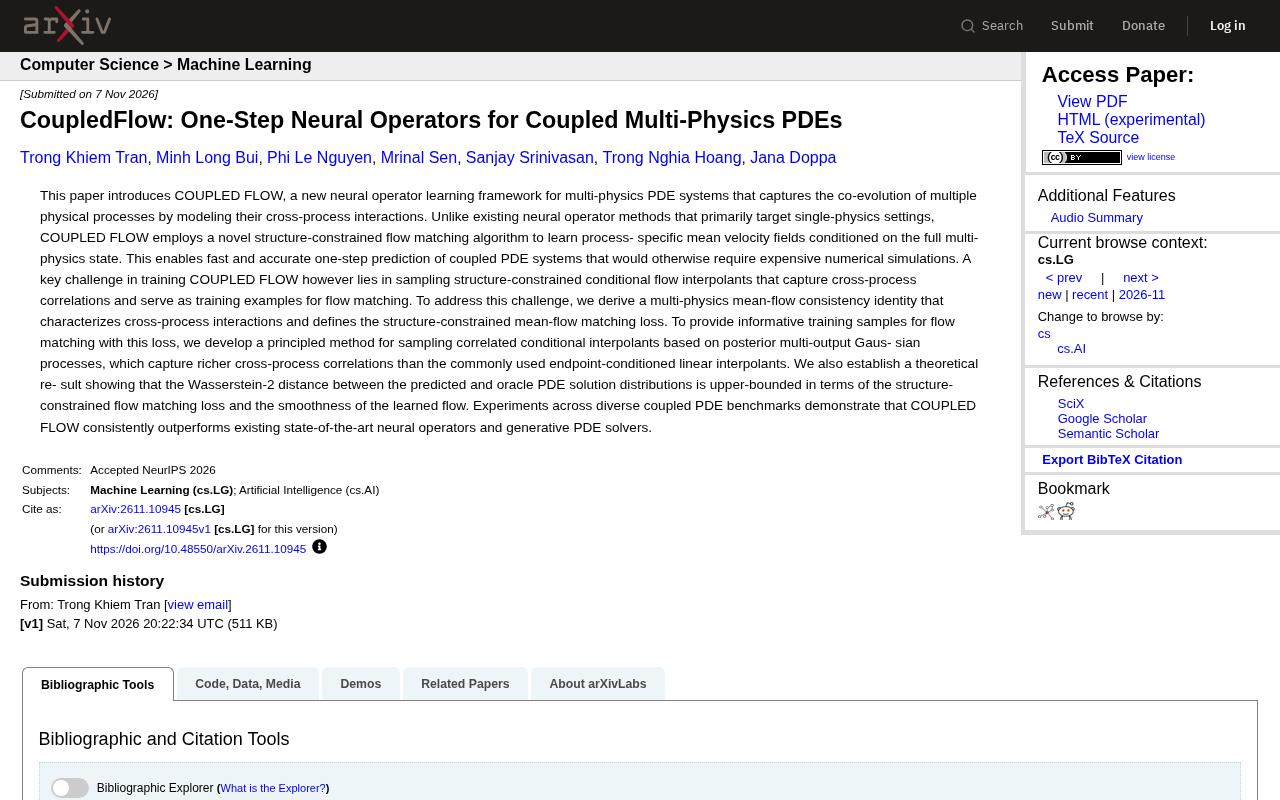
CoupledFlow uses structure-constrained flow matching for one-step neural operator prediction of multi-physics coupled PDEs.
CoupledFlow is a neural operator learning framework for multi-physics coupled PDE systems, aiming to replace expensive numerical simulation with a single forward inference. It conditions on the joint state of multiple physical processes to learn each process's mean velocity field, preserving coupling at the modeling level. It adopts structure-constrained flow matching with correlation-conditional interpolation sampling based on posterior multi-output Gaussian processes, providing richer cross-process correlations than linear interpolation. Theoretically, it gives a multi-physics mean-flow consistency identity and proves the Wasserstein-2 distance between predictive and true solution distributions is upper-bounded by the flow matching loss and smoothness. Experiments show it outperforms existing neural operators and generative solvers on multiple coupled PDE benchmarks, though specific speedup and error values are not disclosed.
CoupledFlow: Neural Operators for One-Step Prediction of Multi-Physics PDEs
Multi-physics coupled partial differential equation (PDE) systems are ubiquitous in engineering and scientific scenarios such as climate simulation, combustion modeling, and chip thermal management, and their numerical solution typically incurs extremely high computational cost. Most traditional neural operator methods are designed for single-physics-field modeling and struggle to capture the co-evolution among multiple physical processes. A paper titled "CoupledFlow: One-Step Neural Operators for Coupled Multi-Physics PDEs" proposes a neural operator learning framework for multi-physics PDE systems, attempting to replace expensive numerical simulation with a single forward inference.
From Single-Physics to Multi-Physics: The Capability Gap of Neural Operators
Neural operators have previously demonstrated the potential to replace numerical solvers on single-physics-field PDE tasks. However, the difficulty of multi-physics systems lies in the fact that different physical processes do not evolve independently but interact through cross-coupling terms—a change in one field immediately alters the evolution trajectory of another. According to the original text, existing neural operator methods are "mainly designed for single-physics-field settings," and applying them directly to coupled systems loses this cross-process interaction information. The core idea of CoupledFlow is to take the joint state of multiple physical processes as conditional input and learn the respective mean velocity field of each process, thereby preserving coupling relationships at the modeling level.
Neural operators are a class of deep learning models that establish mappings between function spaces; their goal is to learn the operator mapping from initial conditions, boundary conditions, or parameter fields to PDE solutions, rather than solving on a single discrete grid. Representative works include the Fourier Neural Operator (FNO) and DeepONet: the former performs global convolution in the frequency domain to capture long-range dependencies, while the latter encodes the input function and query coordinates separately through a branch network and a trunk network. Since a single forward pass after training can produce predictions at arbitrary resolutions, neural operators offer significant speed advantages in scenarios requiring repeated solutions of parameterized PDEs, which is the basis for considering them as alternatives to numerical solvers.
However, the inputs and outputs of standard neural operators are typically set as a single scalar field or vector field, and the training distribution also comes from single-physics-field simulations. When a system contains multiple physical fields coupled through source terms, transport terms, or boundary conditions, merely stacking the fields as multi-channel input makes it difficult for the model to explicitly distinguish the causal structure of "which field affects which field," and cross-process interaction information is easily lost in the shared network. This is precisely the capability gap referred to in the original text.
Structure-Constrained Flow Matching: Prediction in a Single Inference
The technical mainline of CoupledFlow is an algorithm called "structure-constrained flow matching." Unlike step-by-step iterative diffusion-based generation, flow matching enables fast sampling by learning a velocity field, and CoupledFlow leverages this to achieve one-step prediction for coupled PDE systems.
The key obstacle in training this algorithm lies in sampling: flow matching requires "structure-constrained conditional flow interpolation" as training samples, and these interpolations must reflect cross-process correlations. The original text points out that the cross-process correlations expressible by commonly used endpoint-conditional linear interpolation are relatively limited. Therefore, the authors instead design a principled correlation-conditional interpolation sampling method based on posterior multi-output Gaussian processes, to obtain more informative training samples.
Flow matching is a class of generative modeling methods based on continuous normalizing flows. Its basic idea is to construct a probability path from a simple prior distribution (such as a standard Gaussian) to the target data distribution, and train a neural network to regress the instantaneous velocity field along this path; during sampling, one starts from the prior and integrates an ordinary differential equation along the learned velocity field to obtain samples. Compared with diffusion models, the training objective of flow matching acts directly on the velocity field, is more concise in form, and can complete sampling with fewer or even a single integration step—this is precisely the foundation for enabling one-step prediction.
Conditional flow matching further builds the learning of the velocity field on given conditions, with training samples consisting of interpolation points along conditional paths. The choice of interpolation method directly determines the form of the conditional distribution the model can learn: commonly used linear interpolation transitions along a straight line between endpoints and has limited ability to characterize correlations among multi-dimensional outputs. The original text instead uses posterior multi-output Gaussian processes to generate interpolations, precisely leveraging the Gaussian process's ability to model covariance structures among multiple outputs, so that training samples carry more realistic cross-process correlation information.
Theoretical Foundation: Consistency Identity and Error Upper Bound
In addition to the algorithm design, the paper provides two theoretical supports. The first is a "multi-physics mean-flow consistency identity," used to characterize cross-process interactions and to define the structure-constrained mean-flow matching loss accordingly. The second is a theoretical result concerning the Wasserstein-2 distance between the predictive distribution and the true PDE solution distribution: this distance is proven to be upper-bounded jointly by the structure-constrained flow matching loss and the learned smoothness. This conclusion provides a formal basis for "a decrease in loss means the solution distribution is closer to the true solution," and also makes the framework more interpretable than purely empirical generative solvers.
The Wasserstein-2 distance is a commonly used tool for measuring the difference between two probability distributions; intuitively, it can be understood as the minimum cost required to "transport" one distribution into the other, and its squared form has geometric properties convenient for analysis under continuous distributions. In the context of generative PDE solving, it measures the overall closeness between the predictive solution distribution output by the model and the true PDE solution distribution, reflecting distribution-level deviations better than pointwise error.
Smoothness usually refers to the boundedness of the derivatives of the learned velocity field or solution mapping with respect to input and time, and is a key regularization property for controlling the stability of generative models. If the velocity field oscillates violently, samples obtained by integrating along it may deviate from the true solution manifold. The original text decomposes the Wasserstein-2 distance upper bound into a flow matching loss term and a smoothness term, with the significance that two monitorable quantities—the decrease in training loss and the sufficient smoothness of the velocity field—jointly guarantee that the predictive distribution approaches the true solution distribution, thereby bringing empirical generative modeling into an analyzable error framework.
Experimental Performance and Positioning
The authors conducted experiments on multiple coupled PDE benchmarks, and the results show that CoupledFlow consistently outperforms existing state-of-the-art neural operators and generative PDE solvers. The original text emphasizes that this advantage is built on "fast and accurate one-step prediction," whereas such coupled systems originally required expensive numerical simulation to solve. It should be noted that the original text does not disclose specific speedup ratios or error values, so its quantitative benefits still need to be further verified in conjunction with the experimental section of the paper.
From a research positioning perspective, the value of CoupledFlow lies in combining the generative modeling paradigm of flow matching with multi-physics coupling structures and constraining its convergence behavior with theoretical results. For scenarios requiring repeated solving of coupled PDEs, such one-step neural operators, if they can generalize stably, are expected to significantly reduce simulation costs; however, their performance under stronger coupling and more complex boundary conditions remains to be examined in future work.
Key Points
- CoupledFlow targets multi-physics coupled PDE systems, filling the gap that existing neural operators mainly address single-physics-field settings.
- It adopts a structure-constrained flow matching algorithm, learning the mean velocity field of each process conditioned on the full multi-physics state to achieve one-step prediction.
- It samples correlation-conditional interpolations based on posterior multi-output Gaussian processes, capturing richer cross-process correlations than linear interpolation.
- It theoretically proves that the Wasserstein-2 distance between the predictive distribution and the true solution distribution can be upper-bounded by the flow matching loss and smoothness.
- It outperforms existing neural operators and generative PDE solvers on multiple coupled PDE benchmarks.
One-line Summary
CoupledFlow uses structure-constrained flow matching to achieve one-step neural operator prediction for multi-physics coupled PDEs.
Paragraph Summary
CoupledFlow is a neural operator learning framework for multi-physics coupled partial differential equation systems, aiming to replace expensive numerical simulation with a single forward inference. The article points out that existing neural operators are mainly designed for single-physics-field settings, and applying them directly to coupled systems loses cross-process interaction information; CoupledFlow conditions on the joint state of multiple physical processes and learns the respective mean velocity field of each process, thereby preserving coupling relationships at the modeling level. Algorithmically, it adopts structure-constrained flow matching and obtains training samples with richer cross-process correlations than linear interpolation through correlation-conditional interpolation sampling based on posterior multi-output Gaussian processes. Theoretically, it provides a multi-physics mean-flow consistency identity and proves that the Wasserstein-2 distance between the predictive distribution and the true solution distribution can be jointly upper-bounded by the flow matching loss and smoothness. Experiments show that it outperforms existing neural operators and generative solvers on multiple coupled PDE benchmarks, but the specific speedup ratios and error values are not disclosed in the original text.
Related articles
Claude Context Window and Prompt Caching: A Practical Guide to Cost Optimization
A deep dive into Claude's context window and prompt caching costs: cache breakpoints, invalidation, TTL choices, context editing vs. compaction, skill progressive disclosure, and a real case where caching cost more than no caching, plus an architectural decision framework.

Building an AI Agent Is Cheap — But Have You Calculated the Cost of Running It 10,000 Times?
AI agents are cheap to build but costly to run at scale. This analysis of SimplAI, Agentforce, Copilot Studio, and CrewAI pricing reveals three dimensions for evaluating true agent costs.

Rejecting AI Slop: A "No AI Slop" Manifesto
AIE speakers jointly propose a "No AI Slop Manifesto," calling for resistance against the flood of low-quality AI-generated content. This article explains what AI slop is, the sources of industry anxiety, and what it means for content creators.