Court Denies Motion to Dismiss: DRAM Price-Fixing Case to Proceed
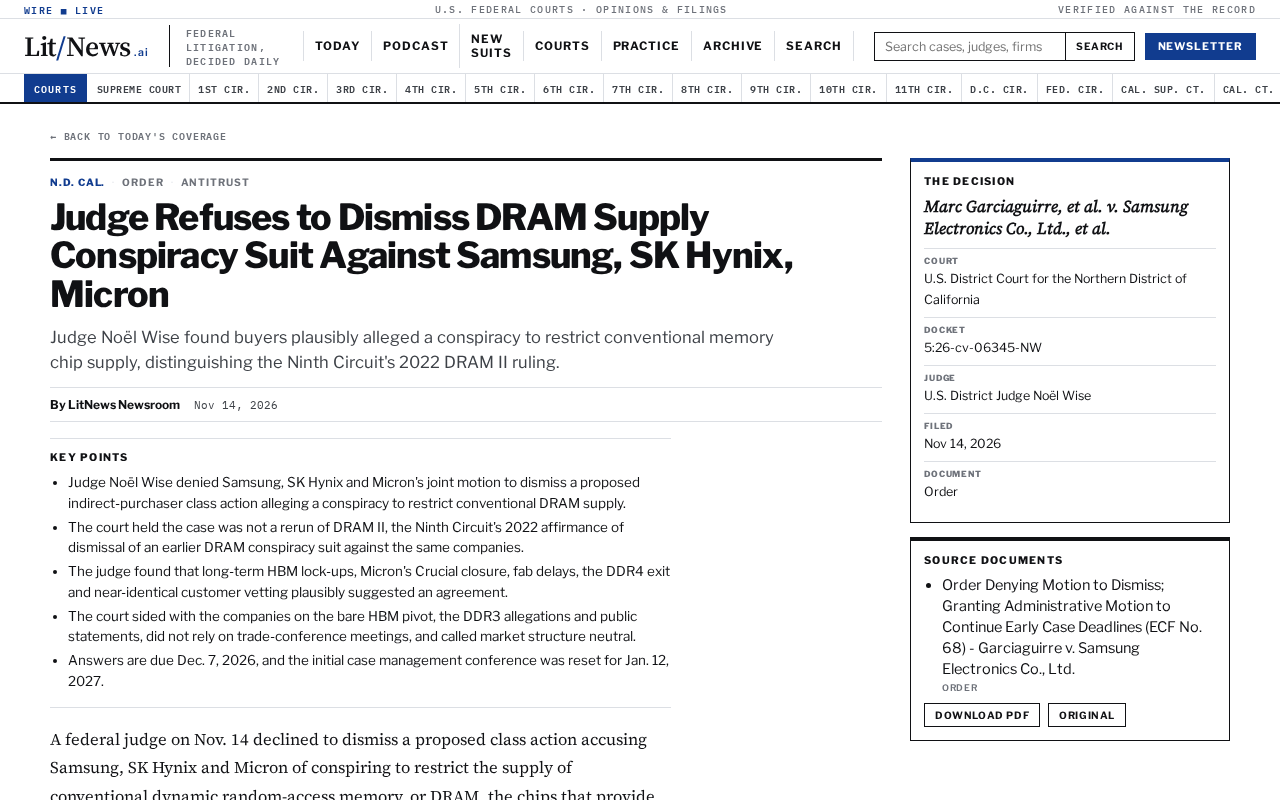
Court denies motion to dismiss in DRAM price-fixing case; the case proceeds to merits adjudication.
The article covers procedural developments in a DRAM price-fixing lawsuit. The court's denial of the motion to dismiss means the plaintiff's allegations meet the legal threshold, and the case will proceed to substantive stages such as discovery—though this does not equate to a finding of illegality. The DRAM market is highly concentrated, with a few manufacturers controlling most capacity and pricing power, making it a long-standing antitrust focus. The case's advancement may constrain pricing behavior and prompt regulatory re-examination. Given limited public information, details remain unclear and the case requires continued monitoring.
Case Update: Motion to Dismiss Denied
According to discussions in the Hacker News community, a lawsuit involving DRAM (dynamic random-access memory) price-fixing has reached a key procedural milestone—the court has denied the defendants' motion to dismiss, meaning the case will proceed to subsequent stages of litigation.
A motion to dismiss is a common tactic used by defendants early in litigation to try to terminate a case, arguing that the plaintiff's complaint lacks sufficient legal basis. The court's refusal to dismiss indicates that the judge believes the plaintiff's allegations have a basis for continued adjudication, and the core factual disputes of the case need to be further clarified in subsequent proceedings.
You may not have noticed that the source material here only provides the title and minimal discussion information, without disclosing the specific court, the companies involved, details of the allegations, or the legal basis. Therefore, the analysis in this article is based more on the public background of the DRAM industry and the general patterns of antitrust litigation.
Motion to dismiss is an early procedural motion in U.S. federal civil litigation, typically filed under Rule 12(b)(6) of the Federal Rules of Civil Procedure, arguing that the plaintiff's complaint—even assuming all facts alleged are true—fails to state a claim upon which relief can be granted. When ruling on such motions, courts generally do not examine evidence or resolve factual disputes; they only review the legal sufficiency of the complaint. If the motion is denied, the case proceeds to the answer and discovery stages; if granted, the plaintiff usually has one opportunity to amend the complaint. Therefore, denial of a motion to dismiss only means the allegations "hold up legally"—it is entirely separate from whether the defendants actually violated the law.
Why DRAM Price-Fixing Deserves Attention
DRAM is a core category of memory chips, widely used in servers, personal computers, smartphones, and data centers. The global DRAM market has long been highly concentrated, with a few manufacturers controlling the vast majority of production capacity and pricing power. For this reason, the market has historically been a key focus of antitrust regulators in various countries.
Once price-fixing allegations are established, they typically involve manufacturers coordinating capacity, exchanging pricing information, or restricting supply—explicitly or implicitly—to drive up product prices. For downstream manufacturers and end consumers, such conduct directly raises the cost of finished devices, with impacts far beyond a single component.
The oligopolistic structure of the DRAM market is key background for understanding such antitrust cases. For a long time, global DRAM supply has been dominated by three manufacturers—Samsung, SK Hynix, and Micron—which together hold over 90% of market share. This high concentration stems from the fact that DRAM manufacturing is both capital- and technology-intensive: a single advanced fab can require investments on the order of tens of billions of dollars, and process node scaling is extremely difficult, making it very hard for new entrants to gain a foothold. Historically, the industry has seen multiple episodes of severe price volatility and regulatory investigations—for example, the U.S. Department of Justice's price-fixing investigation into DRAM manufacturers in the early 2000s, which ultimately led to several companies pleading guilty and paying fines. High market concentration is not itself illegal, but it makes capacity and pricing behavior among manufacturers more closely scrutinized by antitrust authorities.
What the Denial of Dismissal Means
From a procedural perspective, denial of a motion to dismiss does not equate to a court finding that the defendants engaged in illegal conduct, but it sends several signals:
- The plaintiff's complaint meets the legal threshold, and the allegations are not obviously untenable;
- The case will proceed to stages such as discovery, where both parties must produce more internal documents and communications;
- The defendants will need to defend on the merits rather than relying solely on procedural tactics to end the litigation.
For the market, the advancement of such cases itself imposes some constraint on manufacturers' pricing behavior and may prompt regulators to re-examine the memory chip market.
Discovery is a core pretrial procedure in U.S. civil litigation, governed by Rules 26 through 37 of the Federal Rules of Civil Procedure. Parties can request documents from each other, answer written interrogatories, give sworn testimony (depositions), and seek subpoenas for third parties to produce information. In antitrust cases, discovery is often the most critical and lengthy phase, because price-fixing conspiracies usually leave no written agreements; plaintiffs must look for indirect evidence of "parallel conduct" or "price signals" in internal emails, meeting minutes, and executive communications. Discovery can involve millions of pages of documents, take years, and be extremely costly—an important reason why many antitrust cases ultimately settle.
Potential Impact on the Industry and Market
DRAM prices are highly cyclical, with supply-demand relationships, inventory levels, and capacity expansion paces all triggering sharp price fluctuations. The advancement of price-fixing litigation may, in the short term, heighten market attention to the compliance of supply behavior and prompt downstream buyers to reassess supply chain risks.
Based on historical experience, similar antitrust cases tend to be lengthy, with final outcomes possibly including settlements, fines, or judgments. Regardless of the outcome, the continued existence of the case will make manufacturers more cautious in capacity coordination and price communications—a positive development for maintaining fair market competition.
Information Limitations and Follow-Up Focus
Currently available public information is limited; the specific scope of allegations, the list of defendants, and the identity of the plaintiff remain unclear. Areas worth monitoring include: the court's definition of the scope of allegations, internal communications disclosed during discovery, and whether more manufacturers or regulators will join related proceedings. For practitioners following the semiconductor supply chain, this is a legal event that warrants continued tracking.
One-line Summary
Court denies motion to dismiss in DRAM price-fixing case; the case proceeds to merits adjudication.
Paragraph Summary
The article focuses on the procedural developments in a DRAM price-fixing lawsuit. The court's denial of the defendants' motion to dismiss means the plaintiff's allegations meet the legal threshold, and the case will proceed to substantive stages such as discovery—though this does not equate to a finding that the defendants violated the law. The article notes that the DRAM market is highly concentrated, with a few manufacturers controlling most capacity and pricing power, and has long been a focus of antitrust regulation; price-fixing directly raises downstream device costs. The advancement of the case may constrain manufacturers' pricing behavior and prompt regulators to re-examine the memory chip market. Due to limited public information, the specific court, companies involved, and details of the allegations remain unclear, and the case's trajectory requires continued monitoring.
Related articles
Gemini 4 Hydrogen In-Depth Review: Real Value Beyond Cost-Effectiveness
Based on Artificial Analysis selection data and hands-on feedback, this review unpacks the Gemini 4 Hydrogen value paradox: high scores don't equal high value, performance splits across automation workflows and coding tasks, pricing and Google subscription bundles are separate ledgers, and SynthID output labeling could be a dealbreaker.

Gemini 4 Hydrogen Five Extreme Tests: 96.7% Accuracy and One-Prompt Website Building
A YouTube creator runs five extreme tests on Gemini 4 Hydrogen: single-prompt game generation, 3D solar system simulation, 30-minute video timestamp localization, converting a 287-page report into an interactive dashboard, and 96.7% accuracy in hallucination resistance.

Gemini 4 Hydrogen Released: A 2.5x Faster Everyday AI Model
Google releases Gemini 4 Hydrogen, claiming 2.5x the speed of Gemini 3.8 Flash, with four-tier thinking control, a million-token context, and Orchestrator multi-model collaboration. API pricing is $1.50 per million input tokens.