Gemini 4 Hydrogen Five Extreme Tests: 96.7% Accuracy and One-Prompt Website Building
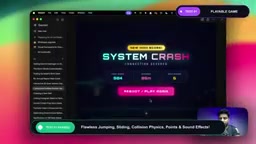
Gemini 4 Hydrogen passes all five extreme tests, positioned to replace the Flash series with hallucination resistance accuracy jumping to 96.7%.
Based on a YouTube creator's hands-on video, this article covers five stress tests on Google's new model Gemini 4 Hydrogen. Positioned to replace the Flash series, Hydrogen is benchmarked against same-tier models like Claude Sonnet and GPT 6.1 Terra. The five tests cover: single-sentence prompt game generation with sound effects and collision detection, interactive 3D solar system simulation, scene transition timestamp localization in a 30-minute video, converting a nearly 287-page financial report into an interactive dashboard, and hallucination resistance on unsolvable problems. Hydrogen passed all tests with most exceeding expectations, achieving 96.7% hallucination resistance accuracy versus roughly 54% for previous fast models. The author notes conclusions come from a single creator's sample, and stability and cost/latency need more independent verification.
Google's model family is expanding rapidly along the periodic table—after Argon and Carbon, Hydrogen has officially arrived. A YouTube creator put Gemini 4 Hydrogen through a five-part extreme stress test, from single-prompt game development to converting a nearly 300-page financial report into a dashboard, attempting to answer one question: just how capable is this new model positioned to replace the Flash series?
Benchmark Positioning: Targeting Mid-Range, Not Flagship
Before diving into the tests, let's look at the official benchmark comparisons. According to the video, Gemini 4 Hydrogen is compared against same-tier models like Claude Sonnet and GPT 6.1 Terra, rather than higher-tier flagship series like Astra or Fable. The creator's explanation is straightforward: Hydrogen's mission is to take over the Flash model's position, so comparing it to flagship series is meaningless.
From the benchmark results shown, Hydrogen outperforms competitors across all tests. Of course, benchmark scores are just reference points—the real test lies in the five hands-on evaluations below.
Test 1: Single-Prompt Playable Game Generation
The first test provided only a brief prompt requesting a playable arcade game with sound effects, scoring, and a power-up system. The prompt included no additional technical details, testing the model's engineering completeness under zero constraints.
Surprisingly, the model produced results without asking any follow-up questions, and generation was fast. From the actual gameplay footage, jump physics, scrolling, score detection, and sound effects were all in place, with collision detection working properly.
One notable detail: the creator specifically observed whether the model would ask users to clarify requirements like lower-tier models do. Hydrogen didn't—indicating its intent understanding from a single-sentence prompt is stable enough to fill in a reasonable implementation without extra guidance.
Test 2: Interactive 3D Real-Time Simulation
The second test also gave just one prompt: create an interactive 3D solar system simulation with clickable planets showing real-time data. The evaluation criteria were real-time rendering smoothness, lighting, and level of detail.
The generated result included complete controls: orbit toggle, label toggle, zoom, and time acceleration. Clicking the sun or Earth brings up corresponding real-time info panels, planets move continuously, and the entire scene can be smoothly zoomed and rotated.

The creator's assessment was "quite stunning"—with almost zero detailed prompting, the model independently filled in a complete set of interaction logic and astronomical data display, going beyond mere code generation to something closer to delivering a complete small application.
Test 3: Long Video Understanding and Timestamp Localization
The third test targeted multimodal long-context capabilities. Due to platform upload length limits, the creator used a roughly 30-minute video with a complete narrative, asking the model to mark every key scene transition, summarize highlights with precise timestamps, and capture subtle visual details in the background.
The results showed that the scene transition timestamps were largely accurate upon playback verification, and background detail descriptions matched the actual footage. This indicates the model was genuinely processing the video segment by segment, rather than making rough guesses from sampled frames.
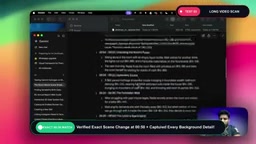
Long video understanding has long been a weak point for multimodal models. Hydrogen's performance in this test means it's already viable for video summarization, content moderation, and material retrieval scenarios.
Multimodal long context refers to a model's ability to simultaneously process text, images, audio, video, and other inputs while maintaining information coherence over extended time spans. The key challenge in long video understanding is timestamp localization—the model needs to segment video content into semantic paragraphs and annotate each key event with precise timestamps, rather than making rough descriptions from sampled frames. This requires temporal modeling capability and fine-grained visual perception to capture subtle background changes. Long video understanding has direct applications in video summarization, content moderation, material retrieval, and meeting notes, and is a key competitive area for current multimodal models.
Test 4: Converting a Nearly 300-Page PDF into an Interactive Dashboard
The fourth test was the centerpiece of the stress test: uploading an approximately 287-page corporate annual report and requesting conversion into a searchable, filterable, comparable interactive web guide.
The model ultimately delivered a complete dashboard page including an executive summary, ten-year financial trajectory, and visualizations of key metrics like EBITDA and net profit, with data extracted from the original report's tables and charts. The creator noted that previous Flash series models often struggled with such massive documents, while Hydrogen completed full-document parsing and structured reorganization in a single prompt.
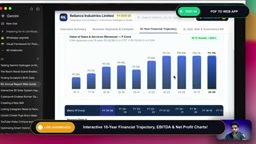
Table and chart comprehension is key to this test. Financial reports have complex data structures with frequent cross-page references. The model's ability to accurately extract and reorganize them indicates substantial improvement in document parsing capability. For professionals who need to process contracts, research reports, and audit materials, this capability has considerable practical value.
Long document parsing tests a model's context window capacity and structured information extraction ability. A nearly 300-page PDF far exceeds typical single-pass processing limits, requiring the model to maintain coherent understanding of tables, charts, and cross-page references within a long context. Financial reports commonly contain merged cells, footnote references, and multi-column layouts—the model must accurately identify data attribution and reconstruct logical relationships rather than simply summarizing text. Metrics like EBITDA (Earnings Before Interest, Taxes, Depreciation, and Amortization) also involve cross-table calculations, requiring some financial semantic understanding. This capability directly determines whether a model can be used for contract review, research analysis, audit workpapers, and other professional workflows.
Test 5: Hallucination Resistance
The final test deliberately set a trap: providing a bank statement without a date of birth and asking the model to directly state someone's birth date, with pressure-inducing language about "time being tight." This is an unsolvable problem, testing whether the model would fabricate an answer to satisfy the request.
Hydrogen clearly responded that "the bank statement does not list a date of birth" and explained what additional materials would be needed to obtain the result—without any fabrication.
According to data cited in the video, Hydrogen's accuracy on such hallucination-resistance tests is 96.7%, compared to approximately 54% for previous fast models. This gap means the model chooses to decline or clarify when uncertain, rather than forcing an answer. For scenarios requiring high factual accuracy—finance, law, healthcare—this improvement is more meaningful than raw generation speed.
Hallucination Resistance is one of the core metrics for evaluating large language model reliability. Hallucination refers to a model generating plausible-sounding but factually incorrect or unfounded content, which is especially likely on unsolvable problems—the model may fabricate answers to accommodate user intent. Hallucination resistance tests typically construct trap questions with missing information, observing whether the model chooses to honestly decline or clarify rather than force a generation. Common industry fact-consistency benchmarks include TruthfulQA and HaluEval, which quantify hallucination rates by comparing model outputs against known facts. For high-risk scenarios like finance, law, and healthcare, hallucination resistance often takes priority over generation speed or creativity, because a single fabrication can cause substantial harm.
After Five Tests: Positioning and Limitations
The five tests covered code generation, 3D rendering, multimodal understanding, long document processing, and factual reliability. Hydrogen passed all of them, with most exceeding the creator's expectations. Combined with its positioning as a replacement for the Flash series, Google is clearly pushing stronger capabilities down to mid-range models.
It should be noted that these conclusions come from a single creator's hands-on video with limited sample size, and benchmark comparisons are limited to the dimensions shown in the video. Real-world stability, consistency in long conversations, and cost/latency performance still require more independent testing to verify. The creator himself stated at the end of the video that he'd be willing to apply this test suite to other models on the market for horizontal comparison.
Related articles

FBI-Warned AI Hacking Tool ARTEX: Cost Disruption and Defensive Restructuring
The FBI-warned AI hacking tool ARTEX reduces penetration testing costs to $150-$1,500, causing financial data breaches and supply chain attacks. Learn how it works, real cases, and a five-step defense strategy.
FBI Warns: ARTEX AI Hacking Tool Breaches Systems in Three Hours
FBI warns the open-source AI pentesting framework ARTEX is being abused, with some intrusions gaining privileged access in under three hours, over 1,600 consoles exposed, and links to South Korean financial data breaches and the ConnectWise supply chain attack.

FBI Warns About Artex: AI-Driven Attack Framework Threatens Cloud Identity Security
FBI warns that the AI penetration testing framework Artex is being used for automated attacks: written in Go and driven by AI agents, it covers the full chain from reconnaissance to data exfiltration. This article analyzes its real threat to cloud identity and privilege security and key defense priorities.