Covering 100K Papers: AI Extracts a Million Experimental Findings, 2026 Top Conference Data Now Searchable
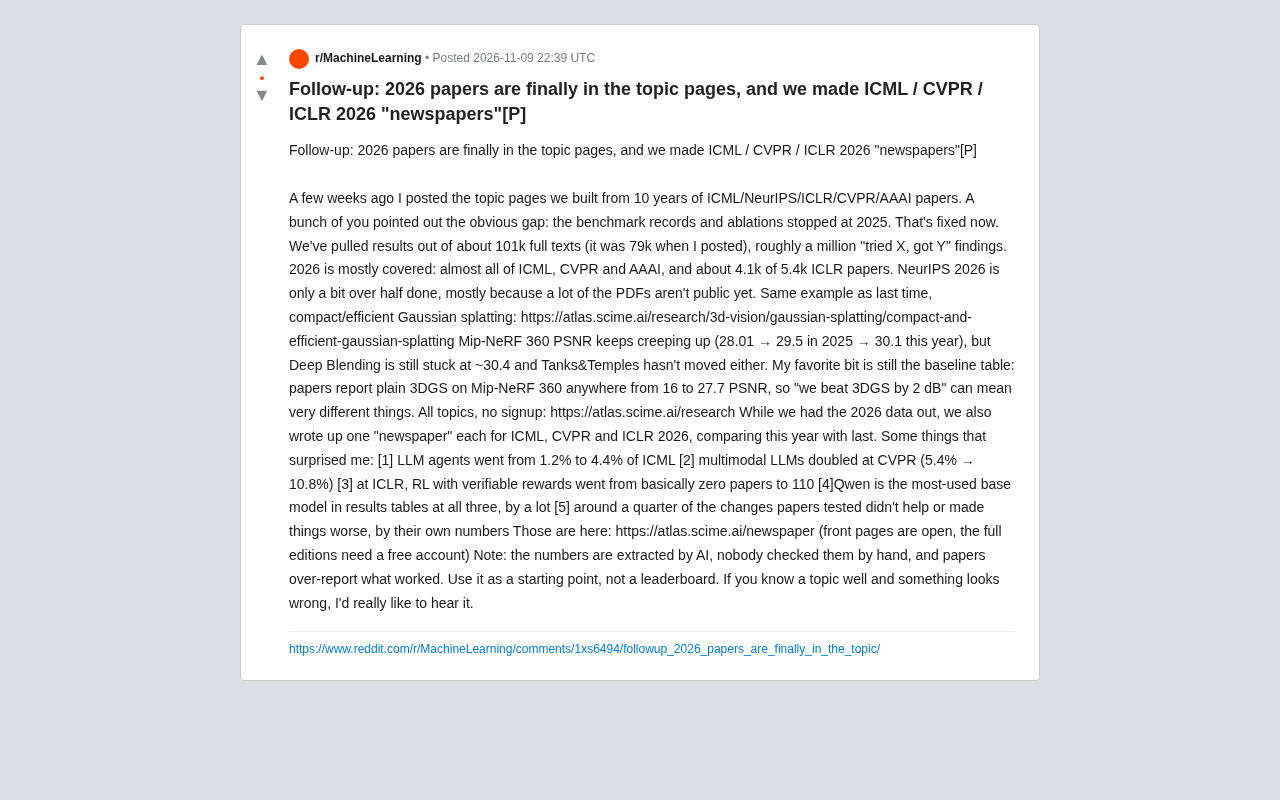
Paper knowledge base expands to 101k papers, structurally extracting a million experimental findings and revealing 2026 top conference trends.
A knowledge base built from a decade of papers from ICML, NeurIPS, ICLR, CVPR, and AAAI has expanded from about 79k to about 101k full-text papers, extracting about one million 'tried X, got Y' findings and completing 2026 coverage—ICML, CVPR, and AAAI are basically complete, ICLR covers about 4.1k/5.4k papers, and NeurIPS 2026 is only over half complete because PDFs are not public. Using efficient Gaussian splatting as an example, it shows PSNR on Mip-NeRF 360 rising to 30.1 while Deep Blending stagnates, and exposes baseline values for ordinary 3DGS ranging from 16 to 27.7. 2026 trends show significant growth in LLM agents, multimodal LLMs, and RL with verifiable rewards; Qwen is the most commonly used foundation model; and about one quarter of modifications are ineffective or harmful. The author emphasizes that data was AI-extracted without manual checking and should be a starting point, not a leaderboard.
From 79k to 101k: Expanding the Paper Knowledge Base and Completing 2026 Coverage
A few weeks ago, a developer's "topic pages" built from a decade of papers from ICML, NeurIPS, ICLR, CVPR, and AAAI sparked discussion. At the time, users pointed out an obvious gap: benchmark records and ablation experiment data were only updated through 2025. That issue has now been fixed.
According to an update to the original Reddit post, the team extracted results from approximately 101k full-text papers (up from 79k at the time of the previous post), yielding about one million "tried X, got Y" findings. 2026 coverage is as follows: ICML, CVPR, and AAAI are almost fully included, and ICLR covers about 4.1k of its 5.4k papers. NeurIPS 2026 is just over half complete, mainly because many PDFs have not yet been made public.
The significance of this progress lies in the fact that knowledge retrieval in AI research is evolving from "keyword-searching paper titles" to "structurally extracting experimental findings." For researchers and engineers who need to quickly understand progress in a subfield, directly viewing trends in benchmark data is more efficient than reading abstracts one by one.
Gaussian Splatting Case Study: PSNR Is Rising, but Some Datasets Barely Move
The original post gave an example that has been tracked over time: compact/efficient Gaussian splatting. On the Mip-NeRF 360 dataset, PSNR has continued to climb—from 28.01 to 29.5 in 2025, and then to 30.1 in 2026. But Deep Blending remains stuck at about 30.4, and Tanks&Temples has shown no obvious change either.
Even more interesting is the confusion in baseline tables. The PSNR reported in papers for ordinary 3DGS on Mip-NeRF 360 ranges from 16 to 27.7. This means that the statement "we improve over 3DGS by 2 dB" may have completely different actual meanings in different papers—because the "3DGS" being compared is not even the same number.
This case reveals a common problem in AI papers: inconsistency in baseline reproduction makes cross-paper performance comparisons difficult. Structured data extraction happens to expose this inconsistency.
Gaussian Splatting is a 3D scene reconstruction and real-time rendering technique introduced at SIGGRAPH 2023. It represents a scene as a large number of 3D Gaussian ellipsoids with position, covariance, color, and opacity parameters, and renders them by projecting them onto the image plane through a differentiable "splatting" rasterization pipeline. Compared with NeRF's reliance on per-point sampling and volumetric rendering, Gaussian splatting achieves order-of-magnitude improvements in both training and inference speed, which is why it quickly became the mainstream baseline in novel view synthesis. Its performance is usually measured by metrics such as PSNR, SSIM, and LPIPS, while Mip-NeRF 360, Tanks&Temples, and Deep Blending are three standard real-scene evaluation datasets with different difficulty levels and scene characteristics—Mip-NeRF 360 leans toward unbounded scenes, while Deep Blending has fewer scenes and is already close to saturation, which explains why the latter's PSNR has stagnated for a long time.
Three Major Conference Trends for 2026: Agents Heat Up, Multimodality Doubles, Verifiable RL Explodes
The team also wrote a "newspaper" for each of ICML, CVPR, and ICLR 2026, comparing changes in paper topics between this year and last year. Several surprising findings listed by the original author include:
- LLM agents rose from 1.2% to 4.4% at ICML;
- Multimodal LLMs doubled at CVPR (5.4% → 10.8%);
- At ICLR, reinforcement learning with verifiable rewards grew from almost zero to 110 papers;
- Qwen is the most-used foundation model in the results tables across all three conferences, and by a large margin;
- About one quarter of the modifications tested in papers did not help, or even made results worse, according to the authors' own data.
The last point is especially worth noting. Papers tend to over-report "effective" results, but even so, a considerable proportion of ablation experiments show that modifications are ineffective or harmful. This reminds readers: when you read "we propose method X and achieve improved performance," take an extra look at the ablation table.
Reinforcement learning with verifiable rewards (RLVR) is a training paradigm that emerged around 2025, with representative work including the method adopted by DeepSeekAd-R1. Its core idea is: for tasks with objectively correct answers, such as math problems and coding problems, use rule-based verifiers (such as answer matching and unit test pass rates) to automatically provide reward signals, thereby bypassing the step of training a reward model and directly optimizing the LLM with reinforcement learning. Because the reward signal is verifiable and difficult to exploit through "reward hacking," RLVR performs outstandingly in improving model reasoning ability, and this is why it grew from almost zero to 110 papers at ICLR 2026, becoming one of the fastest-growing directions.
Qwen is the open-source large language model series from Alibaba's Tongyi Qianwen team, covering dense and MoE versions from 0.5B to hundreds of billions of parameters, and providing specialized variants for multimodality, code, and other areas. Because it is open source and commercially usable, has a complete size gradient, and has strong Chinese and multilingual capabilities, Qwen is widely used in academic research as a base model or comparison baseline—this is the main reason it has become the most frequently appearing foundation model in results tables across the three major conferences.
Usage Note: AI-Extracted Data Should Not Be Used as a Leaderboard
The original author clearly noted the limitations: the numbers were extracted by AI and were not manually checked, and papers themselves tend to over-report successful results. It is recommended to use this as a starting point rather than a leaderboard.
This attitude deserves recognition. The value of structured paper data tools is not in providing absolute rankings, but in helping researchers quickly locate relevant experiments, discover baseline inconsistencies, and track trend changes. If you are familiar with a topic and find errors, the author says feedback would be very welcome.
Currently, all topic pages are accessible without registration. The front pages of the three "newspapers" are open, while the full versions require a free account.
Implications for the AI Research Tool Ecosystem
Judging from the iteration pace driven by community feedback, this type of tool is filling a real need: the number of papers is exploding, but the comparability of experimental data is declining. Structuring million-level "attempt-result" pairs, although its accuracy still needs manual verification, provides a new entry point for literature review.
For AI engineers, this means that before starting reproduction work, they can first check the distribution of numbers reported by different papers on the same benchmark, giving them a more realistic expectation of "SOTA." For researchers, the confusion in baseline tables is itself a methodological problem worth noting.
One-line Summary
Paper knowledge base expands to 101k papers, structurally extracting a million experimental findings and revealing 2026 top conference trends.
Paragraph Summary
A topic-page knowledge base built from a decade of papers from ICML, NeurIPS, ICLR, CVPR, and AAAI has expanded from about 79k full-text papers to about 101k, extracting about one million "tried X, got Y" experimental findings and completing 2026 coverage—ICML, CVPR, and AAAI are basically complete, ICLR covers about 4.1k/5.4k papers, and NeurIPS 2026 is only over half complete because PDFs are not public. Using efficient Gaussian splatting as an example, the article shows PSNR on Mip-NeRF 360 rising to 30.1 while Deep Blending stagnates, and exposes confusion in reported baseline values for ordinary 3DGS ranging from 16 to 27.7. Trends for 2026 show significant growth in LLM agents, multimodal LLMs, and RL with verifiable rewards; Qwen is the most commonly used foundation model; and about one quarter of the modifications in papers are ineffective or harmful. The author emphasizes that the data was extracted by AI without manual checking and should be used as a starting point rather than a leaderboard.
Related articles

Gemini 4 Neon Review: Benchmark Scores Rival Carbon, API Pricing and Quota Breakdown
Google Gemini 4 Neon is now live, benchmark scores closely tracking Carbon, API pricing 3/15 at twice Hydrogen's rate. This article compiles Bilibili creator testing: Neon can replace 90% of Carbon scenarios, AntiGravity quota consumption is only one-third of Carbon, plus subscription channel restrictions and 2API ban risks.

Gemini 4 Helium Coming Soon? Signals of Google Loosening Subscription Restrictions
Google team member hints releases will continue; community speculates Gemini 4 Helium (Flash Lite) may be next. Subscription ban controversy gets a response as product lead says "Soon," suggesting restrictions may be lifted. This article covers Gemini developments, OpenAI Coding Agent and risk management, Doubao real-time audio-video API, and compute business dynamics.

AI-Assisted React Development in Practice: Optimizing a Video App and Handling Errors
A 14-year veteran developer demonstrates AI-assisted React video app optimization: compressing video from 80MB to 5MB (~94%) via ImageKit, plus reliable error handling and retry mechanisms. Includes planning, code understanding, and verification methods for working with AI.