Coze Deep Dive: A Complete Guide to the Agent Building Platform vs. Dify

A comprehensive breakdown of Coze's features, positioning, and how it compares to Dify for building AI Agents.
This article demystifies Coze (扣子), ByteDance's AI Agent building platform, by first establishing a three-tier framework for AI tools — building platforms, Agent software, and development frameworks. It then analyzes Coze's dual identity, its key modules (Skill Store, workflows, multi-agent collaboration), and how it compares to Dify on ecosystem, deployment flexibility, and target use cases.
Article Content
Coze, the AI agent building platform developed by ByteDance, has been gaining significant traction in China's AI Agent space. It empowers non-developers to build agents with zero code, while also functioning like mature Agent software with ready-to-use skills. This article systematically examines what Coze is, how it differs from Dify, and where its capability boundaries lie — across dimensions like tool classification, platform positioning, and core features.
First, Let's Define the Categories: Three Types of AI Tools
Before diving into Coze, it helps to establish a clear mental framework. Products in today's AI ecosystem can generally be grouped into three layers — understanding this hierarchy helps us accurately position Coze's value.
What is an AI Agent? An AI Agent is an AI system capable of perceiving its environment, making autonomous decisions, and executing actions to accomplish goals. Unlike traditional question-answering AI (e.g., simply querying ChatGPT for a response), an Agent has a closed-loop "plan–execute–feedback" capability: it can break down complex goals into multi-step subtasks, call external tools (such as search engines, databases, and APIs), and dynamically adjust its strategy based on execution results. This makes Agents well-suited for complex scenarios requiring multi-round reasoning and tool coordination — such as automatically drafting and publishing reports, or processing data across multiple systems.
Category 1: Agent Building Platforms
This is the category our main subject belongs to. Platforms like Coze, Dify, and n8n share a core mission: helping users rapidly build deployable agents that can be integrated into real projects.
The greatest value of these platforms lies in lowering the barrier to entry. Whether or not you know how to code or have experience with Agent development frameworks, you can build an Agent from scratch using a visual workflow interface and hand it off to a real business application. These platforms are not finished Agents themselves — they are "factories that produce Agents."
Technical Background on Visual Workflows: Visual Workflow is an extension of the low-code/no-code movement into the AI domain. The core idea is to abstract program logic into draggable nodes and connecting lines, where each node represents a processing step (e.g., "Call LLM," "HTTP Request," "Conditional Branch"), and the lines between nodes represent data flow. This paradigm matured first in RPA (Robotic Process Automation) and ETL (data pipeline) domains, and has since been adopted by platforms like Coze, Dify, and n8n for AI Agent construction — enabling non-technical users to orchestrate complex, multi-step AI workflows.

Category 2: Agent Software
The second category consists of ready-made Agent software that most users have already encountered — tools like Claude Code for programming, various CLI tools, and Codex.
These tools are defined by their immediacy: someone else already built them, and you just use them. Users don't need to worry about how they're constructed internally — the focus is purely on practical utility.
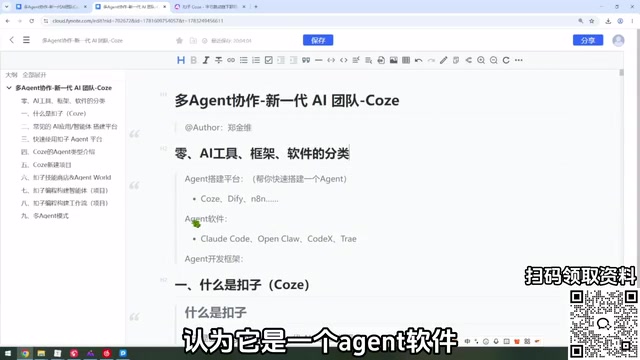
Category 3: Agent Development Frameworks
The third category is aimed at developers: Agent development frameworks. Examples from the Python ecosystem include LangChain, LangGraph, and DeepAgent; from the Java ecosystem, Spring AI and Spring AI Alibaba fall into this group.
These are more like libraries or dependency components. Java developers import them as dependencies; Python developers install them via pip. Their core use case is building Agents programmatically — offering maximum flexibility, but also the highest barrier to entry.
Framework Evolution Background: LangChain emerged in late 2022 alongside the ChatGPT wave as a Python/JavaScript framework. It was among the first to introduce the abstractions of "Chain" (chained calls) and "Agent" (tool-calling loops), dramatically reducing the complexity of building LLM applications. LangGraph is its advanced counterpart, introducing a directed acyclic graph (DAG) structure to support more complex, multi-step, stateful Agent workflows. Spring AI is the Java ecosystem's official counterpart to LangChain, maintained by the Spring team and designed to help enterprise Java applications integrate LLM capabilities. What these frameworks share in common: standardized LLM call interfaces, tool integration conventions, and memory management mechanisms.

Coze's Positioning: Evolving from "Building Platform" to "Agent Software"
With the three categories clarified, Coze's positioning becomes an interesting story.
Coze started out as a platform squarely in Category 1 — helping users rapidly build Agents — which is exactly why it competes in the same space as Dify and n8n.
But through continuous iterations, Coze has shown a clear tendency to "cross over" — it has grown to look increasingly like Category 2 Agent software. The platform provides a rich library of pre-built Skills that users can invoke directly to accomplish specific tasks, without having to build logic from scratch.
In other words, Coze is developing a dual identity:
- For developers: A powerful Agent building platform with customizable workflows and the ability to construct complex agents.
- For non-developers: An out-of-the-box Agent software product where pre-built skills solve problems immediately.
This coexistence of "build it yourself" and "just use it" dramatically broadens Coze's audience — it works for developers and non-developers alike.
Coze vs. Dify: Differentiated Choices Within the Same Arena
Comparing Coze and Dify is fundamentally a matchup between two leading products in the same category. Both are centered on rapidly building Agents, both offer visual workflow capabilities, and both aim to help users produce functional agents at the lowest possible cost.
The differences are mainly in ecosystem and form factor. As a ByteDance product, Coze excels at cross-platform continuity — it offers a web version, a mobile app, and even an installable desktop client, all with synced data — allowing users to manage their agents seamlessly across devices. This is a clear advantage for users who need to work on the go.
Coze also provides a diverse range of Agent types, including official built-in options as well as support for local and cloud-based integrations. Dify, by contrast, is known for its open-source ecosystem and deployment flexibility, making it a better fit for teams with strong requirements around data sovereignty and self-hosted deployment.
Dify's Open-Source Advantage Explained: Dify is an open-source LLM application development platform, with its code hosted on GitHub under the Apache 2.0 license (with a separate commercial license for enterprise features). The core benefit of being open source is data sovereignty: organizations can deploy Dify entirely on their own servers or private cloud infrastructure, ensuring that all conversation logs, knowledge base files, and workflow configurations never pass through third-party servers. This meets stringent data compliance requirements in industries like finance, healthcare, and government. By contrast, Coze is a ByteDance SaaS product with data stored on ByteDance's cloud, offering relatively limited private deployment options — one of the most critical differentiators for enterprise customers evaluating the two products.
Coze's Core Capability Modules
From a product architecture perspective, Coze's capabilities can be broken down into several key modules:
Diverse Agent Types
Coze includes a variety of built-in Agent types, covering official, local, and cloud-based sources. Users can leverage official capabilities directly or connect local Agents to address needs around data privacy or specific runtime environments.
The Skill Store
Skills are at the heart of Coze's evolution toward "Agent software" territory. The platform packages common functionalities into reusable Skill modules that users can invoke directly to complete tasks — no need to build the underlying logic yourself. This is the most tangible way Coze differentiates itself from a pure building platform.
Workflows and Zero-Code Building
For users with higher customization needs, Coze supports rapid agent and workflow creation through both visual and programmatic interfaces. Typical use cases include building zero-code news aggregation pipelines and complete 2D-to-3D conversion workflows — demonstrating the platform's end-to-end capability from data collection to content processing.
Multi-Agent Collaboration Mode
Coze introduces a "Multi-Agent Mode" that allows multiple agents to collaborate on complex tasks. This represents a frontier direction in the AI Agent space and is an important benchmark for evaluating the maturity of any building platform.
Technical Principles Behind Multi-Agent Collaboration: A Multi-Agent System (MAS) refers to multiple AI agents dividing labor and collaborating within a shared task framework. Common collaboration patterns include: the "Orchestrator" model (one Orchestrator Agent decomposes a task and delegates subtasks to specialized Sub-Agents), the "Pipeline" model (multiple Agents process data sequentially, similar to a factory assembly line), and the "Debate" model (multiple Agents provide different perspectives on the same problem and cross-verify results). This direction was brought into the mainstream by Stanford University's "Generative Agents" paper (2023) and Microsoft's AutoGen framework, and is widely considered a key pathway to overcoming single-LLM context limitations for ultra-complex tasks.

It's worth noting that the Agent World feature within the platform has been under development for quite some time without being publicly released, and the reasons remain unclear pending an official explanation. This serves as a reminder that, as a continuously evolving product, some of Coze's features are still in flux.
Conclusion: How to Choose Between Coze and Dify
Coze's value lies precisely in blurring the line between "building" and "using" — bringing the benefits of Agent technology within reach of non-developers while preserving meaningful customization space for developers.
For teams and individuals looking to rapidly validate AI application ideas, platforms like Coze and Dify dramatically shorten the path from concept to deployment. Which one to choose depends on whether you prioritize cross-platform continuity and ready-made skills (lean toward Coze), or open-source ecosystem and private deployment (lean toward Dify). Clarifying these foundational trade-offs before diving in will ensure the tools actually work for you.
Key Takeaways
Related articles

DynamicLake 2.0: Bringing Dynamic Island to Your Mac
DynamicLake 2.0 brings iPhone's Dynamic Island experience to Mac, with notifications, file staging, format conversion, AirDrop, timers, and a new plugin system.

Proofrr: One Workspace for Creative Feedback, Review, and Approval
Proofrr unifies client feedback, version comparison, review, and approval for design and video teams in one workspace — with no-login sharing and AI-assisted review.

FATHER: A Mac Operations Monitoring Dashboard Built for Vercel Teams
FATHER is a Mac-native ops dashboard for Vercel teams, aggregating traffic, deployments, uptime, PageSpeed, and Search Console SEO data with downtime alerts, SSL reminders, local token storage, and a one-time purchase model.