Coze Deep Dive: Multi-Agent Collaboration Platform Features & Usage Guide

Coze is ByteDance's no-code multi-agent collaboration platform for teams and solo builders alike.
Coze (扣子) by ByteDance is a no-code multi-agent platform enabling multi-user AI collaboration, local tool integration, and cross-platform project management. This guide covers its three core features, credit system, and how it compares to Dify — helping you decide if it's the right tool for your workflow.
What is Coze?
Coze is an intelligent agent (Agent) development and collaboration platform from ByteDance. Unlike general-purpose chat assistants such as Doubao, Coze is purpose-built as a multi-agent collaborative workspace for both developers and non-developers — it not only orchestrates multiple AI agents, but also allows multiple people to work together on the same project.
To appreciate what Coze offers, it helps to understand the technical context behind the concept of an "Agent." Unlike traditional single-turn Q&A AI, an Agent operates in a closed-loop cycle of perceive–decide–act: it can receive external information, call tools (such as search engines, code interpreters, and API endpoints), and dynamically adjust its next steps based on intermediate results. This paradigm traces its roots to the "intelligent agent" theory in reinforcement learning, but took a qualitative leap forward with the rise of large language models (LLMs). OpenAI's Function Calling, Anthropic's Tool Use, and the widespread adoption of the ReAct (Reasoning + Acting) framework have all helped bring LLM-powered agents from academic concept to engineering reality. Multi-Agent collaboration takes this even further — by assigning specialized agents to different responsibilities, it addresses the bottlenecks of limited context and narrow capabilities that constrain a single agent. This is precisely the core design philosophy behind the Coze platform architecture.
In short, Coze aims to let you build fully functional agents without writing a single line of code. For developers, it is equally capable of handling coding tasks and running workflows. In the platform's own words, it is a place where "people and AIs all show up, and multiple people can collaborate on a single project together."
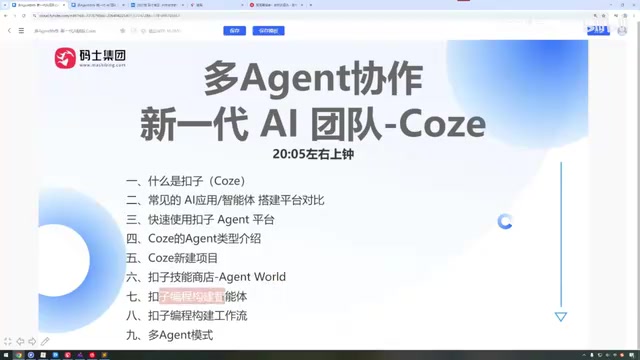
The fastest and most accurate way to learn any new tool is to read through the official documentation. Coze's website provides a complete documentation portal under the "Resources" section — many of the features discussed in this article are drawn directly from there.
Three Core Features of Coze
1. Multi-User, Multi-AI Collaborative Workspace
Coze's most distinctive characteristic is multi-user, multi-AI collaboration on shared projects. You can create a "Project," add different agents during setup, and — with a VIP subscription — even invite real team members to participate.
Each project has its own dedicated chat window and stored conversation history, and you can switch between projects at any time — for example, one project for an AI comic series, another connected to a local Cloud Code environment for development, and a third functioning as a sensitive-word-filtering bot. All project data and history are retained server-side, enabling instant team formation and division of labor.

It's worth noting that the maximum number of collaborators per project is tied to your VIP tier. For free users, personal mode typically supports only one or two agents, so multi-user collaboration is not required.
2. Customizable AI with Local Tool Integration
Coze includes built-in templates covering a wide range of industries — whether it's programming, AI comic creation, or other vertical applications, you can get started quickly. More importantly, it supports integration with local development tools — for instance, a local Cloud Code environment can be directly connected to and orchestrated by the Coze platform.
Cloud Code broadly refers to code execution services running in cloud or local sandbox environments, with prominent examples including Google Cloud Code, GitHub Codespaces, and the code interpreter modules found in various AI coding assistants. Bridging a remote AI platform with local development tools is essentially achieved through MCP (Model Context Protocol), LSP (Language Server Protocol), or custom API bridges. The strategic significance of this capability lies in closing the last mile between "AI planning" and "local execution" — AI no longer just gives suggestions; it directly operates real development environments. This is also the core technical path behind the "AI software engineer" category (as seen in tools like Devin and SWE-agent), and Coze's support for local tools is a direct reflection of this trend.
In hands-on testing, this "local integration" capability is currently in a limited-time free phase (most other custom Agent types require a VIP subscription). This means developers can have Coze remotely operate a computer for development tasks, or even deploy directly within a sandbox environment, forming a smooth remote AI programming pipeline.

Coze is also compatible with Cloud Code, CodeX, and many other mainstream development tools. While its native capabilities may not exceed those of dedicated tools like Cloud Code, its real advantage lies in the overall workflow continuity — "it gets the job done."
3. Cross-Platform Sync and All-in-One Project Capabilities
As a ByteDance product, Coze offers seamless sync across three platforms — web, desktop client, and mobile app. You can pick up any project at any time from any device, which is a significant advantage over purely desktop-based tools.
On the execution front, Coze positions itself as a one-stop solution — from task decomposition and automatic execution to error detection and iterative correction, it operates autonomously like a true agent. Behind this self-check–correct–retry loop is a deep integration of the Workflow engine with LLMs: the workflow engine breaks complex tasks into ordered nodes, where each node can be an LLM inference call, an API request, a code execution step, or a conditional branch. Through a low-code/no-code visual orchestration interface, non-technical users can build automated processes that would otherwise require traditional programming. This is the essence of core Agent capability.
Credit System: One-Stop Automation Is Great — But Use It Wisely
Coze uses a credit-based system rather than charging per token. New accounts receive approximately 3,000 credits upon first login, followed by around 1,500 credits per daily login. This may sound generous, but credits deplete surprisingly fast.
Understanding why requires grasping the fundamental difference between tokens and credits. A token is the basic unit by which large language models process text — roughly corresponding to a word fragment in English or a single Chinese character (1 Chinese character ≈ 1.5–2 tokens). Token-based billing is standard practice for model APIs such as OpenAI's — it's transparent and predictable, but requires users to understand the model's internals. A credit system, by contrast, is a consumer-friendly abstraction that packages the costs of model calls, tool usage, storage, and more into a single unified currency. In multi-agent collaboration scenarios, a single complex task can trigger dozens of LLM inference calls, image generation requests, and tool invocations — the actual compute consumption accumulates far beyond what users intuitively expect. This is the fundamental reason credits are depleted so quickly.

Here's a concrete example: attempting to have Coze produce an AI comic series "from scratch" prompted a system warning that the task would consume over 10,000 credits — a single casual selection was enough to drain an entire account balance. By comparison, programming-related tasks consume credits at a much more modest rate.
For free users, the core advice is: don't blindly chase full end-to-end automation — execute in stages instead. If a task has six steps, use the day's free credits to complete step one, then move on to step two the next day. A gradual, incremental approach avoids burning through your credits all at once. This is the practical cost reality that comes with using most AI agent tools today.
Coze vs. Dify: Who Are They Really For?
Compared to Dify, another frequently mentioned agent-building platform, the two share a similar category but serve noticeably different audiences:
- Dify leans more toward developers and internal enterprise scenarios, with a relatively higher technical barrier to entry;
- Coze, while also supporting internal enterprise development, is primarily positioned as an official online team collaboration tool, emphasizing simplicity and accessibility so that users with no technical background can produce results quickly.
This difference has deep technical and commercial roots. Dify is an open-source LLMOps (Large Language Model Operations) platform focused on self-hosted deployment and enterprise-grade customization. It supports multiple model backends and provides developer-oriented features such as RAG (Retrieval-Augmented Generation) knowledge bases, API publishing, and log monitoring. Unlike Coze's SaaS-based collaborative model, Dify prioritizes data sovereignty and technical control, making it more popular in data-compliance-sensitive industries such as finance and healthcare. If data security and the flexibility for secondary development are top priorities, Dify is the better fit; if speed of onboarding and team collaboration matter more, Coze has the edge.
In other words, Coze has invested more heavily in usability and collaboration, resulting in a gentler learning curve — making it ideal for users who want to quickly validate ideas without deep tooling expertise.
Summary
Coze represents an important direction for homegrown Chinese AI agent platforms: evolving from a single chat assistant into an engineered multi-user, multi-agent collaborative platform. Its three pillars — multi-user multi-AI collaboration, customizable AI with local tool integration, and cross-platform all-in-one project capabilities — together form a low-barrier, highly collaborative Agent development environment. This product form mirrors the broader trend of AI technology shifting from "conversational assistant" to "autonomous executor": by integrating multi-agent collaboration, workflow orchestration, and low-code operation into a single platform, Coze aims to turn "everyone can use AI to get things done" from a slogan into reality.
For general users, Coze's greatest value is "you can build a functional agent even without technical knowledge." For developers, the remote AI programming and local tool integration (currently free during the limited-time period) opens up additional possibilities. The one thing to keep in mind is the credit cost — plan sensibly, execute in stages, and you'll be able to get the most out of what's available within the free quota.
Key Takeaways
Related articles
Understanding GitHub's Availability Report: Platform Stability and Developer Response Strategies
Deep dive into GitHub's monthly availability report: analyzing service degradation impacts, CI/CD fault tolerance, and platform dependency risk strategies for resilient development.

OpenAI's Claim of Solving a Millennium Prize Problem Sparks Academic Controversy
OpenAI claims its AI solved a Millennium Prize Problem, sparking debates over attribution, verification, and AI's role in reshaping mathematical research.

Ledoit-Wolf Covariance Shrinkage in Practice: 57% Lower Turnover + 10x GPU Acceleration
Learn how Ledoit-Wolf covariance shrinkage reduces portfolio turnover by up to 57% and how cuML GPU acceleration cuts backtest time from 1.5 hours to 9 minutes.