Coze Zero-Basics Course: From Beginner to AI Agent in 7 Days

Bilibili 748-episode Coze course analysis: agent platform value, learning path, and beginner misconceptions.
Based on a Bilibili Coze course claiming 748 episodes, this article outlines Coze's core value as an AI agent platform: it not only chats but directly executes tasks like organizing materials, generating documents, and analyzing spreadsheets, with domestic direct access and a friendly free quota. It highlights the beginner misconception of treating agents as chatbots and presents a four-module learning path with 12 common plugins, emphasizing hands-on practice and rational evaluation of marketing claims.
Coze Zero-Basics Course: From Beginner to AI Agent in 7 Days
In today's flood of AI tools, if you had to pick just one to study deeply, many professionals would recommend Coze. What exactly is it? Simply put, it's an AI agent platform—it understands your needs and gets the work done directly on your computer. Unlike pure chatbots, Coze emphasizes "hands-on capability": it can organize materials, generate documents, analyze spreadsheets, and even complete repetitive operations.
Recently, a set of Coze zero-basics tutorials claiming to span "all 748 episodes" appeared on Bilibili, covering the full chain from beginner to industry application. This article is based on the public introduction of that course, combined with information from multiple sources, to outline Coze's core value, the learning path, and common beginner misconceptions, helping you judge whether it's worth your time.
What Is Coze: More Than a Chat Window
According to the Bilibili creator's description at the start of the course, Coze can be understood as an AI agent platform. In plain terms, it's an AI that understands your needs and can directly get work done on your computer. It's a domestic product with a Chinese interface, directly accessible on domestic networks, requires no complex configuration, has low device requirements, and offers a free quota.
More importantly, it can directly connect with common office software. Work that previously required constant switching between multiple applications can now potentially all be handled by it in a unified way: organizing materials, generating documents, analyzing spreadsheets, completing repetitive operations. It doesn't just chat with you—it genuinely helps you get work done. This characteristic clearly distinguishes it from most conversational AI on the market—the latter often stops at the "suggestion" level, while Coze attempts to bridge the "execution" link.
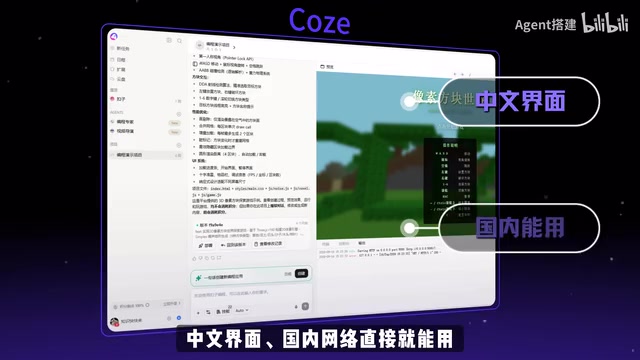
From an industry perspective, AI agents are moving from concept to implementation. Coze's positioning lowers the barrier for ordinary users to build and use agents, making it especially suitable for people without programming backgrounds who want to improve office efficiency. However, the more powerful the tool, the more it requires correct usage methods—otherwise it's easy to treat it as an ordinary chat window.
AI Agent is an important concept in the current AI field, referring to AI systems that can perceive their environment, make autonomous decisions, and execute actions to achieve goals. Unlike traditional Q&A AI, agents typically possess capabilities such as task decomposition, tool invocation, memory, and planning. Coze is a representative of such platforms: it allows users to describe tasks in natural language, and the platform automatically invokes corresponding tools (such as document processing, spreadsheet analysis, file operations, etc.) to complete them. The core of an agent lies in "proxy execution," meaning users shift from operators to task delegators—this marks the evolution of AI applications from "assisted suggestions" to "autonomous execution."
Common Beginner Misconception: Treating Agents as Chatbots
The creator says bluntly in the video: many people open Coze and just ask it a few simple questions. The tool is clearly powerful, yet they end up using it as an ordinary chat window—what a pity.
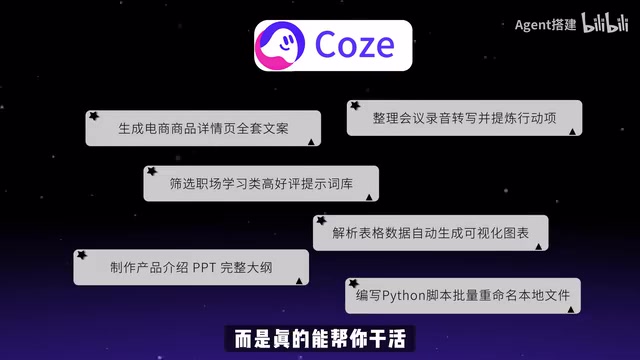
This observation points to a common pain point in AI tool adoption: user habits are hard to migrate. Conversational AI has cultivated the "ask-answer" interaction inertia, while the value of agent platforms lies in "delegate-execute." If you only use it for Q&A, it's like using a sports car to deliver food—it's not that you can't, but you're wasting its core capability.
According to analyses by several AI tool review bloggers on YouTube, the learning curve for agent platforms isn't steep, but users need to shift their mindset: from "asking it questions" to "giving it tasks." For example, rather than asking "how do I organize this spreadsheet," just say "summarize this spreadsheet by month and generate a chart." The more specific the task description, the more value the agent can deliver.
Four-Stage Learning Path: From Beginner to Industry Application
The course divides its content into four modules: Introduction, Case Studies, Advanced, and Industry Applications. Knowledge points progress from basic operations to real office scenarios, deepening step by step. The creator emphasizes that it doesn't matter if you can't write code, and it doesn't matter if you've never touched AI—as long as you follow the course and practice hands-on, you can gradually hand all repetitive, time-consuming work over to AI.
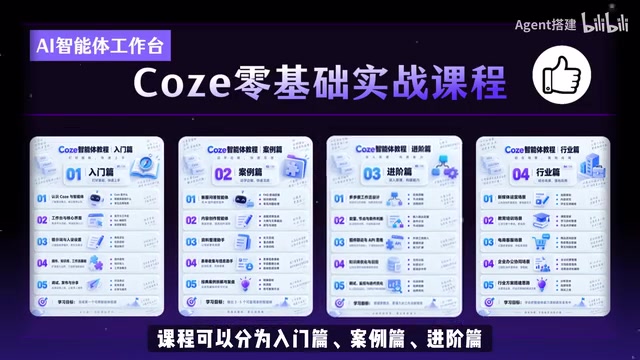
The Introduction module is expected to cover interface familiarization, basic operations, and building your first agent; the Case Studies module breaks down real office scenarios to help users develop task-oriented thinking; the Advanced module involves more complex configurations such as plugin customization; and Industry Applications demonstrates how Coze is implemented in different fields. This layered design aligns with the structure of most systematic courses, but whether 748 episodes means redundant content is something learners need to judge for themselves.
Interestingly, the creator has also put together a companion resource pack covering four modules—installation instructions, case breakdowns, plugin customization, and industry applications—plus 12 commonly used plugins and more materials for direct hands-on practice. The way to get it: like, favorite, and reply "resource pack" in the comments.

Plugin is a key mechanism for extending Coze platform capabilities, referring to external services or APIs that encapsulate specific functions, which agents can invoke as needed. For example, a "weather query" plugin enables an agent to retrieve real-time weather information, and a "document generation" plugin can automatically create reports. The plugin ecosystem determines the boundaries of an agent's capabilities; users can combine existing plugins to complete complex tasks without developing from scratch. The 12 commonly used plugins mentioned in the course typically cover high-frequency scenarios in office automation, such as file processing, data scraping, and content generation—making them a starting point for beginners to get up to speed quickly.
Learning Advice: Do While You Watch, Don't Let the Tool Collect Dust
At the end of the video, the creator gives a simple but crucial piece of advice: after getting the materials, watch and do simultaneously—don't let this tool just sit in your favorites folder.
From a learning-science perspective, AI tools are highly operational, and pure watching yields very low retention. Multiple education creators across platforms have noted that hands-on practice is the shortest path to mastering AI tools. For Coze, it's recommended to start with a small task—such as automatically organizing your downloads folder or batch-renaming files—get one complete workflow running first, then gradually increase complexity.
Additionally, while the free quota is friendly, high-frequency use may require attention to quota consumption. The plugin ecosystem is where Coze's extensibility lies; the 12 common plugins can serve as a starting point, but there's no need to master them all at once.
Multi-Source Perspective: The Demand and Limitations Behind the Course's Popularity
According to the title and description of this course on Bilibili, its selling points are "the most comprehensive and detailed," "from novice to master in seven days," and "job-ready upon completion." Some AI channels on YouTube are more cautious in their evaluation of such courses: systematic tutorials are suitable for zero-basics users to build a framework, but "master" and "employment" are more marketing rhetoric—actual capability depends on the depth of project practice.
The consensus is that Coze, as a domestically accessible agent platform, genuinely lowers the barrier to AI applications and has real value for office automation. The disagreement concerns the actual information density of the course—whether 748 episodes contain a lot of repetitive content may vary significantly among different learners. Prospective learners are advised to first watch the Introduction and Case Studies modules to judge whether the style and pace suit them, then decide whether to commit to the full course.
Overall, this course provides a structured entry path to Coze, and the companion resource pack adds practical convenience. But the value of a tool ultimately depends on the user's task-design ability, not on the number of episodes.
Free quota is a common business model for AI platforms, referring to the amount users can use for free within a certain limit, beyond which payment or restrictions apply. For agent platforms like Coze, the free quota typically covers a certain number of task executions or plugin invocations. It's generally sufficient for beginners practicing in the early stages, but high-frequency or complex tasks may consume it quickly. Understanding quota rules helps with reasonable usage planning and avoids interruptions to learning due to quota exhaustion. At the same time, the free quota is also a strategy for platforms to lower the experience barrier and attract users to try, but long-term reliance requires attention to costs.
One-line Summary
Analysis of Bilibili's 748-episode Coze course: the value of an agent platform, the learning path, and beginner misconceptions.
Paragraph Summary
Based on a Bilibili Coze zero-basics course claiming to span all 748 episodes, combined with multiple sources, this article outlines Coze's core value as an AI agent platform: it can not only chat but also directly execute tasks such as organizing materials, generating documents, and analyzing spreadsheets, with direct domestic access and a friendly free quota. The article points out the common beginner misconception of treating agents as chatbots—asking questions without delegating tasks. The course is divided into four modules: Introduction, Case Studies, Advanced, and Industry Applications, with a companion resource pack including 12 common plugins. The learning advice emphasizes doing while watching and running a complete workflow starting from small tasks. It also reminds readers to view marketing phrases like "job-ready upon completion" rationally—actual capability depends on the depth of project practice.
Related articles

Bilibili's Hit Dify Tutorial: A Practical Guide to Building 20+ AI Apps from Scratch
A distilled guide to Bilibili's top-rated Dify tutorial: Windows + Docker deployment, MySQL connection, five app types, model integration strategy, and publishing.

Agent Skills Beginner's Guide: From Concepts to Multi-Agent Collaboration in Practice
A comprehensive guide to Agent Skills: core concepts, components, the importance of Description, standardization, beginner learning paths, and multi-agent collaboration.

One Neuron Detects Both Cats and Cars? We Reproduced It and Found a New Explanation
The cat-car neuron reinterpreted: researcher Cammarata argues it distinguishes pointy from round, not cats from cars. We reproduced the experiment and found the new explanation holds on most inputs—but cars are the exception. The interpretability debate continues on language models.