Creads: Let an AI Agent Team Run Your Marketing Autonomously

Creads replaces traditional marketing workflows with role-based AI agents that deliver results autonomously.
Creads is an AI product built around the concept of a "self-running marketing team," composed of multiple AI agents with distinct functional roles covering paid advertising, organic growth, and market research. Unlike traditional marketing SaaS tools, it aims to close the full loop from planning to execution — users simply set goals through conversation and the agent team handles the rest. Targeting resource-constrained startups and SMBs, it offers a 3-day free trial. While the "autonomous AI marketing team" direction is compelling, brand alignment, decision transparency, and controllability remain key challenges to validate in real-world use.
A Marketing Team That Runs Itself
Marketing automation tools are everywhere, but most still require humans to set strategy, write copy, and manage campaigns — the tools simply make execution more efficient. Creads flips this logic entirely. Its tagline is "Your marketing, running on its own," and its goal is to build a marketing team that genuinely operates itself.
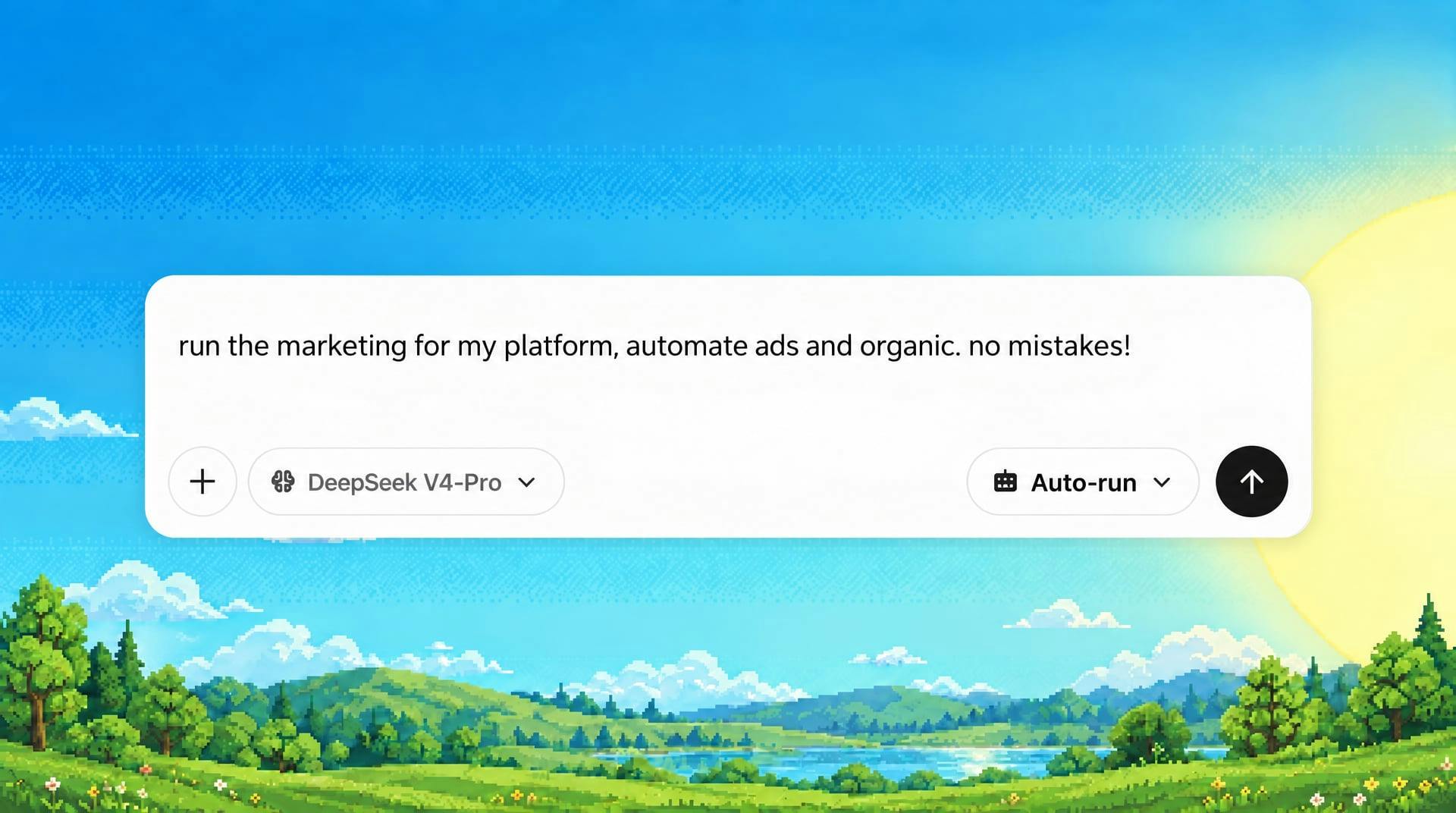
According to the official description, Creads is composed of a group of AI agents with real functional roles. Through conversational interaction, these agents handle paid advertising, organic growth, and market research respectively. They don't just offer suggestions — they complete the full cycle of creation, publishing, and optimization. Users receive outcomes, not tedious intermediate workflows. As the tagline puts it: "You get the outcome, not the workflow."
From "Tool" to "Agent Team": A Shift in Thinking
Creads' product positioning reflects a significant trend in AI applications today: the evolution from single-point tools to multi-agent collaborative systems. Traditional marketing SaaS typically focuses on one area — content generation, social media scheduling, or ad analytics — leaving users to switch between multiple tools and manually stitch processes together.
Creads bundles these roles into a single system, with each agent having a clear division of labor: some handle paid advertising, some focus on organic growth, and some provide research support. In theory, users simply chat to set a goal, and the agent team collaborates to handle everything from planning to execution. This "role-based agent" design brings AI closer to the form of "digital employees" rather than simple automation scripts.
Who Would Need This?
For resource-constrained startups, indie founders, or small-to-medium businesses, building a full marketing team is expensive. Creads' value proposition speaks directly to this pain point: replace some human roles with affordable AI agents, enabling teams with limited marketing resources to continuously produce and optimize campaigns.
The product currently offers a 3-day free trial, giving users a low-barrier way to experience its automation capabilities.
Multi-Agent Systems (MAS) have become a major architectural paradigm in AI applications over the past two years. Unlike a single large model responding directly to user requests, a multi-agent system breaks down complex tasks among multiple specialized AI agents — each with its own "role definition," tool-calling permissions, and execution scope — and agents can pass information to each other to collaboratively complete subtasks. The advantages of this design include: specialized division of labor improving individual task quality, parallel execution reducing overall time, and role boundaries lowering decision complexity for each agent. OpenAI's Swarm, Microsoft's AutoGen, and Anthropic's Claude tool-calling support are all representative explorations in this direction. Creads applies this architecture to marketing, essentially replacing "feature modules" with "functional roles" — making users perceive a "team" rather than "software."
Questions Worth Asking
The tagline is compelling, but the actual effectiveness of "fully automated marketing" still needs to be proven. Marketing is highly dependent on understanding brand tone, target audiences, and market timing. Whether AI agents can make brand-appropriate judgments in real-world scenarios is the biggest test for this type of product.
Furthermore, paid advertising involves real budget expenditure. Delegating optimization decisions entirely to AI agents requires significant trust and control mechanisms. Enterprise users typically want to know: Are the agents' decisions transparent? Can humans intervene at any time? These details will determine whether the product can move from "conceptually impressive" to "practically usable."
Based on early performance on Product Hunt, Creads attracted some attention (ranked #17 on launch day), though discussion volume wasn't particularly high. The product is still in its early stages. The "autonomous AI marketing team" direction it represents is genuinely promising, but real-world effectiveness still needs to be validated by more user feedback.
The "human control" problem in ad automation is known in the industry as the trade-off between Human-in-the-Loop (HITL) and Full Automation. Full automation means AI can independently adjust bidding strategies, pause, or scale campaigns — maximizing efficiency but also concentrating risk. If the model makes a poor judgment call, budget burn can escalate rapidly. Google Ads' Smart Bidding and Meta's Advantage+ campaigns both offer varying degrees of automation, but generally maintain human guardrails like budget caps and audience exclusions. For products like Creads that further delegate decision-making to AI agents, the design of auditable operation logs, anomaly circuit-breaker mechanisms, and manual override entry points will directly affect enterprise adoption — especially among budget-sensitive SMBs.
Summary
Creads brings the hot concept of "AI agents" to the specific context of marketing, replacing traditional workflows with a team of role-based agents built around a "results only, no process required" experience. For teams with limited resources, this is a direction worth trying. But the reliability, controllability, and brand alignment of automated marketing remain the core questions this product still needs to answer with real-world performance.
Related articles

AI Compute Is the New Oil, But the Market Mechanism Has Yet to Take Shape
Hacker News compares AI compute to the new oil, noting the lack of price discovery, concentrated supply, and no hedging tools. The article analyzes structural issues in compute trading and explores a possible three-tier market of spot, contracts, and derivatives, plus the real impact on AI practitioners' cost management.

Running Full iOS 16.5 Firmware on Android Devices: Technical Demo or Marketing Gimmick?
A Hacker News post claims full iOS 16.5 firmware can run on Android, with 315 upvotes. This analysis argues it is more likely a web UI simulation than a true firmware port, and explores the value and risks of such projects.

Etsy Cracks Down on AI Slop: Addressing Buyer and Seller Anxieties
Etsy introduces stricter rules limiting AI-generated content in listings, addressing buyer confusion over AI products and seller fears of original work being diluted by AI slop.