croft: Build Data Pipelines in TypeScript, All in a Single DuckDB File

croft writes data pipelines in TypeScript and packs all assets into a single DuckDB file—no Python required.
croft is an open-source data pipeline tool that lets you write transformation logic in TypeScript or SQL and consolidates raw data, transformation logic, and scheduling state into a single DuckDB file for zero-config, high portability. It auto-generates TypeScript types per table, giving app developers type hints and compile-time checks. It has built-in scheduling and is claimed to be driven by Claude Code, though integration details are undisclosed. The single-file design suits small-to-medium pipelines, but DuckDB's single-writer limits may become a bottleneck at scale.
croft: Build Data Pipelines in TypeScript, All in a Single DuckDB File
Data engineering has long been dominated by the Python ecosystem—from Airflow to dbt, Python has been the near-default choice. But an open-source tool called croft is trying a different path: writing data pipelines in TypeScript, storing all data in a single DuckDB file, and even being driven by Claude Code. The project received 65 votes on Product Hunt, ranking 19th, positioned as an open-source developer tool.
Core Philosophy: One File, a Full-Stack Data Pipeline
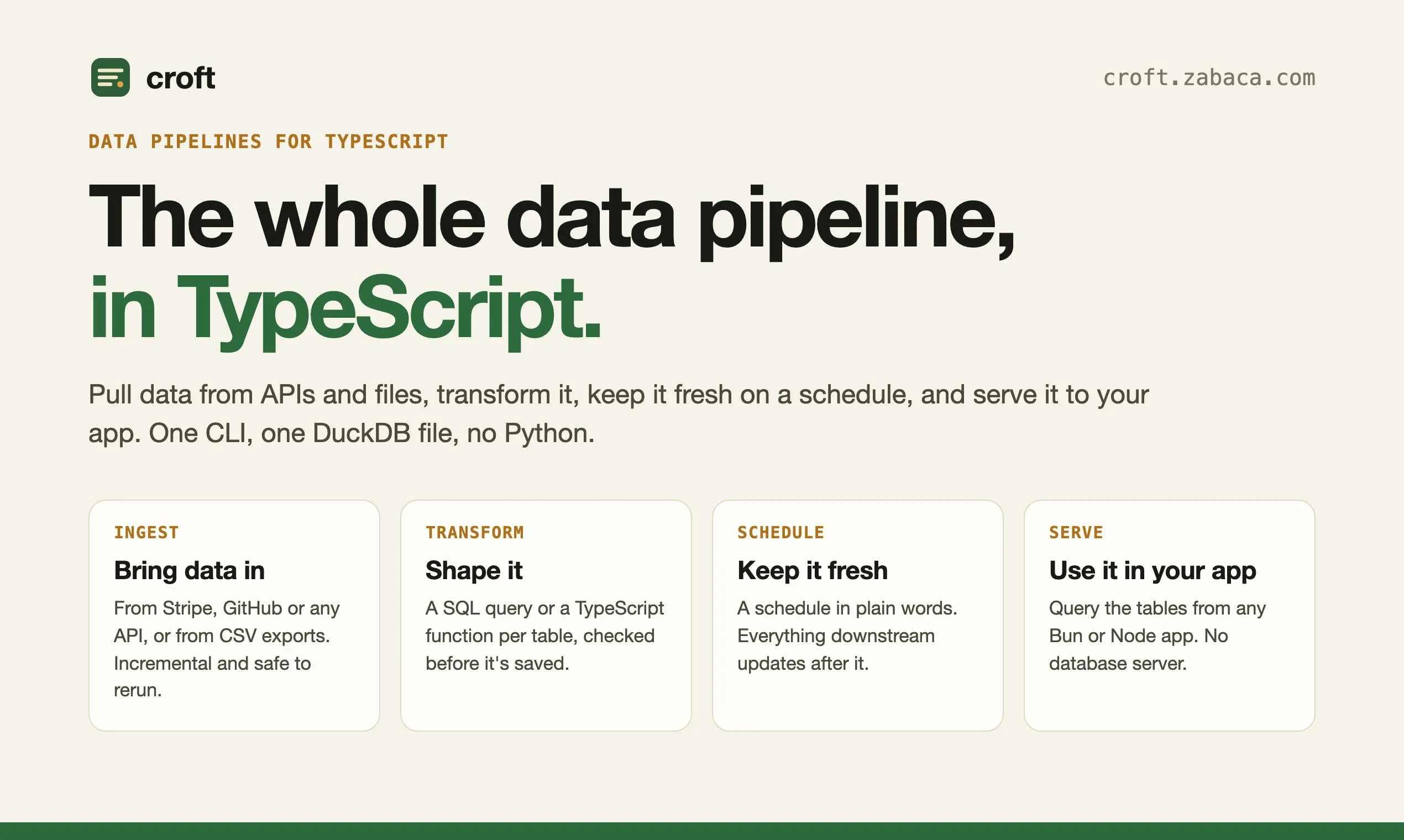
croft's design philosophy is refreshingly direct: put every asset of a data pipeline—raw data, transformation logic, and scheduling state—into a single DuckDB file. DuckDB itself is an embedded analytical database known for being single-file and zero-config, and croft layers data ingestion, transformation, and scheduling on top of it.
According to the official description, croft can pull data from APIs and files, transform it with SQL or TypeScript, and keep data fresh on a schedule. Every table generates a corresponding TypeScript type, meaning developers get full type hints and compile-time checks while writing transformation logic. For front-end or full-stack developers already comfortable with TypeScript, this significantly lowers the barrier to entry into data engineering—no need to switch to Python, and no need to maintain separate type definition files.
The appeal of this "single-file" architecture lies in portability and simplicity. A traditional data stack often requires a database service, a scheduler, a transformation framework, and more, whereas croft consolidates these into one file plus one runtime.
DuckDB is an embedded analytical (OLAP) database written in C++, often called "the SQLite of analytics." Like SQLite, it runs as an in-process library, requires no separate server process, and stores data in a single file by default, so deployment and migration only require copying that file. Compared with traditional row-oriented transactional databases, DuckDB uses columnar storage and a vectorized execution engine, delivering significantly better performance on analytical queries involving aggregations, joins, and large table scans, and it natively supports direct querying of formats like Parquet, CSV, and JSON. Its limitations are also clear: it is designed primarily around a single writer, so multiple processes writing to the same file at once is constrained, and concurrent writes and high-concurrency online serving are not its strengths. This is important background to consider when evaluating croft's production readiness.
The Experience of Data Transformation in TypeScript
croft allows transformation logic to be written in SQL or TypeScript. SQL suits analysts familiar with data warehouses, while TypeScript targets application developers. Because every table has generated types, TypeScript code directly gets intelligent autocompletion and type validation for table structures, reducing runtime errors.
This design aligns with the recent trend of "doing data with application languages." Traditionally, data transformation relies on SQL or Python, but TypeScript's static type system offers advantages in complex business logic—especially when data pipelines need to share type definitions with front-end applications. croft automates type generation, avoiding the repetitive work of manually maintaining schema types.
However, currently available public information does not disclose the specific API shape of TypeScript transformations, the performance of the type generation mechanism, or the expressive limits in complex transformation scenarios. These would need hands-on use to evaluate.
Scheduling and AI Assistance: Claude Code Can Drive It
croft has built-in scheduling to refresh data on a schedule. The official material specifically notes that "Claude Code can drive it," meaning users can use natural-language instructions to have Claude Code operate croft to complete pipeline creation, queries, or maintenance tasks. This continues the trend of AI coding assistants infiltrating the data toolchain.
But note that this description is fairly vague. How exactly Claude Code integrates with croft—whether through CLI calls, the MCP protocol, or something else—is not explained in the original text. This is a single-source feature claim, and the actual experience needs verification.
MCP (Model Context Protocol) is an open protocol proposed by Anthropic to let AI assistants connect to external tools and data sources in a standardized way: the tool side implements an MCP server exposing capabilities (such as querying a database or executing commands), and the AI client discovers and invokes these capabilities according to the protocol. If croft integrates with Claude Code via MCP, that means croft could package operations like "build pipeline, run transformation, query data" as tools callable by the model, so users can trigger them by describing intent in natural language. In contrast, pure CLI integration relies on the model generating and executing command-line instructions—flexible but more dependent on prompt quality. Distinguishing these two approaches helps judge whether the feature is a stable, reusable protocol-level integration or a demo-style command-line invocation.
Positioning and Competitive Landscape
croft positions itself as "free, open source, no Python required." This directly targets TypeScript developers who don't want to introduce Python dependencies. Compared with dbt, croft is lighter and does not depend on a data warehouse service; compared with emerging analytical languages like Malloy, croft opts for the more conservative SQL + TypeScript combination.
Its differentiation lies in "single file" and "type generation." For small-to-medium data pipelines, personal projects, or prototyping, this minimalist architecture has clear appeal. But for production environments requiring multi-user collaboration, large data volumes, or complex lineage management, the concurrent-write and scalability limits of single-file DuckDB may become a bottleneck—DuckDB itself is better suited to single-writer scenarios, which needs to be assessed before adoption.
Who Should Keep an Eye on croft
If you're a TypeScript developer who needs to pull data from a few APIs, do simple transformations, and refresh periodically—without wanting to set up a Python data stack—croft is worth a try. It's free and open source, so the cost of experimentation is low. If you need team collaboration, large-scale data processing, or mature data governance capabilities, the current stage of croft may not be enough.
The project is developed by James Lee and received 65 votes and 2 comments on Product Hunt. Community discussion is limited, and actual stability and long-term maintenance remain to be seen. The open-source address can be obtained via the Product Hunt page.
One-line Summary
croft lets you write data pipelines in TypeScript with all assets in a single DuckDB file, no Python needed.
Paragraph Summary
croft is an open-source data pipeline tool that advocates writing transformation logic in TypeScript or SQL and consolidating raw data, transformation logic, and scheduling state into a single DuckDB file for zero-config and high portability. It automatically generates TypeScript types for each table, giving application developers type hints and compile-time checks and lowering the barrier to data engineering. The tool has built-in scheduling, and the official material claims it can be driven by Claude Code, though the integration method is not disclosed. Positioned as free, open source, and Python-free, it targets TypeScript developers and differentiates itself from tools like dbt. The single-file architecture suits small-to-medium pipelines and personal projects, but DuckDB's single-writer nature may become a bottleneck in concurrent and large-scale production scenarios. Community discussion is limited, and stability remains to be verified.
Related articles

AI-Powered SRC Vulnerability Hunting: A Hands-On Guide to Building the Hermes Agent Workbench
Based on a hands-on Bilibili video: how to build an AI-powered SRC vulnerability hunting workbench—three-step method, four report elements, Agent mode vs web chat, and tool selection.

CLI-Anything Complete Beginner's Guide: How AI Operates Software — Principles and Practice
A complete beginner's guide to CLI-Anything: how AI Agents operate professional software via the command line, covering the three-layer architecture, CLI Hub installation, DrawIO practice, generator principles, and limits.

Carbon-X: A 14.8B Open-Source Model That Handles DNA and Text Simultaneously
Carbon-X is a 14.8B open-source multimodal model on Hugging Face where DNA and text share a token stream. 6-mer tokenization, 302B token mid-training, deployable on a single 80GB GPU, 66.7% average on five DNA benchmarks, Apache 2.0 license.