Cross-Token Transfer: A New Approach to Low-Resource Non-Verbal TTS
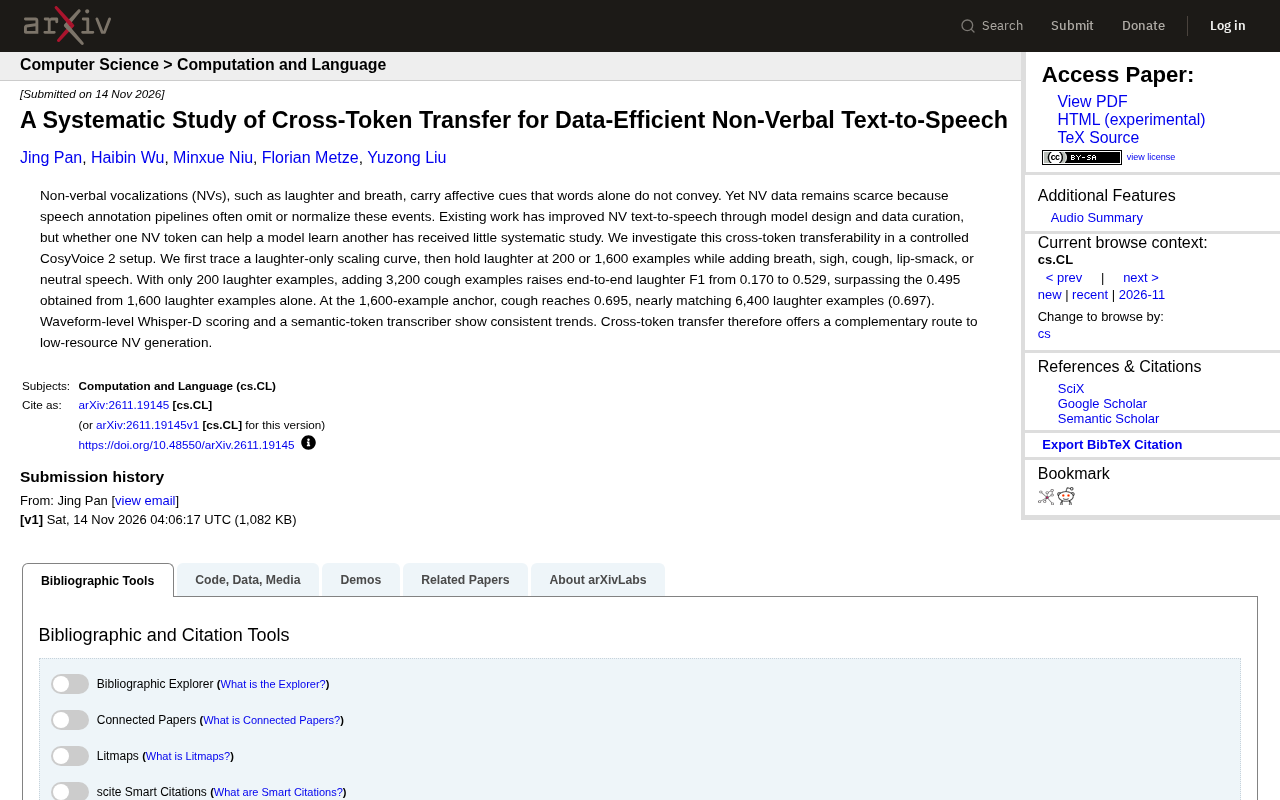
Cross-token transferability between different non-verbal vocalization tokens is confirmed on CosyVoice 2, alleviating the data bottleneck of low-resource NV generation.
The article introduces work systematically studying cross-token transferability of non-verbal vocalizations (NVs) under a controlled CosyVoice 2 setting. NVs like laughter and breathing carry emotional cues but are often ignored or normalized in annotation pipelines, causing data scarcity. Fixing laughter samples at 200 or 1600 and adding other NV data, results show adding 3200 coughing samples raises laughter F1 from 0.170 to 0.529, exceeding 1600 laughter samples' 0.495; under a 1600 laughter anchor, coughing reaches 0.695, nearly matching 6400 laughter samples' 0.697. Whisper-D scores and semantic token transcribers confirm consistent trends. The article argues this reveals possible shared acoustic or semantic representations among NV tokens, offering a data-efficient strategy for low-resource NV generation, but the mechanism is unclear and experiments are limited to a single model and limited NV types.
Title
Cross-Token Transfer: A New Approach to Low-Resource Non-Verbal TTS
Meta Description
This article reviews a study on cross-token transfer, validating the transfer effect between non-verbal vocalizations such as laughter and coughing on CosyVoice 2, offering a data-efficient new method for low-resource non-verbal TTS.
Article Content
Non-verbal vocalizations (NVs) such as laughter and breathing carry emotional cues that words cannot convey. However, such data is often ignored or normalized in speech annotation pipelines, resulting in scarce NV data. Existing research improves NV text-to-speech (TTS) through model design and data curation, but whether one NV token can help the model learn another NV token lacks systematic study. A recent paper, under a controlled CosyVoice 2 setting, deeply investigates this cross-token transferability, offering new ideas for low-resource NV generation.
Research Background and Motivation
In speech synthesis, non-verbal vocalizations such as laughter, sighs, and coughing are important components of emotional expression. But annotation pipelines often omit or normalize these events, resulting in far less NV data than pure speech data. Prior work mostly focused on model architecture improvements or data curation strategies, rarely exploring the mutual facilitation between different NV tokens. The authors raise a key question: can learning one NV token (e.g., laughter) transfer to another NV token (e.g., coughing)? If so, low-resource NV generation might be significantly enhanced through cross-token transfer.
Annotation bottlenecks in non-verbal vocalizations (NV) and text-to-speech (TTS)
In TTS tasks, training data typically consists of "text-speech" pairs, and annotation pipelines automatically or semi-automatically transcribe audio into text. Non-verbal vocalizations such as laughter, sighs, and coughing are often discarded or uniformly replaced with neutral markers (e.g., "[laughter]") during transcription, because traditional TTS systems only care about how to read out the text. This normalization operation results in an extremely low proportion of NV samples in training sets, making it difficult for models to learn to generate natural and diverse NVs. The "low-resource NV generation" discussed in this article refers to enabling the model to possess the ability to generate a target NV category even when annotated data for that category is scarce, which is also the core problem that cross-token transfer attempts to solve.
Experimental Setup and Core Findings
The study is based on the CosyVoice 2 framework and adopts a controlled variable method. First, it tracks the scaling curve using only laughter data, then fixes laughter samples at 200 or 1600 and separately adds breathing, sighing, coughing, lip-smacking, or neutral speech data.
The key results are surprising: when there are only 200 laughter samples, adding 3200 coughing samples raises the end-to-end laughter F1 from 0.170 to 0.529, exceeding the 0.495 obtained with only 1600 laughter samples. Under a 1600 laughter anchor, coughing reaches 0.695, almost matching the 0.697 of 6400 laughter samples. In addition, waveform-level Whisper-D scores and semantic token transcribers also show consistent trends. These results indicate that cross-token transfer can serve as a complementary pathway to alleviate the data bottleneck of low-resource NV generation.
What are F1, Whisper-D, and semantic token transcribers
The three evaluation metrics used in the paper each have different emphases. F1 is a common metric for event detection; here it refers to the temporal overlap between segments judged as "laughter" in the model-generated audio and the real laughter, balancing precision and recall. Whisper-D is a waveform-level distance/score computed using the Whisper speech recognition model, used to measure how close the generated audio is to the reference audio in acoustic details, without relying on human listening tests. The semantic token transcriber encodes audio into discrete semantic tokens and then decodes them into text, using the transcription result to determine whether the generated audio is correctly recognized as the target NV category. The three cross-validate from three levels—event detection, acoustic similarity, and semantic consistency—so the conclusions are more reliable than a single F1.
Multi-Source Validation and Consistency
According to the paper, in addition to the mainstream F1 metric, the study also uses waveform-level Whisper-D scores and semantic token transcribers for cross-validation, and consistent trends are observed in all of them. This multi-dimensional evaluation enhances the reliability of the conclusions. Although no other independent study has yet reproduced these results, the work itself provides rigorous controlled experiments in methodology, laying a foundation for subsequent research.
Implications for the TTS Field
The significance of this research lies in revealing that NV tokens may share acoustic or semantic representations, enabling the model to learn features useful for one NV type from another NV type. For NV types with scarce data, performance can be improved by introducing other NV data without relying entirely on large amounts of annotations for the target NV. This provides a new data-efficient strategy for low-resource speech synthesis and may also inspire more research on cross-modal transfer.
CosyVoice 2 and tokenized TTS
CosyVoice 2 is a zero-shot TTS system based on a large language model. It first discretizes speech into token sequences, then lets the language model autoregressively generate speech tokens just like generating text. In this architecture, different NVs (laughter, coughing, etc.) may share some acoustic primitives in the token space, which provides structural possibilities for "one NV token helping the model learn another NV token." The reason this paper chooses to conduct controlled experiments on CosyVoice 2 is precisely that its tokenized representation facilitates separating and replacing data of different NVs, thereby cleanly observing cross-token transfer effects; with a non-tokenized end-to-end TTS model, whether transfer holds would need to be re-validated.
Limitations and Future Directions
The current experiments are conducted only on CosyVoice 2 and focus on a limited set of NV types. Whether cross-token transfer applies to other model architectures, more languages, and more complex NV combinations still requires further exploration. In addition, the underlying mechanism of transfer remains unclear, and future work could combine representation learning for analysis. Nevertheless, this research opens a promising path for low-resource NV generation.
One-line Summary
Cross-token transferability between different non-verbal vocalization tokens is confirmed on CosyVoice 2, which can alleviate the data bottleneck of low-resource NV generation.
Paragraph Summary
The article introduces work that systematically studies the cross-token transferability of non-verbal vocalizations (NVs) under a controlled CosyVoice 2 setting. NVs such as laughter and breathing carry emotional cues but are often ignored or normalized in annotation pipelines, leading to data scarcity. The researchers fix the number of laughter samples (200 or 1600) and separately add breathing, sighing, coughing, lip-smacking, or neutral speech data to observe changes in target NV generation performance. Results show that with only 200 laughter samples, adding 3200 coughing samples raises laughter F1 from 0.170 to 0.529, exceeding the 0.495 of 1600 laughter samples; under a 1600 laughter anchor, coughing reaches 0.695, almost matching the 0.697 of 6400 laughter samples. Whisper-D scores and semantic token transcribers verify the consistency of the trends. The article argues that this reveals possible shared acoustic or semantic representations among NV tokens, providing a data-efficient strategy for low-resource NV generation, but the mechanism remains unclear, and the experiments are limited to a single model and a limited set of NV types.
Related articles

Developer Naming Woes: The Technical Names That Drive Us Crazy
Why is technical naming so maddening? From Nginx and Vite to Qt and Sudo, a YouTube creator rants about the chaos of developer naming and pronunciation, revealing the tug-of-war between creators' intentions and community habits, and the cultural roots behind spelling traps like PyPI and GNOME.

Figma Workplace Scandal: Employee Sues CEO for Forcing Confrontation with Harasser
Figma and its CEO are sued by a current employee alleging sexual harassment and discrimination, and forcing the victim to confront her harasser. This article outlines the background, potential impact, and industry reflection.

Jensen Huang and Nvidia: Elite Privilege Behind the Revolving Door of Business and Politics
An opinion piece uses Jensen Huang's reappointment as Nvidia CEO to examine business-government ties and elite impunity, questioning free-market ideals and AI industry governance.