Cubicle: A Visual Virtual Office Built for AI Agents

Cubicle turns AI agent activity into virtual office animations with read-only monitoring and Telegram alerts.
Cubicle is an open-source developer tool that maps the runtime states of AI agents like Claude Code, Codex, and Gemini CLI onto a skeuomorphic virtual office — agents type when working, raise their hands when awaiting input, and head to a break room when done. Its core principle is read-only design: the tool never writes to any agent or system, only observes. Telegram alert integration creates a lightweight on-demand human-in-the-loop cycle. With one-command `npx` setup, zero dependencies, and MIT licensing, Cubicle exemplifies an observability-first, security-conscious approach to multi-agent tooling.
When AI Agents Need a "Workstation"
As command-line AI coding tools like Claude Code, Codex, and Gemini CLI become increasingly widespread, developers face a new challenge: when multiple agents are running simultaneously, it's hard to intuitively know what each one is doing, whether any are stuck, or when human intervention is needed. The open-source project Cubicle offers an inventive answer — put your AI agents inside a visual "virtual office."
Cubicle was built by developer Çağlar Utku GÜLER and recently launched on Product Hunt, earning 68 upvotes and 7 comments, ranking 12th for the day across the categories of open source, developer tools, and artificial intelligence. Its core idea is straightforward: use a skeuomorphic office environment to turn abstract background processes into visible, legible actions.
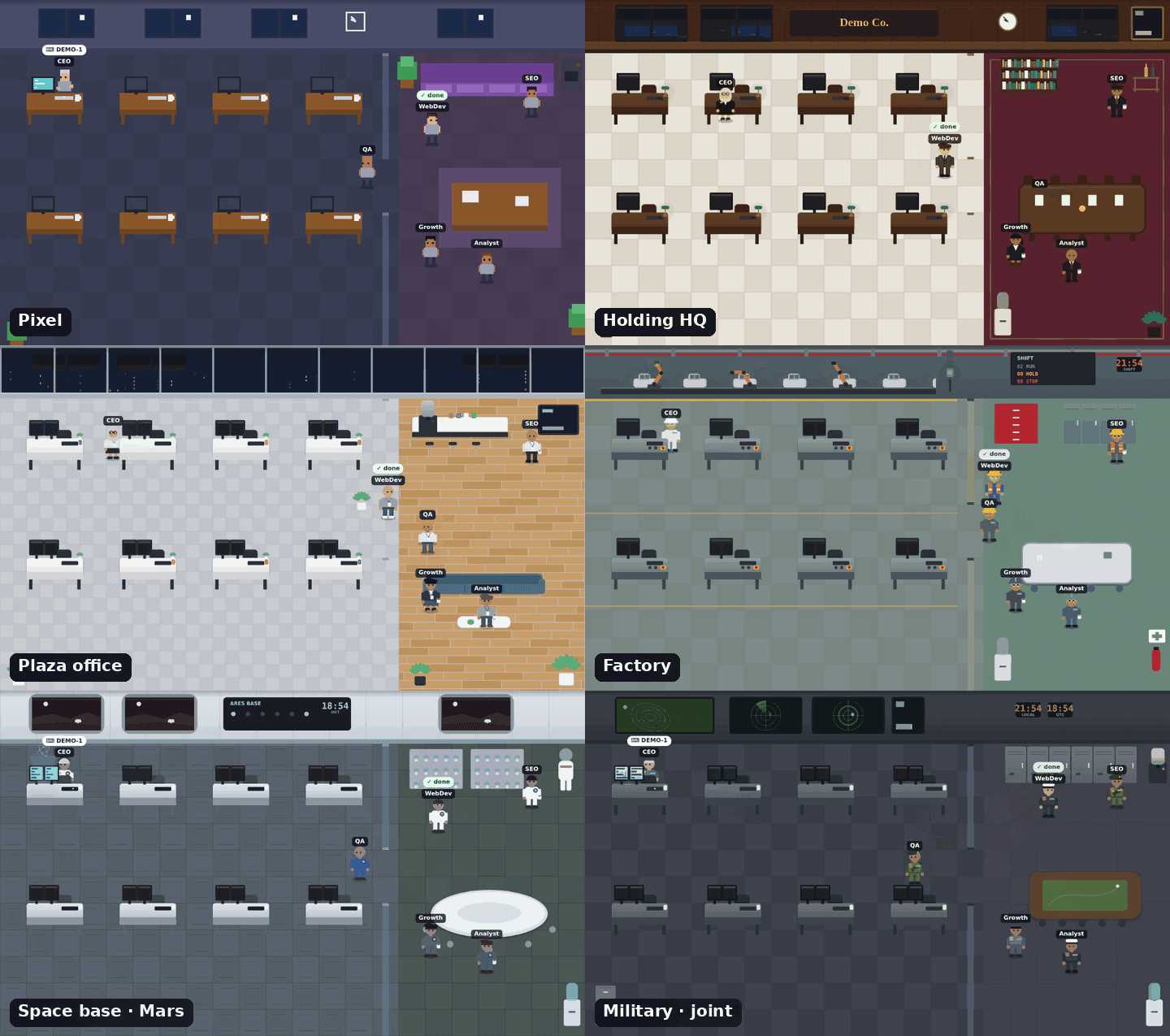
Turning Processes into "People at Work"
In Cubicle's interface, each agent is embodied as an "employee" inside an office. They sit down and type to indicate they're working, raise their hand or queue up at your desk to signal they need your confirmation or input, and head to a break room once a task is complete. This design transforms states that would otherwise require log-watching into spatially intuitive, at-a-glance cues.
Beyond the animated actions, Cubicle also provides a KPI dashboard for tracking task progress. The interface supports mobile view, offers both pixel-art and HD themes, and even supports real photo avatars and custom company logos — details that deepen the immersion of the "virtual office" concept while adding a lighthearted touch.
This skeuomorphic design approach has a basis in cognitive science. Humans process social signals and spatial metaphors far more efficiently than abstract text logs. When the brain sees "a person raising their hand to wait," it requires almost no cognitive load to recognize that action is needed. Reading logs, by contrast, requires interpreting status codes and timestamps before mapping them to any real meaning. As the number of simultaneously running agents grows, this cognitive efficiency gap widens — and that's precisely the core pain point of traditional multi-window terminal monitoring in multi-agent scenarios.
"Read-Only by Design" Is the Key Safety Promise
The most important design principle in Cubicle is read-only by design. It explicitly does only one thing: observe the running state of agents, without performing any writes or interventions on their processes.
This matters enormously in an era overflowing with AI agent tooling. Many monitoring or orchestration tools require elevated system permissions to function, introducing potential security and controllability risks. Cubicle positions itself as a pure "observation window" — the only optional write operation is when you reply to an agent's message via Telegram, and that reply is posted as a comment, remaining entirely under the user's control. This restrained design minimizes the risk introduced by the tool itself.
In the field of AI agent security, the Principle of Least Privilege is a foundational rule for reducing risk: a tool should only hold the minimum permissions necessary to accomplish its task. Many orchestration frameworks (such as LangChain and AutoGen) require read/write access to the filesystem, processes, or network in order to coordinate agents — boosting capability while also expanding the attack surface. Cubicle's read-only commitment means that even if the tool itself contains a vulnerability or is exploited by malicious code, it cannot be used to modify system state. For teams running multi-agent workflows in production environments or sensitive codebases, this is a design choice worth paying attention to.
Telegram Alerts: Keeping Humans in the Decision Loop
The more autonomous AI agents become, the more "when does a human step in" becomes the critical bottleneck. Cubicle addresses this through Telegram alerts: when an agent encounters something that requires human judgment, it pushes the question to your Telegram, where you can review and respond from anywhere.
This effectively creates a lightweight human-in-the-loop collaboration cycle — you don't have to sit in front of a terminal the whole time, but get called in only when an agent genuinely needs you. Combined with the mobile view, developers can maintain a sense of control over multiple agent tasks even when away from their computers. This "interrupt on demand" model is far more efficient than continuously polling logs.
Zero Dependencies and MIT Licensing: Engineering-Friendly by Design
From an engineering standpoint, Cubicle deliberately keeps the barrier to entry as low as possible. It supports running directly via a single npx command, claims zero dependencies, and is open-sourced under the MIT license. This means developers can try it out with virtually no environment setup, and are free to read the source code, build on it, or integrate it into their own workflows.
For teams already using agents like Claude Code, Codex, Gemini CLI, or Paperclip, Cubicle offers a low-cost observability layer. It doesn't replace these tools — it adds an intuitive state display and a human intervention channel on top of them.
npx is a command execution tool bundled with the npm package manager for Node.js. It lets users run an npm package directly without installing it globally first. npx some-package temporarily downloads and executes the specified package, leaving no persistent installation on the system afterward. "Zero dependencies" means the package itself doesn't reference any third-party libraries — all functionality is implemented using native runtime capabilities, completely eliminating the additional risks introduced by dependency version conflicts or supply chain attacks. Together, these two properties allow Cubicle to start up with minimal friction in virtually any environment where Node.js is already installed, making it especially friendly for developers who want to quickly evaluate a tool's value.
A Clever Take on the AI Collaboration Experience
At its core, Cubicle is a creative response to an emerging problem: when we're directing multiple AI agents simultaneously, how do we rebuild the kind of situational awareness that comes with managing a human team? Rather than stacking complex features, it uses a familiar office metaphor to make abstract states tangible, applies a read-only principle to maintain a clear security boundary, and fills in the human-AI collaboration loop with Telegram.
Of course, as an early-stage project that just launched on Product Hunt, Cubicle's real-world stability, compatibility with a broader range of agent frameworks, and long-term maintenance trajectory still need time to prove out. But the philosophy it embodies — making multi-agent work visible, controllable, and interruptible — very likely represents an important direction for AI developer tooling going forward.
Related articles

Uber Deploys ChatGPT Work Company-Wide: AI in the Workplace Enters the Scaled Implementation Phase
Uber deploys ChatGPT Work to 30,000+ employees, extending it from engineering to all roles. We analyze its expert-engineer pairing, end-to-end automation, and questions of AI control and power concentration—insights for scaling AI in the workplace.

Shift at Midnight Hands-On: When "ID Verification" Becomes Alien Hunting
Shift at Midnight blends ID verification with horror survival in a four-player co-op game. We break down its inspection mechanics and chaotic humor.

Zelensky Recounts the Outbreak of War: I Need Ammunition, Not a Ride
Zelensky recalls the first day of war in a YouTube interview: farewell to family, rejecting Biden's evacuation offer with "I need ammunition, not a ride," and how Bucha shaped his stance on compromise and peace talks.