Cursor Cheap Shared Account Pitfall Guide: Dissecting the Real Risks of Gray-Market Account Pools

Exposing the real risks behind Cursor's cheap shared account services and offering compliant alternatives.
This article dissects the gray-market Cursor shared account services that promise steep discounts on Pro subscriptions. Despite polished marketing about "intelligent account rotation," these services are fundamentally account pool sharing schemes that risk device-level bans, code/data exposure through third-party servers, and total loss if providers disappear. Compliant alternatives like free tier usage, on-demand subscriptions, and self-provided API keys offer better long-term value.
Cursor Is Hot, and So Is the Gray-Market Industry Chain
Cursor, currently one of the hottest AI programming tools, has become a daily productivity powerhouse for many programmers, professionals, and even students. Whether it's writing code, fixing bugs, scaffolding projects, or drafting copy and organizing logic, Cursor's AI capabilities deliver tangible efficiency gains.
Cursor is developed by Anysphere and built on VS Code's open-source core (Electron + Monaco Editor), but with deeply integrated large language model capabilities. Its core selling point is embedding AI conversation, code completion, and cross-file editing directly into the editor workflow—rather than existing as an external plugin. Under the hood, Cursor calls APIs from multiple models including Claude and GPT-4o. The Pro subscription (approximately $20/month) provides higher request quotas and priority model access. Since 2024, Cursor has rapidly expanded beyond the developer community, reportedly surpassing millions of users, with its valuation skyrocketing to the multi-billion dollar level in a short time, making it one of the most representative products in the AI coding space.
But along with this success comes a flood of "budget plans" surrounding Cursor Pro subscriptions—promotions claiming "75% off unlimited use," "exclusive genuine Pro accounts," and "full power, no throttling" are everywhere. This article will rationally dissect the operational logic, potential risks, and compliance boundaries of these Cursor shared account services based on a typical promotional material, helping readers make informed decisions.
Important Note: This article analyzes and examines original promotional content and does not constitute any purchase or usage recommendation. Any third-party account service that bypasses the official subscription system may violate Cursor's Terms of Service and pose account and security risks. Please proceed with extreme caution.
What Are These Cursor Budget Services Actually Selling?
Core Selling Points in Their Marketing
From the promotional rhetoric, these Cursor shared account services emphasize several key selling points:
- Pricing at roughly 25% of the official price, claiming "¥100 top-up equals ¥1,000 worth of official quota"
- Pay-per-use with balance that never expires, claiming to solve the "expiration wipes everything" pain point of traditional monthly/quarterly plans
- Matching so-called "official genuine independent Pro accounts" rather than mass-registered throwaway accounts
- All models unlocked, no throttling, emphasizing no modification to Cursor's underlying code
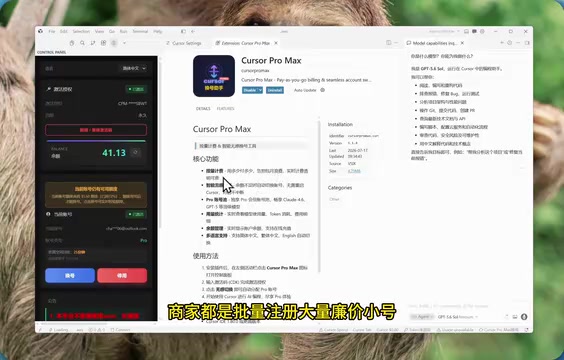
Comparison Rhetoric Against Common Market Solutions
The promoters categorize other budget solutions on the market into three types and criticize each: first, shared accounts for a few dozen yuan with frequent disconnections and permission failures; second, monthly/quarterly card packages where unused quota is wiped at expiration; third, cracked/modified client tools that tamper with the underlying code, leading to bans, device locks, and information leaks.
On this basis, the promoter positions itself as the "legitimate, stable, transparent" third option, with the core mechanism being a "proprietary intelligent scheduling system" enabling "fully automatic seamless account switching" and "intelligent account rotation."
A Sober Analysis: It's Still an Account Pool Sharing Model at Its Core
The Real Logic Behind "Intelligent Account Switching"
You might not have noticed, but the promotional copy criticizes budget accounts for requiring "manual account switching" on one hand, while emphasizing that its own core feature is "intelligent account rotation" and "fully automatic seamless account switching" on the other.

This actually reveals the essence: whether manual or automatic, the underlying logic remains relying on a "massive official account resource pool" for account rotation. The so-called "automation" merely optimizes the experience layer without changing the fundamental model of "shared/rotated accounts." This is essentially the same type of gray-market solution it criticizes—just with more polished packaging.
From a technical implementation perspective, this "account pool" model is quite common in gray-market operations. Its core architecture typically includes: bulk registration or purchase of large numbers of paid accounts, setting up an intermediary scheduling layer (Proxy/Gateway), and when a user initiates a request, the scheduling system selects an available account from the pool to forward the request on behalf of the user, then releases that account for other users after completion. "Intelligent rotation" is essentially load-balancing algorithms applied at the account dimension—dynamically allocating by monitoring each account's remaining quota, cooldown time, and risk-control status to maximize the pool's overall throughput. This model has already appeared in ecosystems of multiple AI products including ChatGPT and Midjourney. It's not a technical innovation—merely the migration of mature gray-market techniques to the Cursor ecosystem. The fragility of this model lies in the fact that once the platform upgrades its risk-control strategies, the entire pool may fail on a massive scale.
Questions About "Pay-Per-Use" and "One-Tenth Cost"
The promotion simultaneously mentions both "75% off" and "approximately one-tenth" pricing—inconsistent claims. And the statement "¥100 top-up equals ¥1,000 worth of official quota" lacks verifiable billing evidence. What truly warrants caution:
- Billing standards are unilaterally set by the service provider; users cannot independently verify the true exchange ratio between tokens and official quota
- "Balance never expires" depends on the service provider's continued operation—if they disappear, the balance vanishes
- So-called "transparent consumption details" are merely data displayed on the service provider's frontend, with no mandatory binding to the official backend
Where Are the Real Risks of Cursor Shared Accounts?
Account Security and Ban Risks
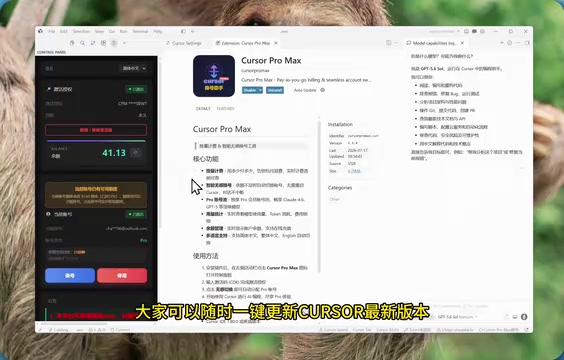
Regardless of how much the marketing emphasizes "no underlying code modification," any involvement of account sharing, bulk logins, and geographically dispersed rotation is highly likely to trigger Cursor's official risk-control mechanisms. The promoters themselves acknowledge that budget accounts have "extremely high risk-control exposure and easy device locking"—and the essence of a shared account pool doesn't reduce this risk just because it's "automated."
Modern SaaS products' risk-control systems typically employ multi-dimensional behavioral analysis. For code editor products, common detection dimensions include: device fingerprinting (hardware ID, OS characteristics, client fingerprint), network characteristics (IP address, geographic location jumps, VPN/proxy detection), usage patterns (login frequency, request intervals, API call patterns), and session characteristics (multi-device concurrency, abnormal active hours, etc.). When the system detects the same account initiating requests from multiple different devices or IPs within a short period, or a single device frequently switching between different account logins, it triggers risk-control rules. Penalties typically escalate from mild to severe: rate limiting, temporary suspension, permanent ban, and in serious cases, device-level bans—meaning any account on that hardware device will be restricted.
More critically, once your device is flagged by the platform for abnormal login behavior, it may affect your ability to use legitimate Cursor on that same computer—a loss far exceeding the subscription fee.
Data and Privacy Leak Risks
To achieve "account rotation," third-party plugins often need to take over your login credentials and request traffic. This means your code, conversation content, and project information may all pass through third-party servers. For developers working with trade secrets or sensitive data, this is an unacceptable privacy exposure.
In the field of software supply chain security, any third-party intermediary layer expands the attack surface. When users install third-party plugins or use AI tools through proxy services, they effectively introduce a new trust node. This node can theoretically: record all code content and conversation history passing through it, inject malicious code snippets into AI-returned results, and collect users' project structure and tech stack information for targeted attacks. This is known as a "Man-in-the-Middle" risk in security. For enterprise developers, code is a core asset—once leaked, it may result in intellectual property loss, competitive advantage erosion, and even compliance penalties (e.g., code involving user data being leaked may trigger notification obligations under GDPR and other data protection regulations).
Terms of Service and Compliance Risks
The vast majority of AI tools' user agreements explicitly prohibit account sharing, resale, and bypassing official billing. By using such services, users effectively operate in a gray zone violating the Terms of Service, subject to removal at any time with no official appeal channel.
How to Use Cursor Compliantly at Low Cost
Prioritize Official Compliant Pathways
If budget is limited, consider evaluating these compliant approaches first:
- Make full use of Cursor's free tier: The free version already supports substantial basic functionality; light users may not need Pro at all
- Subscribe on demand: Activate Pro during project sprint periods, cancel during idle periods to avoid long-term costs
- Bring your own API Key: Cursor supports connecting your own model APIs, paying at official token prices—cost-controllable and fully compliant
The bring-your-own API Key approach deserves further elaboration: Cursor supports users configuring their own OpenAI, Anthropic, and other model providers' API Keys in settings. Under this approach, AI requests are sent directly from the user's local machine to the model provider's servers, with Cursor serving only as the frontend interface and request orchestration tool, consuming none of its own subscription quota. Taking Anthropic's Claude API as an example, at official pricing (using Claude Sonnet as reference: approximately $3/million tokens input, $15/million tokens output), moderate users' monthly API costs typically range from $5-30—comparable to or even lower than the Pro subscription price, with purely usage-based billing and no wasted quota. The compliance of this approach is beyond question, as users establish a direct payment relationship with the model provider, with all data flowing through official channels.
Establish Proper Cost Awareness

The value of AI tools lies in stably and sustainably improving productivity. Risking account bans, data leaks, and service disappearance to save a few dozen yuan per month in subscription fees is, in the long run, often "penny wise, pound foolish." True cost-effectiveness means using stable, controllable methods to let tools continuously create value for you.
Conclusion
These "75% off unlimited Cursor" promotions are essentially refined packaging of the account pool sharing model. They do address users' genuine need for "cost reduction," but deliberately downplay core risks around compliance, security, and sustainability.
For developers and professionals who truly depend on Cursor, rather than entrusting your workflow's lifeline to an unregulated third party, it's better to choose compliant, transparent, and controllable usage methods. Tools are meant for long-term service—stability and security are always more worthy investments than short-term price temptations.
Key Takeaways
- The essence of Cursor budget shared services is an account pool rotation model—regardless of automation level, the underlying logic remains unchanged
- Primary risks include: device-level bans, man-in-the-middle data leak risks from code passing through third-party servers, and balance wiped to zero if the service provider disappears
- Compliant alternatives include: leveraging free tier effectively, subscribing on demand, and bringing your own API Key for pay-per-use billing
- The true cost-effectiveness of AI tools lies in stably and controllably creating sustained value, not short-term price arbitrage
Related articles

Apple HomeView Hands-On Review: Is the $300 Smart Home Hub Worth It?
Apple HomeView hands-on: a $300 smart home hub with facial recognition for quick account switching, but no App Store or voice recognition. Is the wall-mounted version worth it? Should you buy the first generation?

Meta Muse Wonder Launch: What It Means for Meta's Return to the Frontier AI Race
Meta releases Muse Wonder and WonderFull, benchmarks reach the frontier, community feedback is polarized. An in-depth look at Meta's return to the frontier AI race, its personal agent strategy, and Zuckerberg's different path.

Apple Home Smart Home Lineup Leaked: LG and Schneider Team Up, UWB Door Lock on Board
Apple Home ecosystem gains new LG and Schneider devices: UWB smart lock with proximity unlock, 2.5K dual-camera doorbell, privacy indoor camera, and AirPods-like seamless pairing.