Cursor Gives Users $20 in Free Credits: A New User Retention Strategy for AI Coding Tools

Cursor's $20 credit giveaway reveals AI coding tool retention strategies in an increasingly competitive market.
Cursor's distribution of $20 usage credits to users has sparked discussion about AI coding tool marketing strategies. This analysis explores how the move reflects the shift from feature competition to precision user operations, examining the token economics behind credit-based incentives and how cultivating power users through lowered experimentation barriers creates long-term value in the battle against GitHub Copilot, Windsurf, and other competitors.
An Unexpected User Perk
Recently, a Reddit user posted to express gratitude toward the AI coding tool Cursor after receiving a $20 credit boost. The post title was straightforward — "Thank you, cursor" — accompanied by a screenshot showing the newly added credits. The user added: "Appreciate that marketing moves."
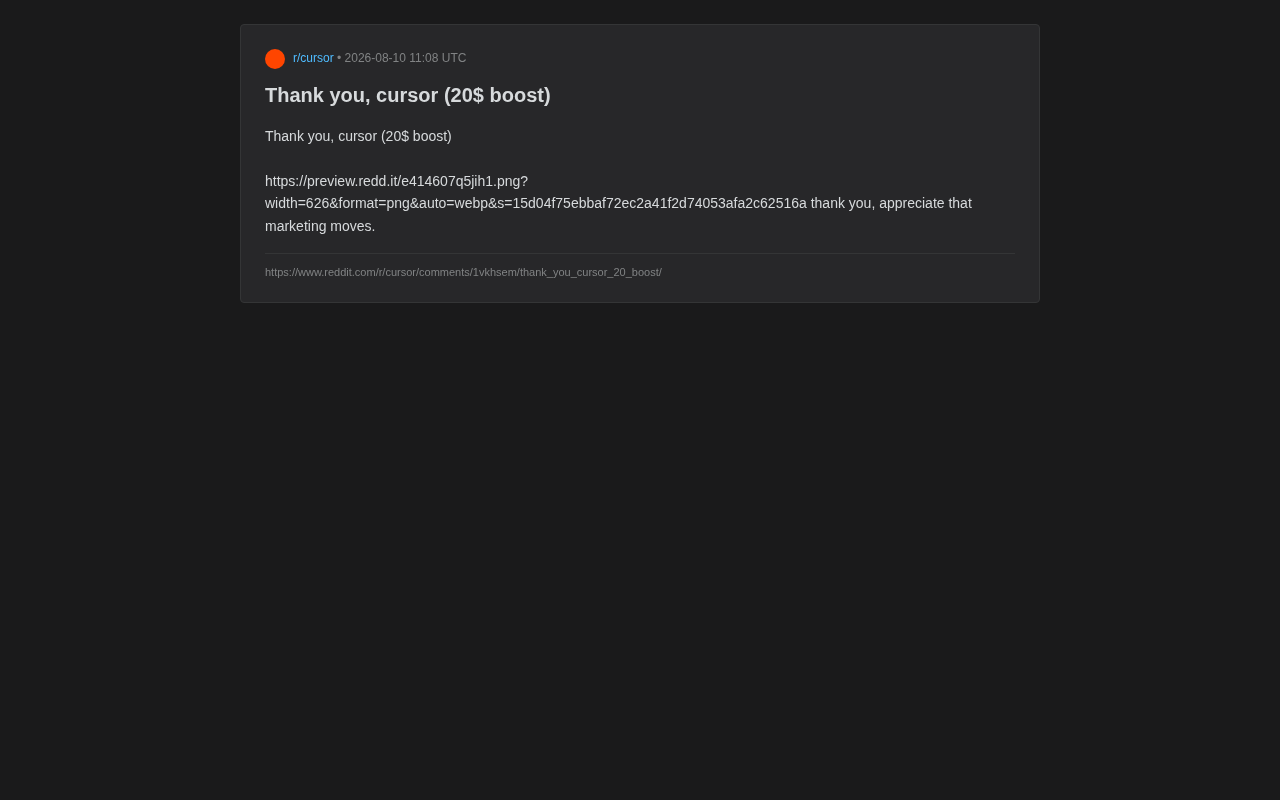
This might seem like an ordinary piece of user feedback, but it reflects the intensely competitive reality of today's AI coding tool market. With GitHub Copilot, Cursor, Windsurf, Cline, and many other products fiercely vying for developers' attention, retaining users and building positive community reputation have become challenges every product must address.
The current AI coding tool market has developed a multi-layered competitive landscape: GitHub Copilot holds a first-mover advantage backed by Microsoft and GitHub's ecosystem; Cursor has earned developer favor through its standalone editor experience and more aggressive AI integration; Windsurf (formerly Codeium) entered the market with a free tier before pivoting to paid plans; and open-source solutions like Cline and Aider attract developers who prioritize control. Additionally, Google's Gemini Code Assist and Amazon's CodeWhisperer are making moves in the enterprise market. This diverse competitive landscape means switching costs are extremely low — developers can migrate tools simply by changing an editor or plugin, which is precisely why every product invests so heavily in user retention.
Why Cursor Is Giving Away Credit Boosts
From Product Competition to User Operations
Cursor is a deeply customized AI code editor built on VS Code that has rapidly accumulated a large developer user base through its excellent code completion, context understanding, and Agent capabilities. Specifically, Cursor is developed by Anysphere and its core technical architecture is based on a deep fork and modification of VS Code's open-source version, rather than a simple plugin extension. This means the Cursor team can perform deeper AI integration optimizations at the editor's foundation, including a custom context indexing system, codebase-level semantic understanding, and unique Tab completion and Cmd+K inline editing interactions. Since 2024, Cursor's Agent mode has become its core differentiating feature, capable of autonomously planning tasks, reading and writing files, and executing terminal commands — elevating AI from assisted completion to autonomous programming.
But the AI coding space never lacks competitors, and user migration costs are relatively low. Any product's experience shortcomings could lead to user churn. In this environment, proactively giving users credits is essentially a user operations and retention strategy. While $20 isn't a huge amount, for individual developers it's enough to cover a significant portion of API calls or subscription usage. This kind of "pleasant surprise" often generates goodwill far exceeding the monetary value itself.
High ROI on Marketing Spend
Here's a telling detail: the poster specifically mentioned "appreciate that marketing moves," showing the user clearly recognized this as a marketing initiative — yet still responded positively. This is precisely what makes such strategies brilliant: when marketing actions genuinely benefit users, they don't just avoid pushback — users actively advocate for the brand.
Compared to running ads, directly giving active users credits creates a shorter conversion path and more authentic word-of-mouth. A spontaneous Reddit thank-you post carries far more credibility than any official marketing copy. From a SaaS product economics perspective, the ROI calculation is straightforward: for a product like Cursor with a $20/month Pro subscription, a user who subscribes for 12 consecutive months has a customer lifetime value (LTV) of $240. Therefore, spending $20 in credits to retain a user who might otherwise churn only needs to extend their subscription by 3-6 months to achieve a positive return. In the SaaS industry, an LTV to customer acquisition cost (CAC) ratio of 3:1 or higher is generally considered a healthy business model, and this precision user incentive approach clearly meets that standard.
The "Credit Economy" Logic of AI Coding Tools
Token Costs and Usage-Based Pricing
The billing models of mainstream AI coding tools are mostly tied to the underlying large model's token consumption. Tokens are the basic unit by which large language models process text — in English, each word corresponds to roughly 1-1.5 tokens, while code has different token consumption patterns due to special characters, indentation, and structured syntax. Every interaction with an AI coding tool involves input tokens (user code context, project files, instruction descriptions) and output tokens (model-generated code, explanatory text), with input tokens typically including substantial project context to ensure generation quality. Using GPT-4-level models as an example, the cost per million tokens ranges from a few to tens of dollars, and a complex code refactoring task might consume tens of thousands of tokens.
Whether it's Cursor, Copilot, or other competitors, actual usage costs are directly tied to call frequency and context length. Therefore, gifting usage credits effectively lowers the barrier to experimentation. When users have extra credits available, they're more willing to try advanced features like Agent mode, large codebase analysis, multi-file refactoring, and other intensive use cases. It's worth noting that $20 in credits might only support a few days to a couple of weeks of heavy Agent mode usage — Agent mode requires multiple reasoning rounds, tool calls, and context maintenance, consuming far more tokens per task than simple code completion. Once users experience and appreciate these capabilities, they're more likely to form usage habits and payment dependencies.
Cultivating the Long-Term Value of Power Users
For subscription-based products like Cursor, the most valuable users aren't one-time experimenters but power developers who integrate the tool into their daily workflow. Stimulating deeper usage through credit rewards is effectively screening for and cultivating these high-value users, whose long-term returns far exceed the short-term cost of $20.
The underlying logic of this strategy lies in AI coding tools' unique "gets better the more you use it" characteristic — the deeper a user engages, the more precisely the tool understands their coding style, project structure, and tech stack preferences (especially in Cursor with its project-level indexing). This creates a natural stickiness barrier. Once users accumulate enough usage data and workflow habits on a particular tool, the implicit cost of migrating to another platform increases dramatically.
Implications for Developers and the Industry
How Developers Should View These Perks
For everyday developers, these credit rewards represent genuine benefits and an opportunity to deeply experience a product's full capabilities. However, it's important to stay rational — tool selection should ultimately be based on actual productivity gains, not short-term credit incentives. Developers are advised to use these credits to validate a tool's value within their real workflows before committing to long-term paid subscriptions.
Specifically, developers can use extra credits to focus-test several dimensions: completion quality in their primary programming languages and frameworks, Agent mode reliability for complex refactoring tasks, contextual understanding of large codebases, and integration smoothness with existing development toolchains (Git, CI/CD, project management, etc.). These are the core factors that determine a tool's long-term value.
AI Coding Tool Competition Enters the Precision Operations Phase
This small "$20 incident" also signals that AI coding tool competition has moved beyond pure feature battles into a new phase of user operations and experience refinement. As model capabilities gradually converge across products, whoever excels at user relationship maintenance, community reputation, and usage experience will be most likely to prevail in this prolonged war.
Notably, as underlying large models like Claude, GPT-4, and Gemini rapidly iterate, the technical moat for AI coding tools is shifting from "model capability" to "product experience" and "ecosystem building." Every tool can integrate the most advanced models, but how to translate model capabilities into a smooth developer experience, how to build an active community ecosystem, and how to boost user loyalty through operational initiatives — these soft powers are becoming the deciding factors in competitive outcomes.
We can expect that as market competition deepens, similar user incentives and community operations initiatives will become increasingly common. For developers, this is undoubtedly a bonus period — multiple quality tools competing to offer perks and excellent experiences, with the entire developer community as the ultimate beneficiary.
Conclusion
A simple Reddit thank-you post may seem insignificant, but it vividly demonstrates the operational wisdom of AI tool companies in fierce competition. By distributing $20 in credits, Cursor exchanged real investment for user goodwill and organic word-of-mouth — a "sacrifice margin for reputation" strategy that's highly instructive in today's market environment. For developers riding the AI coding wave, rationally leveraging these perks and finding the tool best suited to your workflow is what matters most.
Key Takeaways
Related articles

Free Unlimited Claude Code Solution: Agnes AI + CC Switch Setup Guide
No paid subscription needed — pair the free AI platform Agnes AI with the open-source tool CC Switch to provide a backend for Claude Code, enabling unlimited free calls to text, image, and video models. This guide covers the full setup, test results, and usage boundaries.

A Complete Zero-Cost Guide to Getting Started with Claude Code for Beginners in China
A beginner's guide to Claude Code for users in China: two installation methods (command line and IDE plugin), full configuration steps for replacing the official API with the free domestic LongCat model, and a hands-on demo of building a small tool with natural language, plus tips.

When the NSA Gets Involved: The AI Supply Chain Crisis Behind Open-Source CVEs and API Key Hijacking
Multiple open-source projects disclosed severe CVEs in one day, PHP flaws alarmed the FBI, and Railway and OpenCode were breached with API keys stolen. This article breaks down the vulnerability window, AI-accelerated exploitation, and the AI supply chain crisis behind the API key black market, with a developer defense checklist.