Cursor Meets Grok 4.5: A Hands-On Test of an AI Coding Assistant That's 5x Faster with Cleaner Output

Grok 4.5 in Cursor: rivals Claude Opus in quality, 5x faster, with cleaner, filler-free output.
A developer's hands-on test of Grok 4.5 High Fast in Cursor found it matches Claude Opus in quality on PRD and Issue generation while running 5x faster with cleaner, filler-free output. This article covers the real-world experience, core advantages, and implications for the AI programming tool ecosystem.
Grok 4.5 Arrives in Cursor: A Pleasant Surprise from Real-World Testing
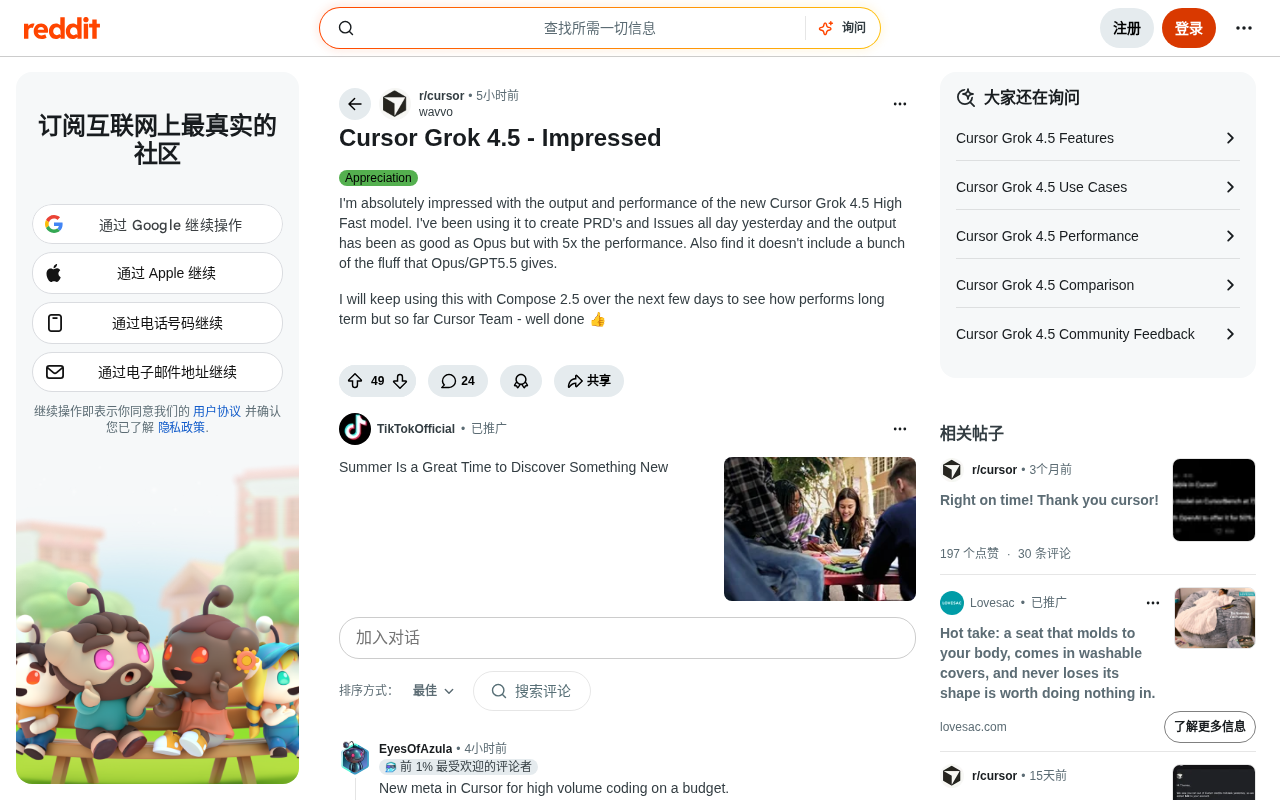
Recently, a developer shared his firsthand experience using the Grok 4.5 High Fast model in Cursor on Reddit, describing it as "impressive."
About Grok 4.5 and xAI: xAI is an artificial intelligence company founded by Elon Musk in 2023, with the Grok series of models as its core product line. As a late entrant, xAI faces unique market challenges in a large-model competitive landscape already deeply staked out by OpenAI, Anthropic, and Google: OpenAI holds the first-mover advantage and the largest share of developer mindshare, Anthropic has set the industry benchmark in safety alignment and complex reasoning, while Google has built a moat through TPU compute power and full-stack vertical integration. Against this backdrop, Grok's entry into developer-dense scenarios like Cursor is a significant strategic move for xAI to establish technical credibility and break through market barriers through real-world performance. Unlike OpenAI's GPT series and Anthropic's Claude series, Grok initially differentiated itself by integrating real-time data from X (formerly Twitter)—this data advantage gave Grok a natural edge in queries related to current events, though the boundaries of its training data have also sparked controversy. The architectural details of Grok 4.5 have not been fully disclosed, but based on its performance, it likely employs a Mixture of Experts (MoE) architecture—the current mainstream technical path for pursuing "high quality + low inference cost." Meta's Llama 3 series and Mistral's Mixtral both adopt similar designs.
The core idea of the MoE architecture originates from early research by Jacobs et al. in 1991, but its truly revolutionary impact in the large language model domain came with Google's Switch Transformer, released in 2021—that paper first demonstrated that MoE could improve training efficiency by more than 4x while maintaining parameter utilization. Its routing mechanism (Router/Gating Network) is essentially a lightweight classification network that dynamically decides which 2-4 expert subnetworks to activate during the forward pass of each token (Top-K Routing), so that a model with trillions of parameters actually performs computation equivalent to a dense model of only tens of billions of parameters at inference time. By activating only a small subset of "expert" subnetworks per inference through its routing mechanism, the MoE architecture achieves knowledge capacity approaching that of an ultra-large-scale dense model while keeping computational overhead relatively low.
The "High Fast" suffix reveals an increasingly common inference optimization strategy in large-model deployment: modern large-model inference typically falls into two modes—"reasoning" and "direct response." The former improves accuracy on complex tasks by extending the internal reasoning chain, at the cost of significantly increased latency; "High Fast" likely represents an engineering balance point that xAI has struck between inference depth and throughput through techniques such as speculative decoding, KV cache optimization, FP8 quantized deployment, or continuous batching—designed for speed-sensitive production scenarios. It's worth noting that modern inference optimization has developed into a complete, coordinated tech stack: from algorithm-level speculative decoding (letting a small model pre-generate drafts while the large model verifies in parallel), to vLLM's PagedAttention (which borrows from operating system virtual memory management to eliminate KV cache fragmentation), to system-level Flash Attention (which reduces GPU HBM access counts through tiled computation), and hardware-level FP8/INT4 mixed-precision quantized deployment. The synergy of these techniques makes "5x faster" an engineering achievement with a clear, realizable path—not merely a marketing number. This tiered deployment strategy has precedents in the industry: OpenAI's o1-mini and o1-preview, and Anthropic's Haiku/Sonnet/Opus tiers, all reflect the same product logic.
As a code editor focused on AI-assisted programming, Cursor continues to expand its underlying large-model support. Cursor itself is an AI-native code editor built on a deep customization of VS Code, developed by Anysphere. Through features like context-aware completion, multi-turn conversational code generation, and codebase-level semantic retrieval, it has become one of the most closely watched AI programming tools among developers besides GitHub Copilot. Notably, Cursor's multi-model support is not simple API forwarding, but is built on a unified context management layer—Cursor has developed its own codebase semantic indexing system that compresses structural information from the entire code repository into a searchable knowledge base via vector embeddings, dynamically injecting the most relevant context fragments before each model call (i.e., RAG, Retrieval-Augmented Generation).
This semantic indexing system represents a deep engineering practice of RAG technology in a vertical domain. Unlike general-purpose RAG systems, code semantic indexing must handle cross-file symbol reference relationships, call graphs, and type dependency chains, rather than simple text similarity matching. Cursor uses a hybrid retrieval strategy: vector-embedding-based semantic search captures concept-level relevance, while AST (Abstract Syntax Tree) parsing-based structured retrieval captures precise code reference relationships. The results of both are fused via a reranker model and injected into the context window, ensuring the model receives the highest density of useful information within a limited window.
Context window lengths vary significantly across models (the Claude 3 series supports 200K tokens, GPT-4o supports 128K tokens), so Cursor's engineering layer must dynamically adjust retrieval granularity for each model's characteristics. Its multi-model architecture allows users to switch flexibly between Claude, GPT, Grok, and others—this design returns model selection to users, while the platform's own moat shifts to the engineering infrastructure layer: context management, codebase semantic indexing, and tool-calling frameworks. For xAI, being able to enter Cursor's model options list means directly reaching millions of high-intent professional developer users, an important channel for building developer mindshare. This integration of Grok 4.5 provides developers with a new option that balances quality and speed.
The user spent an entire day using Grok 4.5 to generate PRDs (Product Requirement Documents) and Issues (task cards), and found that the output quality already rivals Claude Opus, while response speed improved by about 5x. This assessment carries considerable reference value in the fiercely competitive AI programming tool space.
Why choose PRDs and Issues as the test scenario? PRDs and Issues are highly structured written deliverables in the software development process—PRDs need to clearly define feature boundaries, user stories, and acceptance criteria; Issues require high information density, low ambiguity, and strong actionability. These tasks test an LLM differently than pure code generation, placing greater emphasis on logical organization, accuracy of domain terminology, and the ability to avoid redundancy.
From an evaluation methodology standpoint, this choice is quite professional. Academic LLM benchmarks (such as MMLU, HumanEval, GSM8K) focus on knowledge Q&A, code completion, and mathematical reasoning, and exhibit a clear distributional gap from real-world engineering scenarios—this is known as the "benchmark leakage" problem: models may have seen test questions during training, inflating evaluation results. In contrast, document generation tasks in real workflows are highly open-ended with multidimensional evaluation criteria (structural completeness, requirement coverage, ambiguity elimination rate), making them harder to game through "memorizing the training set." Such "engineering-scenario evaluations" are increasingly being incorporated into model selection processes by enterprise AI procurement teams, and their conclusions often carry more practical reference value than public leaderboards.
Quality on Par with Claude Opus, 5x Faster
In AI-assisted programming, model selection often comes down to a trade-off between "output quality" and "response speed." High-quality models (like Claude Opus) reason rigorously but come with higher latency and cost; speed-oriented models tend to fall short on complex tasks.
The industry significance of Claude Opus as a quality benchmark: Claude Opus is Anthropic's highest-end model tier (the flagship tier corresponding to the Claude 3 and subsequent series), known for complex reasoning, long-text comprehension, and rigorous output. In the developer community, it's widely regarded as synonymous with "high quality but high latency and high cost." Benchmarking Grok 4.5 against Opus is an implicit anchoring strategy within the industry—it signals that Grok 4.5 is challenging the quality tier of top-tier models, not mid-tier competitors.
Understanding the "5x faster" performance figure requires grasping the hardware economics of modern large-model inference. Traditional dense models activate all parameters during each forward pass, with computation scaling linearly with parameter size. If Grok 4.5 adopts an MoE architecture combined with inference optimization techniques like FP8 quantization and continuous batching, achieving significant throughput improvements in multi-user concurrent scenarios is entirely plausible. Notably, the rise of dedicated inference chips (such as Groq's LPU, which uses a streaming processing architecture without memory bandwidth bottlenecks, and Cerebras's WSE, which offers extreme memory bandwidth through wafer-scale integration) is reshaping the ceiling on inference speed at the hardware level, giving order-of-magnitude improvements like "5x faster" a solid engineering foundation. The competition over inference speed is no longer confined to the model architecture level, but extends to the full system stack: xAI's self-built Colossus supercomputing cluster (using a liquid-cooled dense deployment of 100,000 H100 GPUs) provides substantial inference infrastructure advantages for the Grok series. This "self-produced, self-consumed" vertical integration path is highly similar to Google's TPU strategy—controlling the underlying compute means controlling the inference cost structure.
This comparison framework itself demonstrates xAI's competitive ambition in the high-end market. Notably, behind Anthropic's model tiering (Haiku/Sonnet/Opus) and xAI's "High Fast" naming lies the entire large-model industry's ongoing exploration of the "compute-performance-cost" triangle—as top-tier model quality converges, reducing inference cost without sacrificing output quality is becoming the new main battleground of technical competition.
The positioning of Grok 4.5 High Fast is precisely an attempt to break this trade-off. According to the developer's testing, in structured writing scenarios like generating product requirement documents and task descriptions, its output quality is "on par with Opus," while response speed is 5x faster.
For product managers and engineers who frequently draft documents, break down requirements, and create tickets, the "high quality + high speed" combination is highly significant—especially in multi-round iteration scenarios, where the speed advantage amplifies significantly as interactions increase, delivering considerable time savings.
Cleaner Output: Farewell to Redundant Filler
Beyond performance, the user specifically pointed out a detail that's easily overlooked in real-world experience yet critically important: Grok 4.5's output has much less "fluff."
Compared to Opus and GPT-5.5, Grok 4.5's generated content is more concise and direct, with fewer redundant explanations, disclaimers, or perfunctory transitions. This is very friendly to real production environments—developers want out-of-the-box results, not to repeatedly sift through lengthy responses for the useful information.
Why Do Models Produce Redundancy?
Large language models' tendency to generate redundant content stems from the training mechanism of RLHF (Reinforcement Learning from Human Feedback). RLHF was systematically proposed by OpenAI in the InstructGPT paper: a reward model is trained by collecting preference comparison data from human annotators, and the language model output is then optimized via reinforcement learning (the PPO algorithm). However, this paradigm has a widely discussed side effect—annotators are often influenced by surface features that "look more complete and more polite," giving higher scores to answers containing lots of disclaimers and repeated summaries, causing the model to learn a "people-pleasing" output pattern.
This side effect is supported by substantial empirical research in academia. A 2023 study by Stanford's CRFM found that under standard RLHF pipelines, model output length increased by an average of 37%, yet human annotator satisfaction scores rose accordingly—a phenomenon called "Verbosity Reward Bias." Its deeper cause lies in the incentive structure of the annotation task itself: annotators are usually paid per item and tend to make quick judgments rather than read deeply, so longer answers that "look more complete" are visually more likely to trigger positive evaluation, even when their information gain is minimal. This also explains why such bias is amplified as model scale grows—larger models are better at "performing effort." Notably, verbosity bias also has a rarely discussed compounding effect: in multi-turn conversation scenarios, models tend to repeat a summary of the preceding text at the start of each reply ("As you mentioned earlier..."), a habit that seems thoughtful in a single interaction but, in Agent scenarios like Composer that require dozens of rounds of tool calls, causes serious context window waste, squeezing out space for genuinely useful information.
Anthropic's 2023 "Constitutional AI" research revealed the deep mechanism behind this contradiction: in the short term, human annotators tend to give higher scores to answers that "look more effortful," even if those answers contain a great deal of redundant information. There are three main solution paths: first, DPO (Direct Preference Optimization), which directly optimizes preference comparisons, bypassing the intermediate reward-model step; second, building high-quality preference datasets tailored to professional scenarios, with experts from the target domain (such as engineers) serving as annotators; and third, introducing a Length Penalty term during inference to constrain output verbosity. Subsequent methods like RLAIF (AI Feedback) are also attempting to mitigate this problem. Domain-specific fine-tuning for professional developer scenarios may specifically suppress redundant output by building comparison datasets that more closely reflect engineer preferences. Grok 4.5 being described as having more concise output is likely a direct reflection of differences in its training data distribution or reward function design.
Why Is "Conciseness" a Genuine Need?
The core value of PRDs and Issues lies in precisely conveying requirement boundaries. Excessive embellishing language not only increases reading cost but may also dilute key information. A model that "gets straight to the point" is actually better aligned with the working habits of professional developers. This also reflects differences in the training orientation of various models: some lean toward "friendly and detailed," while others emphasize "efficient and pragmatic." This trend is driving model vendors to invest more resources in fine-tuning for B2B and developer scenarios.
Pairing with Compose 2.5: Long-Term Stability Still to Be Verified
You may not have noticed, but the user's assessment is currently at the "initial experience" stage. He said he plans to next pair Grok 4.5 with Compose 2.5 to continuously observe its stability in long-cycle, complex tasks.
What is Compose 2.5? Cursor's Composer (Compose) feature represents a key step in AI-assisted programming's evolution from "code completion" to "task-executing agent." GitHub Copilot's early core capability was line-level/block-level code completion, which was fundamentally still a passive response to developer input. Composer, by contrast, allows developers to describe high-level goals in natural language (e.g., "Refactor this REST API into GraphQL and update all related tests"), with the model autonomously planning subtasks, invoking file read/write tools, and coordinating cross-file modifications—approaching the working mode of an AI Agent.
Technically, Composer's implementation is based on the ReAct (Reasoning + Acting) framework and tool-calling (Function Calling / Tool Use) mechanisms. The ReAct framework was jointly proposed by Princeton University and Google Brain in 2022. Its core innovation lies in interweaving "Chain-of-Thought reasoning" with "external tool calls" in the same generation sequence, breaking the previous limitation of LLMs as "closed oracles." In the context of Composer's implementation, each round of the ReAct loop includes: the model generates a reasoning step (Thought) → decides which tool to call (Action) → executes the tool and receives the result (Observation) → updates reasoning based on the observation, looping until the task is complete. The model is no longer an "oracle" of single input-output, but alternates in a loop between reasoning and action until the task goal is achieved. OpenAI's Operator, Anthropic's Computer Use, and Google's Project Mariner are all exploring similar agentic execution paradigms.
The focus of the Compose 2.5 iteration is enhancing long-horizon consistency under long context—as codebase scale grows, the model must maintain an accurate understanding of global state across dozens of rounds of tool calls, avoiding "forgetting" early decisions or producing cross-file logical contradictions. This challenge is technically called "Long-Range Dependency Forgetting," one of the inherent limitations of the current Transformer architecture in processing extremely long sequences, and a core problem that linear attention architectures like Mamba and RWKV aim to solve. From a practical engineering perspective, this forgetting phenomenon has quantifiable boundaries: research shows that when sequence length exceeds 60%-70% of the pre-training maximum length, Transformers begin to exhibit significant "Lost in the Middle" phenomena, where the ability to retrieve information from the middle portion of the input sequence declines sharply. This is precisely why Cursor's RAG retrieval layer is so critical—it does not rely on the model's own long-context memory, but rather re-injects relevant information at the front of the window at each key node through dynamic retrieval, engineeringly bypassing the Transformer's memory decay curve. Pairing Grok 4.5 with Compose 2.5 is essentially testing the model's instruction-following ability and state-tracking ability in "ultra-long context + multi-step tool call" scenarios—this is the real test of whether a model can become a production workhorse, testing not peak capability but the stable floor under complex constraints.
This is a rational judgment framework. Any model, after a short-term "wow" moment, needs to be tested across more diverse tasks. This is especially true in programming scenarios—whether a model can continuously deliver high-quality results in large codebases, complex contexts, and multi-round iterations is the true standard determining whether it can become a primary tool.
Three Takeaways for the AI Programming Tool Ecosystem
This feedback from a real user reflects several key trends in the current competition among AI programming tools:
- Multi-model integration becomes standard: Cursor supports Claude, GPT, Grok, and other models simultaneously, letting users switch flexibly by task type and breaking single-vendor lock-in. The optimal model for different task scenarios (code generation vs. document writing vs. debugging analysis) often differs, and the optimal "task-model" match is itself a source of differentiated value. This strategy also forces major model vendors to continuously optimize developer experience rather than relying solely on platform exclusivity agreements. From a broader industry perspective, the multi-model integration strategy is essentially a rational response by the platform layer to the trend of "model commoditization"—as top-tier model quality gaps narrow, platform players who control user workflow data and switching costs will accumulate structural advantages, while model providers face increasingly fierce price competition pressure.
- Speed is becoming a new point of differentiated competition: As top-tier models' output quality converges, response latency and per-call cost will be the core dimensions of the next stage. "5x faster" means substantive productivity gains in high-frequency iteration scenarios, not merely a perceptual difference. The proliferation of MoE architectures, quantized inference, and dedicated inference chips (such as Groq's LPU and Cerebras's WSE) will intensify this competitive dimension. Notably, the competition over inference speed has extended from software optimization to the hardware architecture level—whoever achieves breakthroughs in chip design will hold a structural advantage in this speed war.
- "Pragmatic output" wins professional users: Developer-facing tools are shifting from "more comprehensive" to "more precise," and concise, efficient output is increasingly favored. Behind this trend, the industry is squarely confronting the limitations of the RLHF training paradigm; domain-specific fine-tuning and high-quality preference dataset construction for professional scenarios are becoming new points of technical competition—whoever can more accurately capture the "genuine preferences" of the target user group rather than their "surface satisfaction" will hold the initiative in the next stage of model quality competition.
For xAI, Grok 4.5 gaining positive word-of-mouth in a mainstream developer tool like Cursor is a positive signal that it is gaining a foothold in the developer market and enterprise applications.
Summary
A single piece of user feedback cannot represent everything, but the assessment of "quality rivaling Opus, 5x faster, and cleaner output" does provide valuable firsthand reference for Grok 4.5 in AI programming scenarios. If you're looking for an efficient AI programming assistant, it's worth testing it yourself in Cursor to see whether it suits your workflow equally well. As this user said, the real test still lies in stable performance over long-term use—and the paired testing with Compose 2.5 will be the key next step in verifying whether Grok 4.5 can graduate from an "initial-test surprise" to a "production workhorse."
Key Takeaways
Key Takeaways
Related articles

Gaussian Process Bandit Optimization: Exploration Strategies and Inference Regret Guarantees
Cumulative regret guarantees in Bayesian optimization fail to reflect final recommendation quality. This article examines a new study that provides inference regret guarantees for Gaussian process bandit optimization through exploration query strategies and fill distance analysis, validated on hyperparameter optimization and control tasks.
The Most Detailed Codex Guide on Bilibili: From Installation to Real-World Practice
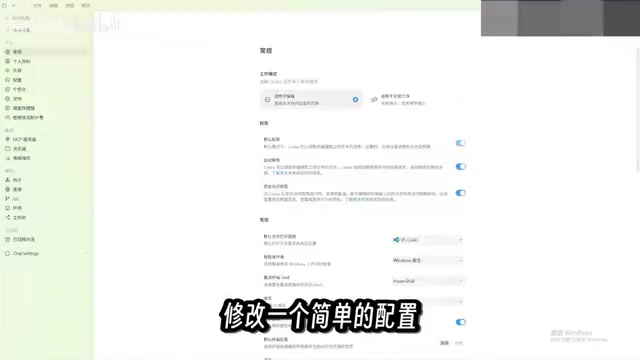
The most detailed Codex guide on Bilibili: from app store installation to daily work mode configuration, with a real coffee shop project demonstrating file organization, data extraction, dashboard creation, and other practical tasks. Learn to use Plan Mode and desktop pets to leverage Codex efficiently.

Appearance Compensation in Volume Rendering: Why RGB Accuracy Cannot Guarantee Density Correctness
Volume rendering research reveals that volumetric data perfectly reproducing external RGB views may still contain density errors: appearance compensation can double central density and keep external rays unchanged even when L2 error exceeds 14.52%. Density recovery depends on appearance capacity, spatial resolution, and measurement design.