Cursor Pro Discounted Top-Up Services Explained: The Truth and Risks Behind Pay-As-You-Go Models

Third-party Cursor Pro top-ups promise 25% pricing and permanent credits, but hide serious compliance, privacy, and platform-collapse risks.
This article examines third-party "Cursor Pro at 25% off" top-up services that use account pool rotation via a plugin, claiming no Cursor modification, no API relay, and ~$137 in usable credits per ¥100 topped up with balances that never expire. While differentiated from short-term Xianyu accounts, the model carries four core risks: bulk accounts likely violate Cursor's ToS, third-party credential control undermines privacy promises, "permanent credits" depend on platform survival and account pool stability, and billing transparency is entirely self-reported. The takeaway: use official subscriptions for production tools and treat any prepaid-plus-permanent-promise third-party service with high caution.
Recently, many AI coding users have been drawn to promotions offering "Cursor Pro at 25% of the official price." These third-party top-up services claim to provide genuine accounts, pay-as-you-go billing, and credits that never expire — a pitch that sets them apart from the typical monthly cards and short-term trial accounts flooding the market. This article is based on a Bilibili promotional video and aims to objectively break down how these services work, what they promise, and the technical and compliance risks users should be aware of.
Note: This article is for informational purposes only and does not constitute a purchase recommendation. Third-party top-up services often carry account compliance and security risks — readers should exercise their own judgment.
What Are These Services Actually Selling?
Cursor is one of the hottest AI code editors right now, and its official Pro subscription price is a barrier for some users — creating a market for third-party "top-up" and "shared account" services. According to the promotional content in question, this model differs from traditional tools (auto account-switchers, monthly/quarterly cards, short-term trial accounts) and focuses on three main selling points:
- Pay-as-you-go: Billed at 25% of the official price, with charges only for what you use — no wasted credits
- Credits never expire: Your balance stays valid indefinitely until it's used up
- Dedicated genuine Pro account: Claimed to be a long-term account, not a 7-day temporary one

The provider summarizes its core value proposition as "real premium models, privacy boundaries, and fully transparent billing," and emphasizes that the original Cursor client and workflow are preserved — no changes to your habits required.
How It Supposedly Works Technically
Based on the content, the service's technical approach involves a plugin that handles account management rather than modifying the Cursor application itself. According to the description, the plugin retains only two core functions: intelligent account rotation and billing record tracking.
The claimed operating logic is as follows: the system assigns an official Pro account to the user; once extended inactivity is detected, the account is released; the next time the user starts working, a new Pro account is matched and billing begins; when the current account's quota runs out, a backup account is automatically rotated in. This "account pool" mechanism relies on bulk purchasing to reduce costs, enabling prices lower than what an individual would pay for a single account.

The provider specifically emphasizes that it does "not route through third-party APIs" and does "not modify Cursor's native code." The reasoning: not touching the client means users can update to the latest official version at any time, without waiting for plugin compatibility. If accurate, this would indeed avoid the quality degradation and model downgrading issues associated with some relay-based tools.
The Account Pool is the core infrastructure concept behind these third-party services: operators bulk-purchase or register large numbers of paid accounts, then use a scheduling system to dynamically assign them to active users, reclaiming idle accounts for reuse. In theory, if the number of simultaneously active users is far smaller than the total number of accounts, each user could genuinely receive an independent account experience. However, this model has two structural vulnerabilities. First, bulk-registering or purchasing accounts typically violates SaaS platforms' "one account per person" terms of service — if Cursor detects the same account logging in from different IPs or devices within a short time window, it has grounds to ban it outright. Second, the ratio of account pool capacity to active users is entirely determined by the operator. Users have no way to verify whether they're actually getting a dedicated Pro account or sharing one with multiple others.
Pricing Breakdown and Comparison with Xianyu Listings
The promotional content provides a concrete pricing calculation: the effective unit cost comes out to roughly one-tenth of the official price — topping up ¥100 is said to give access to ¥1,000 worth of official quota, which at a 7.3 exchange rate translates to approximately $137 in usable credits.
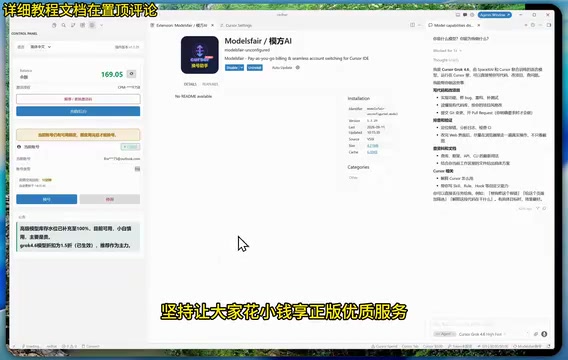
For the obvious question — "Why not just buy a Pro account on Xianyu for a few dozen yuan?" — the provider offers these differentiators:
- Accounts bought individually have a fixed expiration date, so unused credits are forfeited
- You need to manually switch accounts, and there's a risk of bans or device ID locks
- On this platform, credits never expire — charge ¥100, use ¥30, and the remaining ¥70 stays available indefinitely
Risks You Should Be Aware Of
Despite the polished marketing, there are significant concerns from a technical and compliance standpoint that users should approach with clear eyes:
Questionable legitimacy of account sources. The so-called "bulk-purchased" official Pro accounts cannot be verified for their acquisition method or compliance with Cursor's terms of service. Shared or rotated accounts may inherently violate those terms, creating a systemic risk of mass bans by the platform.
Privacy and code security. Despite claims of "privacy mode enabled by default" and "no API relaying," your code is your most sensitive asset as an AI-assisted developer. Using an account managed by a third party means your account credentials are in someone else's hands — and privacy promises can't be independently verified.

The sustainability of "never-expiring" credits. A promise of permanent balance validity is only as good as the platform's continued existence and the account pool's ongoing supply. If the operator shuts down or Cursor cracks down on shared account mechanisms, any pre-loaded balance could vanish overnight. The "prepay + long-term commitment" model is itself a well-known risk structure.
The self-referential problem with billing transparency. The provider repeatedly emphasizes that billing is verifiable and synced with official records — but what users can actually check is only the data the platform itself displays. There's no direct access to the official backend, so "transparency" remains a one-sided claim.
"Prepay + never expire" is a classic high-risk contract structure in internet consumer services. From a regulatory standpoint, prepaid services in China are governed by rules like the Single-Purpose Commercial Prepaid Card Management Measures, but cross-border or gray-area virtual services often fall outside that regulatory scope, leaving users with very limited recourse. From a business model perspective, promising that credits never expire means the operator is carrying a permanent liability to users on its books. If the account pool supply is disrupted (e.g., Cursor bans bulk accounts) or the platform runs out of funding, that "permanent" liability disappears instantly — taking user balances with it. History is full of prepaid model collapses: gym memberships, online tutoring packages, and now AI tool top-up services are no exception.
A Rational Approach to Paying for AI Coding Tools
For developers who genuinely rely on Cursor for daily work, the official subscription costs more — but it offers account stability, data compliance, and long-term reliability that no third-party top-up service can match. The low prices of discounted top-up services ultimately transfer risk onto the user.
If you're just looking to try Cursor out or use it lightly, check out the official free tier and any legitimate promotions. If it's a core tool in a production environment, stability and compliance matter far more than the money you'd save. Any third-party service that requires a prepaid balance and promises "permanent validity" deserves an extra dose of skepticism.
Related articles

Free Unlimited Claude Code Solution: Agnes AI + CC Switch Setup Guide
No paid subscription needed — pair the free AI platform Agnes AI with the open-source tool CC Switch to provide a backend for Claude Code, enabling unlimited free calls to text, image, and video models. This guide covers the full setup, test results, and usage boundaries.

A Complete Zero-Cost Guide to Getting Started with Claude Code for Beginners in China
A beginner's guide to Claude Code for users in China: two installation methods (command line and IDE plugin), full configuration steps for replacing the official API with the free domestic LongCat model, and a hands-on demo of building a small tool with natural language, plus tips.

When the NSA Gets Involved: The AI Supply Chain Crisis Behind Open-Source CVEs and API Key Hijacking
Multiple open-source projects disclosed severe CVEs in one day, PHP flaws alarmed the FBI, and Railway and OpenCode were breached with API keys stolen. This article breaks down the vulnerability window, AI-accelerated exploitation, and the AI supply chain crisis behind the API key black market, with a developer defense checklist.