Cursor's Origin Code Hosting Platform Adds 20+ Integrations

Cursor's Origin now supports 20+ third-party integrations across six key engineering areas.
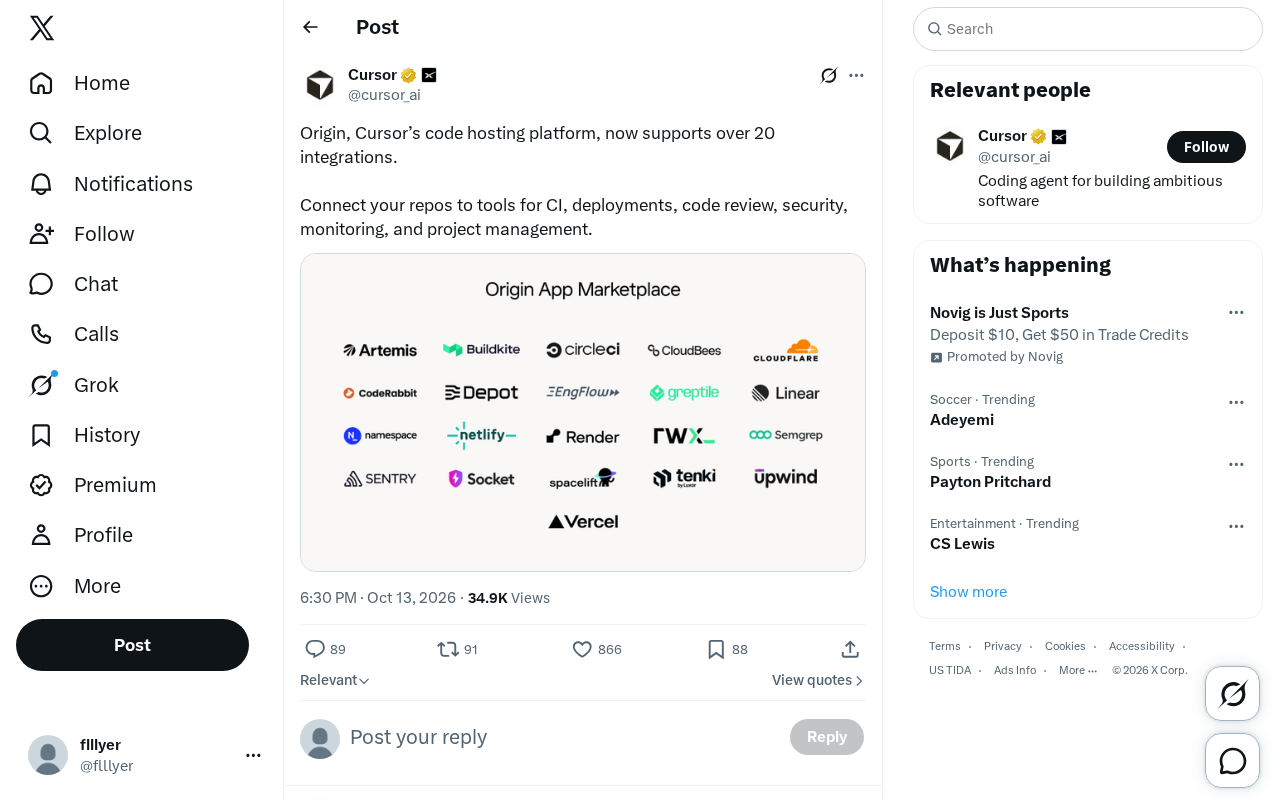
Cursor's code hosting platform Origin announced support for over 20 third-party integrations covering CI, deployment, code review, security, monitoring, and project management. Positioned to be deeply tied to Cursor's AI coding capabilities, this expansion marks a key step in Origin's evolution. The platform chose to connect existing tools rather than build its own, lowering migration barriers. Combined with the Cursor editor, AI could gain richer project context, improving code generation and issue localization. However, specifics on integration depth and self-hosting remain unclear.
Cursor is extending its reach from the AI editor down to the foundational layer of code hosting. Its code hosting platform, Origin, has announced support for over 20 third-party integrations, covering key areas such as CI, deployment, code review, security, monitoring, and project management. This means developers can connect their repositories directly to their existing toolchain without having to switch back and forth between platforms.
What Is Origin, and Why It Matters
Origin is the code hosting platform launched by Cursor. Its positioning isn't simply to replicate GitHub or GitLab, but to be deeply tied to Cursor's AI coding capabilities. For teams already using Cursor for day-to-day development, Origin's arrival means code hosting, AI-assisted coding, and collaboration workflows could potentially converge into a single ecosystem.
This expansion in the number of integrations is a key step for Origin as it moves from "usable" to "genuinely good." Whether a code hosting platform gets adopted by a team largely depends on whether it can fit into their existing engineering pipeline—whether CI runs properly, whether deployment can be automated, whether security scanning can be plugged in. These are the core factors that determine migration cost.
The core value of a code hosting platform isn't just storing code—it's whether it can serve as the hub of a team's engineering pipeline. Mature platforms like GitHub and GitLab, after years of development, have built up vast third-party integration ecosystems covering every step from code commit to production deployment. For emerging platforms, the number and quality of integrations are often the first threshold developers use to decide whether to migrate—a broken toolchain directly interrupts workflows, canceling out any benefit a new platform might bring. Therefore, Origin's integration expansion is essentially about filling in the infrastructure for platform usability, not simply piling on features.
Which Areas Do the 20+ Integrations Cover?
According to official information, these integrations cover six main areas:
- CI (Continuous Integration): Automatically trigger build and test processes after code is committed
- Deployment: Connect the delivery pipeline from repository to production environment
- Code Review: Support integration of review tools within Origin repositories
- Security: Integrate security scanning and vulnerability detection capabilities
- Monitoring: Link runtime monitoring to code repositories
- Project Management: Connect task tracking and collaboration tools
These six areas basically correspond to the tool categories an engineering team relies on most in daily work. One detail worth noting: Origin has chosen the path of "connecting existing tools" rather than "building a full suite of features itself," which lowers the psychological barrier to migration—you don't need to abandon the CI or monitoring systems you're already using.
CI (Continuous Integration) and deployment are the two most fundamental types of integrations for a code hosting platform. CI is responsible for automatically running builds, tests, and static checks after code is committed, ensuring every change is verified; deployment integrations are responsible for automatically releasing verified code to test or production environments. Both typically connect to code hosting platforms via webhooks or APIs, with triggers being pushes, merge requests, or tags. Code review integrations allow comments and check results from review tools to be displayed directly in a repository's merge requests, reducing how often developers need to switch windows. Security integrations typically include dependency vulnerability scanning, secret leak detection, and static application security testing (SAST)—these tools run automatically before code is committed or merged and report risks. Monitoring integrations link runtime metrics and error tracking to code repositories, helping developers quickly identify which code changes correspond to production issues. Project management integrations connect task tracking systems (such as Jira, Linear) to code commits, enabling bidirectional traceability between requirements and code. These six categories of integrations together form a complete inner development loop—none can be missing.
What It Means for the Cursor Ecosystem
Cursor's core product is an AI code editor, and Origin fills in the code hosting piece. Combined, one possible picture emerges: AI can not only help you write code, but also understand the full context of a repository, including CI status, deployment history, and review records.
The value of this integration lies in context. The accuracy of AI coding tools depends heavily on how much project information they can access. When the hosting platform is connected to CI, monitoring, and project management tools, the dimensions of signals AI can reference increase significantly, leading to more grounded output in code generation, issue localization, and review suggestions.
Of course, the information officially disclosed so far is still mainly about the number of integrations. Specifics such as the integration list, depth of functionality, and whether self-hosting is supported remain unclear. For teams considering migration, these are the real variables that affect the decision.
AI coding tools typically obtain project context through local files, conversation history, and repository metadata. But repository metadata itself is static—it can't reflect whether CI passed, whether deployment succeeded, or whether there are anomalies in production. When the hosting platform is connected to CI, monitoring, and project management tools, AI can read these dynamic signals, thereby considering current build status when generating code, referencing recent deployment records when localizing issues, and incorporating security scan results into review suggestions. This cross-tool signal fusion is a key direction for improving the accuracy of AI-assisted coding, and it's something that's difficult to achieve through code analysis within the editor alone.
How Developers Should View This
In the short term, this news is most valuable to developers already in the Cursor ecosystem. If you want to reduce tool-switching costs and are willing to try a new hosting solution, Origin's integration expansion lowers the barrier to experimentation.
For broader development teams, three things are worth watching: first, whether the specific list of integrated tools covers the stack you're currently using; second, whether these integrations are shallow links or deep API connections; third, Origin's strategy around data security and compliance. Until these questions have clear answers, treating Origin as a primary hosting platform still requires careful evaluation.
Origin's integration expansion sends a clear signal: Cursor isn't content with being just an editor—it's building a complete developer workflow from coding to hosting. Whether this path succeeds depends on integration quality and ecosystem openness, not just quantity.
When evaluating the quality of a code hosting platform's integrations, several specific dimensions are worth examining: whether integrations merely provide redirect links or synchronize data bidirectionally through APIs; whether fine-grained permission controls are supported, such as allowing only specific CI tools to read repositories; whether integration configuration can be managed through code (such as YAML files) for versioning and reuse; and whether the platform has fallback mechanisms when integrated tools fail. These details determine the reliability and maintainability of integrations in real engineering environments, and they're the things teams should focus on testing during proof-of-concept before migration.
One-line Summary
Cursor's code hosting platform Origin supports over 20 third-party integrations, covering six major engineering areas.
Paragraph Summary
Cursor's code hosting platform Origin has announced support for over 20 third-party integrations, covering six major areas: CI, deployment, code review, security, monitoring, and project management. Origin is positioned to be deeply tied to Cursor's AI coding capabilities, and this integration expansion is a key step in its journey from "usable" to "genuinely good." The platform has chosen to connect existing tools rather than build a full suite of features itself, lowering the migration barrier for teams. Combined with the Cursor editor, AI is expected to gain access to more complete project context—including CI status, deployment history, and review records—thereby improving the accuracy of code generation and issue localization. However, details such as the specific integration list, depth of functionality, and self-hosting support remain unclear, and teams should still evaluate migration carefully.
Related articles

Free Local Deployment of Claude Code: Build an Offline AI Coding Agent with Ollama + Codex
No API or tokens needed: drive OpenAI Codex with local Ollama models to auto-edit code, fix bugs, and build pages even offline. Full setup steps, model picks, tuning tips, and caveats.

Zero-Cost Claude Code: Free API Access and Multimodal Hands-On Test
A Bilibili creator's guide to zero-cost Claude Code using the free Agnes AI API and CC Switch router, with hands-on tests of text, image, and video models.

Zero-Cost Claude Code in China: Setup and Hands-On Guide
A complete zero-cost guide to Claude Code in China: two installation methods, configuring LongCat's free API instead of the official subscription, and a hands-on to-do tool demo with caveats.