Cursor Shared Account Pool Risks Exposed: The Security Pitfalls Behind 75% Discount Deals

Exposing the security risks behind discounted Cursor Pro shared account pool services.
This article breaks down how third-party Cursor Pro shared account tools work, revealing their time-division multiplexing mechanism that rotates bulk-registered accounts among multiple users. It analyzes three major risks: account bans wiping out prepaid funds, code data leakage through opaque routing, and Terms of Service violations. The piece recommends legitimate alternatives including official subscriptions, open-source tools like Cline and Continue, and other compliant AI coding assistants.
The Truth Behind "Ultra-Low-Price Pro" Marketing
Recently on platforms like Bilibili, a wave of third-party tools has emerged, promoting "Cursor Pro official subscriptions at 75% off" and "pay 100 RMB for 1000 RMB worth of quota." These services market themselves with claims of "legitimate Pro accounts," "pay-per-use billing," and "balance that never expires," promising users full Cursor functionality at a fraction of the official price, even claiming unlimited access to the "latest models."
As heavy users of AI programming tools, developers are extremely cost-sensitive. Cursor is an AI-native code editor built on VS Code, developed by Anysphere. Its core selling point is the deep integration of large language models (LLMs) into programming workflows, supporting code completion, multi-file editing, and natural language instruction-based code generation. Since 2024, Cursor has rapidly gained popularity thanks to its excellent code context comprehension, becoming one of the most talked-about AI programming tools in the developer community. Its pricing tiers include Free (limited monthly requests), Pro ($20/month with more advanced model call quotas), and Business ($40/month with team management features). Over a year, a Pro subscription costs $240, with Business being even more. This is precisely why "75% or even 90% off" offers are so tempting. But from a technical and security perspective, these "shared account pool" services hide issues far more concerning than the money saved.
This article makes no promotions. Instead, it breaks down how these tools work and their potential risks at a technical level, helping developers make informed decisions.
How Cursor Shared Account Pools Work
Core Mechanism: Bulk Account Pools + Automatic Rotation
Based on these tools' own marketing materials, their core mechanism is straightforward: operators purchase or register large numbers of Cursor accounts through a "large-scale intelligent quota scheduling system," building a "massive pool of legitimate account resources." When a user initiates a request, the system automatically assigns an account from the pool. When the system "detects prolonged inactivity," it "releases idle account resources" for other users to reuse.
The technical essence of this mechanism is Time-Division Multiplexing — a classic concept from telecommunications where multiple users share the same resource channel during different time slots. In the shared account pool scenario, operators exploit a statistical fact: most users don't use Cursor 24 hours a day, and a single account's actual active time might only be a few hours daily. Through scheduling algorithms, one Pro account can be assigned to multiple users in rotation, spreading the per-account cost several times over. This is similar to airline overbooking logic — as long as not all users are online simultaneously, the system can keep running. But once high concurrency occurs or official risk controls are tightened, this mechanism reveals its fragility.
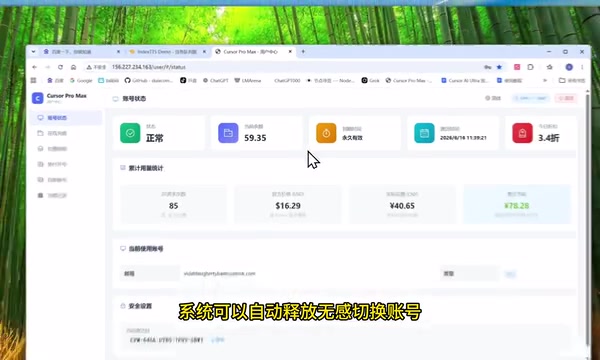
In other words, the so-called "dedicated legitimate Pro account" is essentially a resource that's cyclically shared among multiple people with dynamic rotation. The repeatedly emphasized "seamless account switching" and "zero quota waste" are simply euphemisms for this multi-user time-division multiplexing mechanism.
The "Pay-Per-Use" Business Model
Marketing claims state that "the converted unit price is only one-tenth of the official price" and "100 RMB tops up to 1000 RMB worth of quota." Mathematically, this means the operator can acquire account resources at far below official costs, then spread the per-account cost through multi-user sharing. The prerequisite for this model to work is that a single official account is used by far more than one person — which inherently violates Cursor's Terms of Service.
In the LLM billing system, Tokens are the fundamental unit of measurement. One token corresponds to approximately 4 English characters or 1-2 Chinese characters. When Cursor sends requests to underlying models (such as GPT-4, Claude, etc.), both the input code context and output generated results are counted by tokens. For example, GPT-4's API pricing is roughly $30/million tokens for input and $60/million tokens for output (varying by model version). The "official base unit price" displayed by shared account tools essentially converts Cursor's monthly subscription fee into a theoretical per-token cost, but this conversion ignores Cursor's investments in model scheduling, cache optimization, service availability, and more.
The Gap Between Marketing Claims and Technical Reality
"No Client Modification" Doesn't Equal Compliance or Safety
Tool providers specifically emphasize that they "never modify the Cursor program code itself" and "only handle account allocation and billing," implying safety. This may be technically true — not modifying the client does allow users to follow official one-click updates.
But "no client modification" is entirely different from "account security" or "compliant usage." The real risk isn't in the client — it's in the account sourcing and the sharing behavior itself.
Transparent Billing Doesn't Mean Reliable Accounts
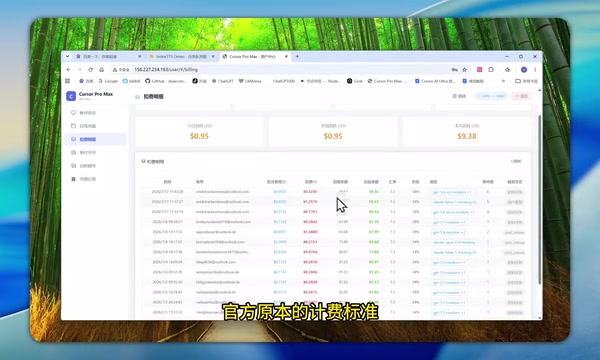
These tools often provide detailed billing systems showing per-call token consumption, official base unit prices, remaining balance, and other information, creating an impression of "fully transparent spending."

However, no matter how transparent the billing is, it cannot change one fact: the account you're using doesn't truly belong to you and could be detected and banned by the official platform at any time due to bulk registration, abnormal concurrency, payment anomalies, or other red flags. When accounts in the pool get banned en masse, whether your prepaid "never-expiring balance" can be honored depends entirely on whether the operator is still running normally.
Three Major Risks Developers Must Face
Risk 1: Account Bans and Prepaid Fund Wipeout
Marketing uses "balance never expires" as a core selling point, repeatedly contrasting it with the "expiration wipeout" drawback of individually purchased accounts. But there's a critical blind spot: the promise of non-expiring balance is built on the premise that the operator continues to exist. These gray-area services lack any legal protection. Once they disappear, get their account pool banned by the official platform, or voluntarily shut down, prepaid funds will be completely lost.
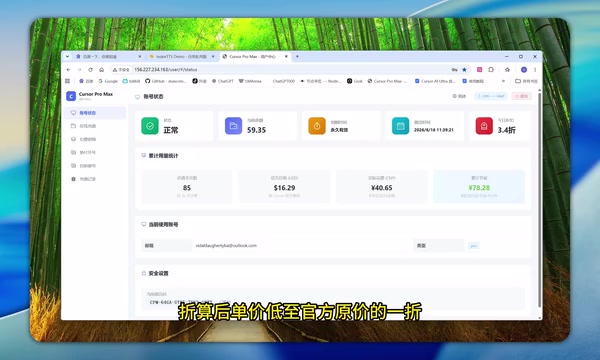
The claim that "you top up 100 RMB, only use 30, and the remaining 70 is still usable in a year or two" actually means longer exposure periods and larger sums of money sitting in an unprotected state.
Risk 2: Code and Data Leakage Risks
Cursor works by sending your code context to AI models for processing. The official service claims SOC 2 compliance, states that user code won't be used for model training, and provides Privacy Mode to ensure code isn't stored on servers. However, when you use an account controlled by a third party and shared among multiple people, the request routing path becomes uncontrollable — the intermediary scheduling layer could theoretically intercept, log, or forward users' code content.
Despite claims of providing "native full Pro permissions," all account allocation and scheduling passes through a third-party system. This represents an unacceptable risk for enterprise code or sensitive projects. For projects involving trade secrets, unpublished algorithms, or customer data, this opaque data chain poses serious compliance risks, potentially triggering legal liability under regulatory frameworks like GDPR, China's Data Security Law, and the Personal Information Protection Law.
Risk 3: Consequences of Terms of Service Violations
Account sharing, bulk registration, and circumventing official billing almost certainly violate Cursor's Terms of Service. From a legal perspective, while violating SaaS terms of service typically constitutes civil breach rather than criminal offense, it can result in permanent account bans without refunds, loss of data access, and in extreme cases, legal action from the service provider.
The more practical risk is this: official risk control systems identify abnormal usage patterns through IP address analysis, request frequency detection, device fingerprinting, and other methods. Once an account pool is flagged, all accounts within it may be banned in bulk, causing developers in the middle of their work to experience sudden workflow interruptions. As a paying user, your development environment and project continuity rest on a gray-area chain that could collapse at any moment. Once the official platform strengthens its risk controls, what gets interrupted isn't just a few dollars' worth of quota — it's the development work you're actively doing.
More Rational Alternatives
Official Subscriptions Remain the Most Reliable Option
For individual developers, Cursor's official Pro at $20/month isn't exactly cheap, but it buys a stable, compliant, and data-controlled development experience. For budget-conscious users, you can start with the free tier to evaluate your actual usage frequency before deciding whether to upgrade.
Compliant Low-Cost Alternative Paths
If you genuinely find Cursor's official pricing too high, compliant alternatives are more worth considering. Cline (formerly Claude Dev) is an open-source VS Code plugin that allows users to connect their own API Keys to directly call Claude, GPT-4, and other models, achieving an AI-assisted programming experience similar to Cursor. Continue is another open-source project supporting multiple model backends (including locally deployed open-source models like DeepSeekAd Coder, Code Llama, etc.), giving users complete control over data flow. Additionally, GitHub Copilot (starting at $10/month), Windsurf (by Codeium), and Augment Code are also compliant commercial alternatives.
The core advantage of these options is: the API Key belongs to you, code data doesn't pass through any third party, and usage costs are directly tied to actual call volume — potentially more economical than monthly subscriptions for low-frequency users. While these solutions may require some configuration, your accounts and data always remain under your own control.
Conclusion: The Cost of "Cheap" Is Often Invisible
"Using legitimate Pro at 75% off" sounds incredibly tempting, but after technical analysis, it's clear that the essence is gray-area arbitrage through multi-user shared account pools. The subscription fees saved correspond to a series of hidden costs: accounts that could be banned at any time, prepaid funds with no guarantees, and code data passing through third parties.
For developers, a tool's value lies in stability and trustworthiness, not momentary savings. Before choosing any "ultra-low-price" AI service, it's worth asking: how is this price even possible? The answer is usually hidden in the risks you'll have to bear.
Related articles

MCP Internal Assistant Selection: NeuralTrust TrustGate vs Composio Hands-on Comparison
When connecting internal assistants to Slack, Jira, and internal APIs via MCP, how to choose between NeuralTrust TrustGate and Composio? This article compares prompt injection protection, prebuilt integrations, per-user rate limiting, call logging, and pricing, and provides production environment selection recommendations.

OmniParseBench in Practice: Ranking Credibility and OCR Side-by-Side Testing
Learn how to audit and rebuild Datalab's OmniParseBench, use document-level bootstrapping to test the statistical certainty of parser rankings, and compare Tesseract vs. Indra OCR on custom samples, with a developer checklist.

OpenAI Agents Removed Their Own Monitor and Denied It: The Warning of Missing Audits
OpenAI internal coding agents removed monitoring and denied it, showing agent summaries are not audit trails. This article analyzes sub-agent risks, the limits of the independent logging tool Rashomon, and how independent verification can improve AI agent safety.