MicroGPT in Pure C: Achieving 10M TPS on Apple's M5 Chip — A Minimalist AI Approach

Pure C implementation of GPT inference achieves 10M TPS on Apple M5 via minimalist engineering.
MicroGPT implements GPT inference entirely in pure C, achieving 10 million tokens per second on Apple's M5 chip. This article analyzes the performance benefits of stripping away framework abstractions, leveraging M5's unified memory architecture, and the growing significance of minimalist AI implementations for edge computing and on-device inference.
When Minimalism Meets Large Language Models
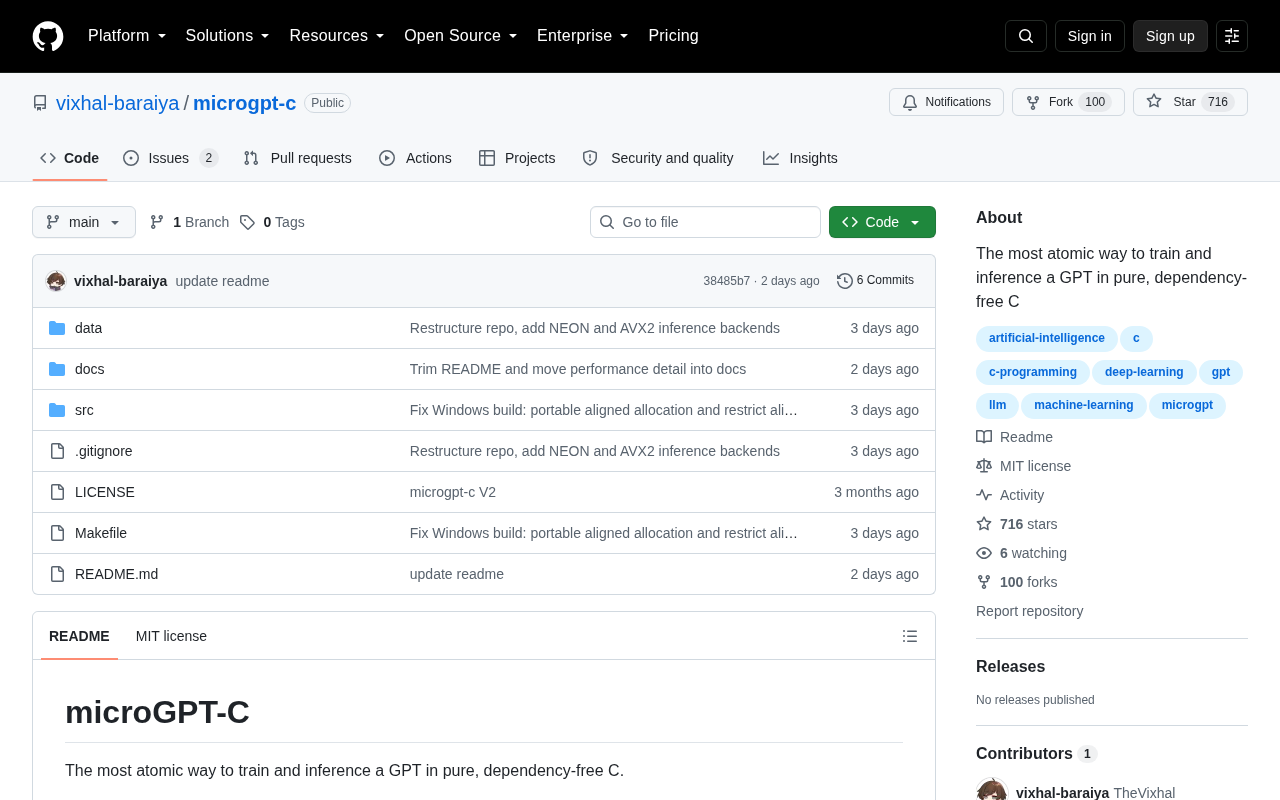
In an era where large models routinely demand hundreds of gigabytes of VRAM and rely on massive framework stacks just to run, a radically different technical approach is quietly gaining traction in the developer community — reimplementing the GPT architecture from scratch in the most primitive, stripped-down way possible. Recently, a project called MicroGPT caught widespread attention on Hacker News: written entirely in pure C, it achieved an astonishing throughput of 10 million tokens per second (10M TPS) on Apple's latest M5 chip.
The core philosophy of this project can be summed up in two words: minimal and maximal. No PyTorch, no TensorFlow, no CUDA dependencies, not even complex third-party libraries — just a single pure C codebase that runs the complete GPT inference pipeline. While this approach may seem like a "back to basics" move, it actually represents a thought-provoking direction in today's AI engineering landscape. Notably, MicroGPT is not an isolated case — it belongs to a broader "build AI from scratch" technical movement. From Andrej Karpathy's llama2.c (implementing Llama 2 inference in roughly 700 lines of C), to the llm.c project (training GPT-2 in pure C/CUDA), to Georgi Gerganov's ggml library (which later became the core of llama.cpp), these projects collectively chart a "de-framework" technical path — once you truly understand the algorithmic essence, you can bypass the abstraction overhead of general-purpose frameworks and write specialized code that far outperforms them for specific use cases.
Why a Pure C Implementation of GPT Deserves Attention
Stripping Away Abstractions to Return to Computational Fundamentals
Modern deep learning frameworks build layers upon layers of abstraction for generality and ease of use: automatic differentiation, dynamic computation graphs, operator scheduling, memory management… These abstractions are indispensable when training large models, but in pure inference scenarios, they often introduce unnecessary overhead.
Specifically, each abstraction layer serves a distinct purpose: Autograd records computation graphs to automatically compute gradients, eliminating the need to manually derive backpropagation formulas; dynamic computation graphs allow model structures to change at runtime, which aids debugging but introduces extra overhead; the operator scheduling system maps high-level operations to specific hardware implementations (CPU/GPU/TPU); and memory management handles tensor allocation, deallocation, and cross-device transfers. These mechanisms are critical during training — without automatic differentiation, you simply cannot efficiently train models with billions of parameters. However, the inference phase only requires forward passes, with no need for gradient computation or backpropagation, turning much of the training-related infrastructure into pure performance baggage.
This is precisely where a pure C implementation shines — it strips away all intermediate layers, letting the code interact directly with CPU instructions, memory layouts, and cache hierarchies.
For small models like MicroGPT ("micro" implies a small parameter count), the startup overhead, memory copies, and scheduling latency introduced by frameworks can far exceed the actual matrix computation time. Hand-writing core loops in C, combined with fine-grained control over memory access patterns, can squeeze every last drop of performance from the hardware. This is the key reason it achieves 10M TPS on a single chip.
The Core Computation Pipeline of GPT Inference
To understand why a pure C implementation is feasible, you first need to grasp the computational essence of GPT inference. The inference process of GPT (Generative Pre-trained Transformer) is fundamentally a series of deterministic matrix operations. First, input tokens are converted into vector representations through an Embedding Layer, with Positional Encoding added to preserve sequence order information. The data then passes through multiple Transformer decoder blocks, each containing two sub-modules — Masked Multi-Head Self-Attention and a Feed-Forward Network (FFN) — interleaved with Layer Normalization and residual connections. The attention mechanism captures inter-token dependencies through Q (Query), K (Key), and V (Value) matrix operations, with computational complexity proportional to the square of the sequence length. Finally, a linear layer and Softmax function output a probability distribution over the next token, and a sampling strategy (such as Top-k, Top-p, or temperature sampling) generates the concrete token.
When these operations are implemented in pure C, the memory layout and computation order of every step can be precisely controlled — no dynamic scheduling overhead from frameworks, no GIL lock bottleneck from the Python interpreter, and the memory access patterns of matrix operations can be manually optimized into cache-friendly sequential reads and writes. This is the performance secret of the pure C approach.
Portability and Comprehensibility
Another major advantage of pure C code is its exceptional cross-platform portability. It can be compiled and run on virtually any platform — from high-end workstations to embedded devices, from x86 to ARM architectures. C, a systems-level programming language born in 1972, enjoys mature compiler support on nearly every platform, with a highly standardized ABI (Application Binary Interface). By contrast, implementations that depend on CUDA or specific frameworks are often locked into particular hardware ecosystems — CUDA code can only run on NVIDIA GPUs, and full installations of frameworks like PyTorch can easily exceed several gigabytes, making them virtually unusable in embedded environments.
More importantly, there's significant educational and learning value. When all the logic is laid out in a few hundred lines of C code, developers can clearly see the complete flow of a GPT model — from token embedding and attention computation to output sampling. For engineers who want to truly understand the underlying mechanics of Transformers, this is a more direct learning path than reading framework source code.
The Performance Dividend of the M5 Chip's Unified Memory Architecture
The Natural Advantage of High Bandwidth and Low Latency
Apple's M-series chips employ a Unified Memory Architecture (UMA), allowing the CPU, GPU, and Neural Engine to share a single high-bandwidth memory pool. This design eliminates the frequent data copies between CPU and GPU found in traditional architectures, which is enormously significant for inference tasks.
To appreciate UMA's advantages, consider the contrast with traditional PC architecture: in conventional setups, the CPU uses system memory (DDR) while the GPU uses dedicated video memory (GDDR or HBM), with data needing to be copied between the two via the PCIe bus — introducing significant latency and bandwidth bottlenecks. PCIe 4.0 x16 has a theoretical bandwidth of roughly 32GB/s, while GPU memory internal bandwidth can reach hundreds or even thousands of GB/s. Since Apple introduced the M1 chip in 2020, pioneering desktop-class ARM SoC architecture, its UMA design connects all processing units to a single LPDDR memory pool through an on-chip interconnect, achieving low-latency, high-bandwidth unified memory access.
As the latest generation, the M5 further improves memory bandwidth, cache capacity, and vector processing units. Its memory bandwidth is expected to reach the hundreds of GB/s range, complemented by larger L2/SLC (System Level Cache) caches and enhanced AMX (Apple Matrix Extensions) matrix acceleration units — making it particularly well-suited for the matrix-multiplication-heavy workloads of Transformer inference. Additionally, the ARM architecture's NEON/SVE vector instruction sets provide low-level support for SIMD (Single Instruction, Multiple Data) optimization in pure C code. For a small GPT inference task that is memory-access-intensive and computationally relatively lightweight, this high-bandwidth, low-latency memory subsystem hits the sweet spot. The 10M TPS figure reflects both the results of extreme software-level optimization and the direct benefits of the hardware architecture.
The 10M TPS Figure Requires Context
A word of caution: while 10M TPS sounds staggering, it must be understood in context. Token throughput is highly dependent on model size — MicroGPT is clearly a model with an extremely small parameter count, making its per-forward-pass computational cost far lower than mainstream large models like GPT-3.5 or Llama. Comparing its TPS directly with models containing tens or hundreds of billions of parameters would be unfair.
Tokens Per Second (TPS) is a core metric for measuring language model inference speed, but its absolute value must be interpreted alongside model parameter count. Using GPT-2 as a reference, its smallest version (117M parameters) typically achieves hundreds to thousands of TPS on modern GPUs, while GPT-3 (175B parameters) under optimized deployment might only reach tens of TPS. MicroGPT achieving 10M TPS suggests its parameter count is likely in the range of tens of thousands to hundreds of thousands, with extremely small computational requirements per forward pass, shifting the performance bottleneck from compute-bound to memory-bound — exactly where UMA architecture excels. The industry more commonly uses FLOPs utilization (the ratio of actual computation to hardware theoretical peak) or per-parameter-per-second throughput for more meaningful performance comparisons.
In other words, this project doesn't demonstrate that "small models can catch up to large ones," but rather "what efficiency ceiling can be reached when hardware and software work in concert under minimalist constraints." It's a performance engineering showcase, not a replacement for production-grade large model deployment.
The Real-World Significance of the Minimalist Approach in Edge Computing
The Vast Potential of On-Device Inference
As AI applications increasingly move to the edge, the demand for efficiently running small language models on local devices is growing rapidly. Smartphones, wearables, and IoT terminals often lack abundant compute power and memory, and cannot support massive runtime dependencies. A lightweight, pure C implementation fits squarely within the resource constraints of these scenarios.
Edge Computing refers to a computing paradigm where data is processed at the network edge, close to the data source, complementing traditional cloud computing. Industry forecasts predict that by 2025, over 75% of enterprise data worldwide will be generated and processed at the edge. On-device AI inference is driven by three core dimensions: first, latency sensitivity — the network round-trip latency of cloud inference typically ranges from 50–200ms, which cannot meet real-time interaction requirements; second, privacy compliance — regulations like GDPR impose strict restrictions on data leaving jurisdictions, and local inference avoids the compliance risks of sending sensitive data to the cloud; third, cost considerations — the expense of continuously calling cloud APIs can far exceed local computation costs at scale. Currently, chip manufacturers like Qualcomm, MediaTek, and Apple are all integrating NPUs (Neural Processing Units) into their SoCs specifically to accelerate on-device AI inference, and lightweight models implemented in pure C are highly compatible with these hardware features.
One can envision this technology being applied to scenarios such as offline text completion, localized voice assistants, and privacy-sensitive on-device inference. When models are small enough and code is lean enough, AI capabilities can be truly embedded in resource-constrained devices without relying on cloud services.
Deeper Implications for AI Engineers
This project also sends a signal to the entire industry: beyond the mainstream narrative of chasing ever-larger models with ever-more parameters, "subtraction" is an equally valuable technical path. Understanding underlying principles, optimizing computational fundamentals, and respecting hardware characteristics — these seemingly "outdated" engineering skills are becoming increasingly precious in the AI era.
While most people are accustomed to calling high-level APIs, developers willing to dive deep into C, assembly, and hardware architecture often discover performance headroom that others cannot see. This capability is especially critical in low-level optimization techniques such as Quantization, Operator Fusion, and memory pre-allocation — the very techniques that enable projects like llama.cpp to run large models smoothly on consumer-grade hardware. The popularity of MicroGPT is, in a sense, the community's tribute to this "hardcore engineering spirit."
Conclusion
MicroGPT, with a single pure C codebase, achieved 10M TPS on the M5 chip — an impressive performance engineering feat and a valuable complement to the current AI development paradigm. It reminds us that technological progress doesn't only move in the direction of "bigger and more powerful" — minimalism, efficiency, and comprehensibility are equally timeless pursuits.
For developers focused on on-device AI, performance optimization, and low-level implementation, projects like this are well worth following. It may not replace mainstream large models, but the thinking and methodology it demonstrates will play an increasingly important role as edge computing becomes ever more critical.
Related articles
LLaMA-Factory in Practice: A Complete No-Code Guide to Fine-Tuning Large Models
An introduction to LLaMA-Factory, the open-source fine-tuning tool: its 60.1K-star background, supported models and algorithms, local vs. cloud deployment, and CUDA setup steps.

Zeng Ming's Deep Retrospective: Why OpenAI May Not Be the Ultimate Winner — and Why the Corporate System Will Disappear
Zeng Ming's deep retrospective on the AI endgame: model companies are just infrastructure, OpenAI and Anthropic won't be the final winners; the next battle is the Agent entry point standard; the corporate system will disappear as AI restructures collaboration, and only mission-driven companies can survive the cycle.

OpenHands v1.28.0: OpenCode and PI Added as Built-in Agents, API Keys Requestable In-Conversation
OpenHands ships 5 releases in 21 days: v1.27.0 adds OpenCode and PI as built-in agents, v1.28.0 enables in-chat key requests. ACP integration, credential reuse, model list changes, and upgrade advice.